


Quick Facts:
- Subject: Canon EOS R8 Mark II (rumored)
- Confidence level: Near 100% per Canon Rumors editor Craig Blair
- Design language: Retro styling, scope undefined
- Expected sensor: 32.5MP CMOS (format unconfirmed), shared with 3 current Canon bodies per the rumor
- Predicted announcement: Late August 2026, pre-Q4 launch window
- Current EOS R8 reference price: $1,499 new (May 2026)
- Source article date: May 15, 2026
- Best for: Canon shooters who love vintage aesthetics with modern mirrorless guts
8 min read
In This Article
- Why the Canon Retro Camera Rumor Now Has a Product Name
- Rumored Canon EOS R8 Mark II Specs at a Glance
- The Retro Design Angle: Why Canon Pulled Out the AE-1
- The 32.5MP Sensor Question
- Inside Canon’s 2026 Digital Ecosystem
- Canon R8 Mark II vs Nikon Zf: A Retro Mirrorless Crossroads
- Pros and Cons of Waiting for the R8 Mark II
- Final Verdict: Wait or Buy Now?
- Frequently Asked Questions
Why the Canon Retro Camera Rumor Now Has a Product Name
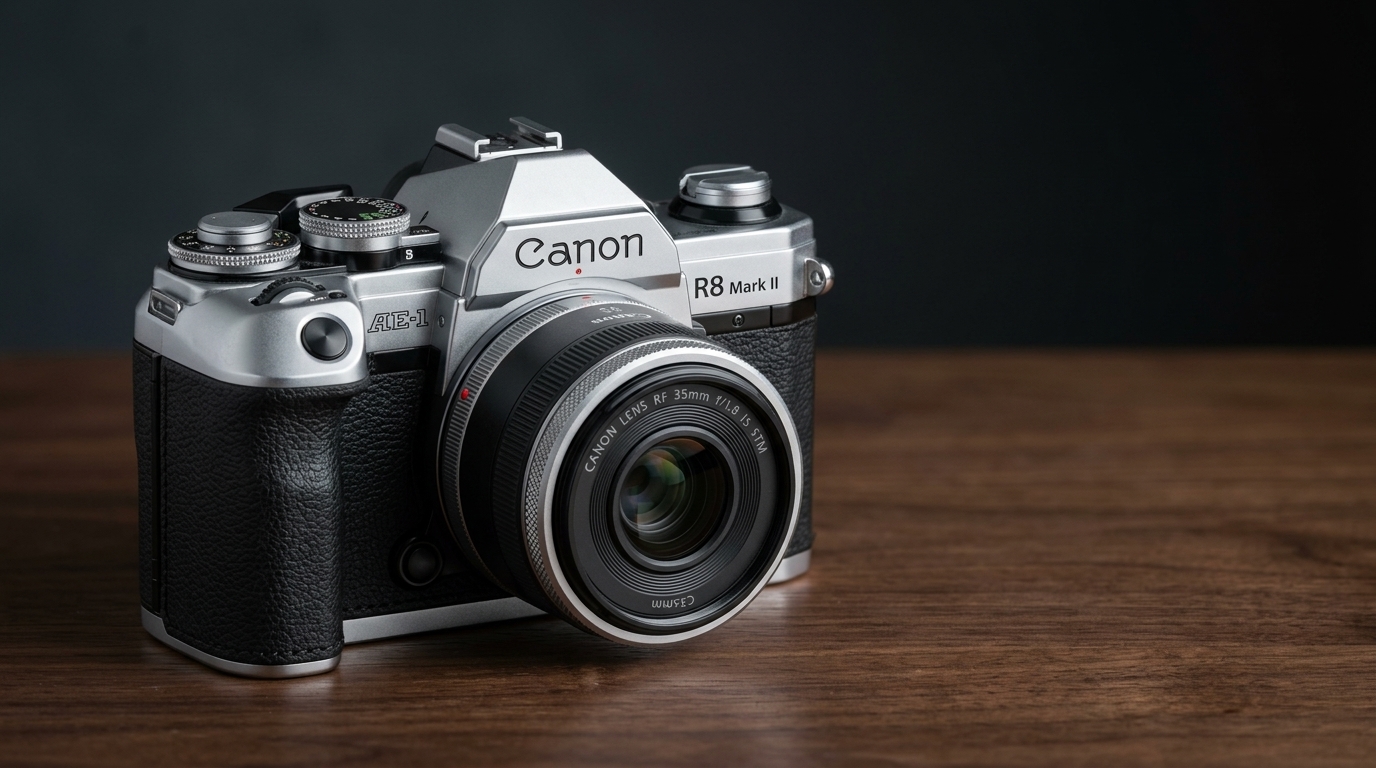
The Canon retro camera speculation got a serious upgrade this week. Specifically, Canon Rumors published its 2026 roadmap on May 15. Editor Craig Blair placed near-100% confidence behind one prediction. Before year-end, a retro-styled Canon R8 Mark II will arrive. Notably, the header image alone tells the story. Blair paired a vintage Canon AE-1 with the current EOS R8, signaling where the design team has been looking for inspiration.
For PhotographyTalk readers tracking the next mirrorless wave, the Canon retro camera rumors matter for three reasons. First, the leak confirms Canon will follow Nikon and Fujifilm into the retro-mirrorless segment. Second, it positions the R8 line as photocentric, away from the video-heavy V-series Canon has pushed since 2025. Third, it gives Canon shooters a possible upgrade path with vintage character, an option Sony has refused to offer.
I have direct experience here. Currently I own a mid-1970s Canon AE-1 and shoot it occasionally on weekend trips. When Nikon announced the Zf in 2023, I had already switched to Canon for the EOS R5 launch. So I watched the Zf release from the sidelines with some envy. A Canon retro camera would address what feels missing from the brand’s lineup for thousands of shooters with a film body in a drawer.
Rumored Canon EOS R8 Mark II Specs at a Glance
Canon Rumors stopped short of confirming specs. However, Blair pointed to logical inheritance from existing bodies. Below is the rumor-stage specification list as of May 15, 2026. Treat each line as informed speculation, not confirmed product information.
| Specification | Rumored Detail |
|---|---|
| Sensor | 32.5MP CMOS (format unconfirmed) |
| Sensor heritage | Shared with three current Canon bodies per Canon Rumors |
| Body style | Retro design, paint or shape unknown |
| Positioning | Photocentric, not video-centric |
| Mount | Canon RF |
| Announcement window | Late August 2026 (Canon Rumors estimate) |
| Reference price (current R8) | $1,499 new, $874-$1,239 used at MPB |
| Probable shutter limit | Slower readout, similar to existing R8 |
Save on the Current Canon EOS R8
Get the Original Before the Mark II Lands
MPB lists used Canon EOS R8 bodies from $874 with six-month warranty and condition grading. Save up to $625 against $1,499 new retail before the Mark II announcement reshapes pricing.
The Retro Design Angle: Why Canon Pulled Out the AE-1
For Canon Rumors to lead with an AE-1 image is a deliberate choice. Originally launched in 1976, the Canon AE-1 sold more than one million units in its first three years and became the camera many photographers learned on. As a current AE-1 owner, I keep the camera on a permanent shelf spot next to my Canon EOS R5. Specifically, the AE-1’s silver-and-black top plate, knurled film advance lever, and clean lines became the visual shorthand for “real camera” for an entire generation.
However, the design choice raises a real question for current RF-mount shooters. As one Canon Rumors commenter pointed out, the RF mount only launched in 2018. Most current Canon RF photographers came from EF-mount bodies, not FD-mount film cameras like the AE-1. So a retro R8 Mark II would reference an era most buyers never personally shot. Although the critique is fair, Canon’s marketing playbook does not need every buyer to have lived through the original. Likewise, Fujifilm’s X100 line targets photographers who never owned a Contax G2.
What “Retro” Will Mean for the R8 Mark II
The bigger design question is execution. As Blair noted, Canon has not defined what “retro” means for this body. For example, a new paint scheme alone would feel cynical. A reshaped top plate with a dedicated ISO dial and exposure compensation dial, similar to the Nikon Zf approach, would land differently. Notably, Canon showed a retro concept body at CP+ 2026, so the design team has been iterating in public. Beyond paint, the existing R8 chassis weighs only 461g, which leaves room for a denser, metal-clad body without crossing into heavyweight territory.
Notably, Canon’s mid-1970s film bodies were workhorses of their era. A digital callback to those lines would benefit from real metal, real dials, and real haptic feedback. For broader context, my best 35mm film camera roundup covers the AE-1 and its peers in detail. The canon retro camera lineage runs deep, and Canon’s design team has decades of inspiration to pull from.
The 32.5MP Sensor Question
Canon Rumors flagged the 32.5MP sensor as the logical pick for the R8 Mark II. Currently, this sensor sits inside three Canon bodies and has a known performance envelope. For photographers, the sensor delivers clean files at base ISO with usable shadow recovery to around ISO 6400. However, the same sensor has a slower readout than the stacked sensors in the R5 Mark II or R1, which means electronic-shutter rolling shutter shows up faster than ideal.
For the R8 Mark II target buyer, the trade-off makes sense. Above all, retro buyers prioritize image quality, color science, and tactile experience. They rarely shoot 30fps sports bursts on the electronic shutter. Although a stacked sensor would feel modern, it would also push the price above $2,500 and pull the camera into R6 Mark III territory. Therefore, Canon will likely hold back a stacked sensor here and instead protect the R6 line’s positioning above this body.
Compared to the original EOS R8’s 24.2MP sensor, the 32.5MP step would deliver roughly 34% more resolution. For travel and street work, the resolution bump is welcome without becoming a storage problem. My Canon R6 Mark II long-term review covers the real-world output from a current 24.2MP Canon body, which sets the baseline for what a sensor-upgrade jump feels like.
Inside Canon’s 2026 Digital Ecosystem
The R8 Mark II will not arrive in a vacuum. As the source article notes, Canon Rumors expects several other moves before Q4 2026. For instance, Blair has high confidence in a new supertelephoto zoom, likely an RF 300-600mm f/5.6L IS USM, slotting between the RF 100-500mm and the RF 100-300mm f/2.8L. Additionally, Canon Rumors expects a second VCM prime lens longer than the 85mm f/1.4L VCM, possibly at 105mm or 135mm. As for the EOS R7 Mark II, Blair was firm: 2026 is unlikely and 2027 is more probable.
For context, I moved into Canon’s RF ecosystem in 2020 with the Canon EOS R5 announcement. At the time, I had been shooting Nikon DSLRs for over a decade, so the switch was significant. However, the R5’s combination of 45MP resolution, 8K video, and IBIS pulled me across the line. Six years later, the RF lens lineup has matured into one of the deepest mirrorless catalogs available. The 24-70 f/2.8L, 70-200 f/2.8L, and 100-500 f/4.5-7.1L form a kit most pros build around.
Why the Ecosystem Matters for Retro Buyers
For a prospective R8 Mark II buyer, the ecosystem question matters as much as the camera body. Specifically, you are signing up for the RF mount, Canon color science, and the lens roadmap. Although Canon’s lens lineup costs more than Sony’s equivalents on average, build quality and weather sealing have been worth the premium in my experience. For shooters weighing options, my breakdown of the Canon R5 vs R5 Mark II comparison walks through how Canon staggers its launches across the lineup.
Shop the Original Canon Retro Icon
Find a Working Canon AE-1 at MPB
If the R8 Mark II hits the retro aesthetic right, the original AE-1 is the body it borrows from. MPB stocks tested film bodies with six-month warranty coverage.
Canon R8 Mark II vs Nikon Zf: A Retro Mirrorless Crossroads
Although the Canon R8 Mark II is unreleased, the Nikon Zf has been on the market since October 2023 and serves as the closest competitor preview. Specifically, the Zf packs a 24.5MP full-frame sensor into a body styled after the 1980s Nikon FM2 film camera. At $1,999 body-only, the Zf undercuts the Canon R6 Mark II while delivering full IBIS, dual card slots, and dedicated retro dials for ISO, shutter speed, and exposure compensation.
For Nikon shooters in 2023, the Zf was the body I would have purchased had I not already switched systems. However, my early 2020 decision to follow the EOS R5 into RF-mount territory closed the door on a Zf purchase. So I have spent two years watching Nikon’s retro full-frame body sell well. Meanwhile, Canon shooters waited for an equivalent. Now Canon Rumors suggests the wait is nearly over. For a deeper look at Nikon’s current lineup, see my best Nikon cameras 2026 buyer’s guide.
Where Canon Will Differ from the Zf
However, Canon will not match the Zf one-for-one. The R8 Mark II will likely lack IBIS, since the current R8 lacks it and pricing pressure forces this trade-off. Additionally, the Zf has a 30fps electronic shutter ceiling the rumored R8 Mark II’s sensor will not match. Notably, Canon’s color science, autofocus, and RF lens lineup remain key advantages, especially the 85mm f/1.4L VCM and 24-70 f/2.8 L IS. The canon retro mirrorless segment is small but growing, and Canon has been late to the party.
For retro-curious photographers, the Fujifilm X100VI sits in a different format class. Still, the design language overlap is worth studying. See my Fujifilm X100V review for the other side of the retro mirrorless market. Together, the Zf, X100VI, and rumored R8 Mark II define the canon retro mirrorless category Canon is about to enter.
Pros and Cons of Waiting for the R8 Mark II
Pros of Waiting
- Retro aesthetic finally arrives in the Canon RF mount lineup
- 32.5MP sensor delivers 35% more resolution than the original R8
- Photocentric positioning away from video-heavy V-series
- Likely sub-$2,000 price tier holds the R8 line’s value proposition
- RF lens compatibility with the broader Canon ecosystem stays intact
- Late August 2026 announcement gives a clear waiting window
- Potential for dedicated retro dials similar to the Nikon Zf
Cons of Waiting
- No confirmed specs, only Canon Rumors confidence rating
- Retro execution scope unknown, paint vs full body redesign
- Announcement window of late August leaves a 14-week wait
- Used original R8 prices will drop further once the Mark II ships
Final Verdict: Wait or Buy Now?
For Canon shooters who love the retro aesthetic, the R8 Mark II deserves the wait. Specifically, Canon Rumors editor Craig Blair has built a 17-year track record of separating real Canon roadmap signals from forum noise. His near-100% confidence rating on this body is the strongest he assigns. For me personally, the AE-1 connection is the hook. As an existing Canon RF shooter with an EOS R5 in my main kit, a retro R8 Mark II as a second body for travel and street work is genuinely compelling.
However, plenty of photographers should not wait. If you need a Canon full-frame body before the end of summer 2026, the current EOS R8 still represents the best value-per-dollar in Canon’s lineup, especially on the used market. For deeper coverage, see the Canon EOS R8 review. Likewise, if you need IBIS, weather sealing, or dual card slots, the R6 Mark II remains the more sensible buy regardless of retro styling.
For value-conscious shooters, used pricing matters. Currently, MPB lists used original R8 bodies in the $874 to $1,239 range, depending on condition, against a new retail price of $1,499. So the Mark II announcement will firmly push the lowest used R8 prices below $850 by Q1 2027. Therefore, if retro design is not a top priority, waiting four months gets you a cheaper R8 anyway.
For everyone else, the R8 Mark II is shaping up as the most interesting Canon body of 2026. Specifically, Canon shooters who own a film camera and have wanted the Nikon Zf experience inside the RF ecosystem stand to gain the most. Mark August on the calendar and watch Canon Rumors for the confirmation post.
Frequently Asked Questions
When will the Canon EOS R8 Mark II be announced?
The canon r8 mark ii release date is most likely late August 2026, per Canon Rumors. Specifically, manufacturers tend to release new cameras at the end of August to land them in the Q4 holiday buying push. Although Canon has not confirmed the date publicly, Blair has a strong multi-year track record on Canon launch timing.
Will the Canon retro camera be the R8 Mark II?
Yes, with high confidence. According to Canon Rumors, the canon retro camera Canon teased at CP+ 2026 will arrive as the EOS R8 Mark II. The header image on the May 15, 2026 source article pairs the Canon AE-1 with the current EOS R8, which is the strongest visual signal Canon Rumors has published so far. So the canon r8 mark ii rumors and the broader canon retro camera leaks describe the same product.
What sensor will the Canon R8 Mark II use?
Canon Rumors expects the same 32.5MP full-frame CMOS sensor currently used in three other Canon bodies. Specifically, the sensor has known performance characteristics: clean image quality at base ISO, usable noise levels to around ISO 6400, and a slower readout than stacked alternatives.
How much will the Canon R8 Mark II cost?
No pricing has been confirmed. However, based on Canon’s pattern of pricing Mark II bodies 10% to 20% above the original at launch, the R8 Mark II should land between $1,650 and $1,800 new. The current EOS R8 launched at $1,499, so retro styling and the sensor upgrade will likely add a modest premium.
Canon R8 vs R6 Mark II, which should I buy?
The canon r8 vs r6 mark ii decision comes down to photo vs hybrid use. For photo-first shooters who want vintage aesthetics, the R8 Mark II will be the pick once available. However, the R6 Mark II offers IBIS, dual card slots, and faster sensor readout, making it the better choice for hybrid shooters or anyone shooting video. The R6 Mark II currently sells between $1,999 and $2,499 new, roughly $300 to $850 above the rumored R8 Mark II price. So the canon r8 vs r6 mark ii gap is real, and Canon protects each tier with feature segmentation.
Should I wait for the R8 Mark II or buy the original R8 now?
If you need a Canon full-frame body before August 2026, buy the original R8 used. The used pricing saves roughly $500 against new retail. However, if the retro aesthetic matters and you have a working camera now, wait for the Mark II announcement. The expected canon r8 mark ii release date is late August 2026. So the canon r8 mark ii rumors confidence is high enough to justify a four-month wait.
What else is Canon launching in 2026?
Beyond the R8 Mark II, Canon Rumors has high confidence in three additional 2026 releases. First, a new RF supertelephoto zoom, likely the long-rumored RF 300-600mm f/5.6L IS USM. Second, a second VCM prime lens longer than the existing 85mm f/1.4L VCM, possibly at 105mm or 135mm. Third, the EOS R7 Mark II is unlikely in 2026 and more probable for 2027.

