


Quick Facts:
- Product: DJI Ronin 4D exoskeleton rig (DJI promo build, not sold as a kit)
- Core gimbal: DJI Ronin 4D 4-Axis Cinema Camera 8K Combo, $10,000
- Front lens: Canon RF 1200mm f/8 L IS USM, $22,700
- Exoskeleton: Hypershell X Ultra outdoor exoskeleton, $1,799 sale (MSRP $1,999)
- Support frame: Riddell football shoulder pads
- Estimated total: $40,000 to $50,000 fully built
- Source: DJI video published 5/12/2026
- Best for: Brand showcase content and Master Chief cosplay with a press credential
8 min read
In This Article
- The DJI Ronin 4D Exoskeleton Rig Looks Like Master Chief Suited Up
- What’s Strapped to This Photographer-Spartan
- The DJI Ronin 4D Exoskeleton Rig Price Tag
- Who Would Wear the DJI Ronin 4D Exoskeleton Rig
- Comparing the Halo Rig to a Realistic Photo Setup
- Pros and Cons of Going Full Spartan
- Final Verdict
- Frequently Asked Questions
The DJI Ronin 4D Exoskeleton Rig Looks Like Master Chief Suited Up
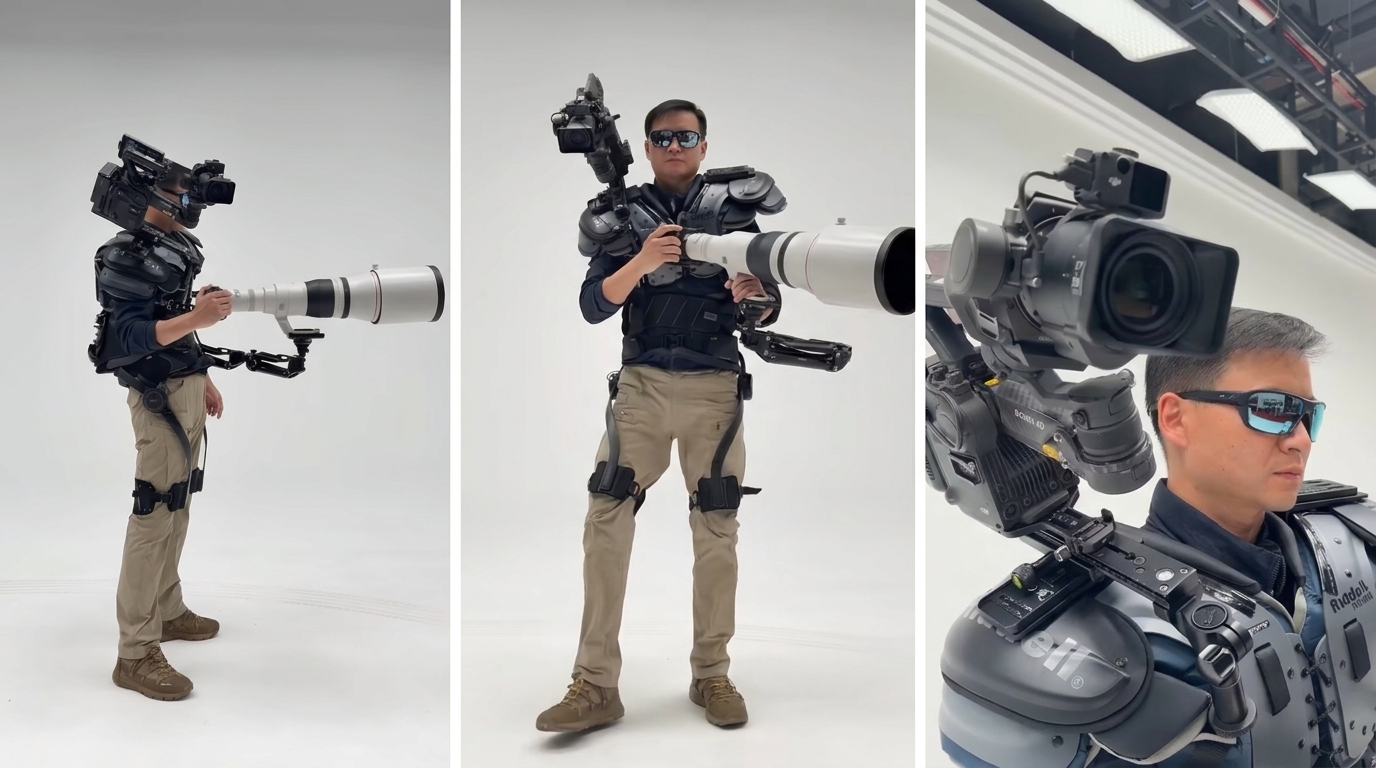
The DJI Ronin 4D exoskeleton rig is what you get when Master Chief swaps his MA5B assault rifle for a Canon telephoto lens. On 5/12/2026, DJI shared a video featuring a photographer wearing Riddell football pads, a four-axis cinema gimbal on his right shoulder, a 22,700 dollar lens strapped across his chest, and a Hypershell exoskeleton supporting his legs. PetaPixel called him a RoboPhotographer. However, we see a different silhouette. We see Spartan-117 with a press pass.
This setup carries a price tag near $50,000, so it sits out of reach for most photographers. Still, the optics matter more than the spec sheet. DJI’s marketing team built the rig to look intimidating on purpose. As a result, the build functions as a flex, a meme, and a preview of where wearable camera stabilization gear is heading.
Below, you’ll find a parts breakdown with running costs, the original DJI video, a use-case rundown for photographers who would consider this kind of build, and a straight take on whether the Master Chief silhouette delivers anything beyond Instagram clout.
Video credit: DJI / HangpaiV. Original coverage by PetaPixel.
What’s Strapped to This Photographer-Spartan
DJI built the rig from parts you order separately. No single retailer sells it as a kit. Instead, the setup combines a gimbal, a telephoto lens, an exoskeleton, and a base frame borrowed from gridiron football. As a result, the photographer wears the gear like a Spartan suiting up for combat, except the targets are wedding processionals and bald eagles.
Right Shoulder: The DJI Ronin 4D Cinema Gimbal
This shoulder-mounted gimbal is a DJI Ronin 4D 4-Axis Cinema Camera, the 8K Combo Kit. B&H lists the configuration at $10,000. Because the gimbal weighs roughly 4 kilograms loaded, mounting it on one shoulder throws off the photographer’s center of gravity. Therefore, PetaPixel suggested a lighting rig on the left shoulder as the obvious next step. We agree, especially if you want full Master Chief energy: ready for orbital insertion.
Chest: A Canon RF 1200mm f/8 L IS USM Telephoto
A chest-mounted gimbal vest carries the Canon 1200mm L IS USM lens across the photographer’s torso. B&H prices the lens alone at $22,700. For context, the lens costs more than a used Toyota Corolla. Mounting a 1200mm prime to a vest gimbal removes the tripod problem and lets the operator pan freely. Therefore, wildlife shooters and field-side sports photographers gain an interesting option, at least in theory.
Legs: The Hypershell X Ultra Exoskeleton
The Hypershell X Ultra is an outdoor consumer exoskeleton. The product page lists it at $1,799 during the 2026 Anniversary Sale, with a regular MSRP of $1,999. According to Hypershell, the device reduces leg fatigue during long hikes by assisting the wearer’s stride. In the DJI context, the exo offsets the combined weight of the gimbal, the camera body, and the giant lens. Consequently, the operator stays mobile through a full shooting day instead of collapsing after 20 minutes.
Base Frame: Riddell Football Pads
The structural backbone is a pair of Riddell football shoulder pads. Because Riddell makes pads for NFL and NCAA athletes, the materials handle impact loads. DJI chose them because they distribute weight across the deltoids and chest. Moreover, the pads create the boxy silhouette every Halo fan recognizes. Without the hard-shouldered shape, the rig would look ordinary instead of Spartan.
The DJI Ronin 4D Exoskeleton Rig Price Tag
The rig clears $40,000 before tax. Below, the running total shows where the money goes. These figures match retail prices verified at B&H Photo and the Hypershell direct store as of mid-2026.
| Component | Retail Price | Running Total |
|---|---|---|
| DJI Ronin 4D 4-Axis Cinema Camera 8K Combo Kit | $10,000 | $10,000 |
| Canon RF 1200mm f/8 L IS USM lens | $22,700 | $32,700 |
| Front camera body (Canon RF mirrorless) | $3,000 to $6,000 | $35,700 to $38,700 |
| Hypershell exoskeleton (X Ultra model, sale) | $1,799 | $37,499 to $40,499 |
| Riddell shoulder pads, rigging, hardware, cables | $1,500 to $3,500 | $39,000 to $44,000 |
| Batteries, monitor, audio, contingency | $1,000 to $6,000 | $40,000 to $50,000 |
For perspective, the total buys a Tesla Model Y Long Range plus a year of insurance and home charging. Alternatively, you fund a complete wedding photography business launch with two pro mirrorless bodies, four lenses, lights, and a Mac Studio. Ultimately, this rig is the photographic equivalent of an MJOLNIR suit fielded by UNSC Special Warfare. Beautiful, intimidating, and absurdly funded.
Who Would Wear the DJI Ronin 4D Exoskeleton Rig
The rig exists as a promotional concept, so DJI built it to be photographed, not sold. However, the underlying components serve real photographer use cases when assembled in less Spartan configurations. Below are the realistic users.
Brand Content Creators and DJI Affiliates
YouTube reviewers and brand-sponsored creators benefit most from the visual impact. A creator wearing the full setup outdraws a creator holding a handheld gimbal by a wide margin in our experience. For context, DJI Ronin’s YouTube channel sits at over 310,000 subscribers, and the rig clip alone fuels click-through across PetaPixel, Digital Camera World, and our coverage here. Visibility wins the day.
Wildlife and Bird Photographers
A 1200mm telephoto is the sharp end of bird and wildlife work. Specifically, most photographers handhold a 600mm or shoulder-mount a 200-600mm zoom. Pairing a 1200mm prime with a vest gimbal and an exoskeleton solves the fatigue problem during all-day blinds. For practical guidance on what you need in the field, our wildlife photography gear list covers reasonable bodies, lenses, and supports without the $40,000 price spike.
Field-Side Sports Photographers (With Caveats)
Field-side shooters work the sideline with 400mm to 600mm primes resting on monopods, and a 1200mm option adds reach. However, sideline credentials enforce mobility, and a vest-mounted lens limits crouching for low angles. The rig works for fixed positions like an end-zone tripod replacement, not for runners chasing a fast break.
Event and Wedding Cinema
The DJI Ronin 4D itself is a legitimate single-operator cinema tool. For instance, wedding filmmakers already use the Ronin 4D for first-look pulls and aisle walks. Therefore, the shoulder mount portion of the rig has merit for events where one operator covers a long ceremony without a Steadicam crew.
Street Photographers Who Want Stares
PetaPixel notes the exoskeleton lets the photographer “spend all day doing street photography and drawing weird looks from passersby.” Agreed. If candid invisibility matters to your work, our guide to budget street photography gear covers a far better path with a Ricoh GR III or Fujifilm X100VI.
Comparing the Halo Rig to a Realistic Photo Setup
A realistic professional setup costs between $4,000 and $8,000. Below, compare the two builds head to head.
| Spec | Halo Rig | Realistic Pro Setup |
|---|---|---|
| Total cost | $40,000 to $50,000 | $4,000 to $8,000 |
| Weight on body (estimated) | Roughly 10 to 13 kg | 2 to 4 kg |
| Setup time | 15 to 25 minutes | 2 to 5 minutes |
| Mobility | Slow walk only | Run, crouch, climb |
| Stares per outing | 100% of bystanders | Roughly 5% |
| Battery swap mid-shoot | Two-person job | Solo, 30 seconds |
Notably, the realistic pro kit delivers nearly the same output for a fraction of the price. Moreover, the operator stays mobile, blends in, and recovers quickly between shoots. In contrast, the Halo rig wins one metric, the visual reaction, but loses every practical one. DJI knows this. Ultimately, the video exists to sell the brand’s halo effect, not the rig’s daily utility.
Pros and Cons of Going Full Spartan
Pros
- Visual reaction is unmatched, useful for brand content and viral video reach
- Hypershell exoskeleton genuinely cuts leg fatigue across 6 to 8 hour shoots
- DJI Ronin 4D delivers cinema-grade 8K stabilization in a single-operator package
- Canon 1200mm provides reach no zoom matches at the long end
- Real wearable camera stabilization platform with cinema-grade 8K output
- Vest gimbal frees the operator from tripod placement constraints
- Modular build means you swap one component without rebuilding the whole rig
- Showcase setup boosting brand reach for sponsored creators
Cons
- Total cost between $40,000 and $50,000 prices out almost every working photographer
- Asymmetric weight on the right shoulder forces awkward gait and stance
- Setup and breakdown take 15 to 25 minutes per session
- No retailer sells the rig as a kit, so assembly burden falls on the buyer
- Bystander attention kills candid street work entirely
- Battery swaps mid-shoot need a second person to support the weight
Final Verdict
The DJI Ronin 4D exoskeleton rig is photography theater. DJI built it to look like Master Chief stepped off the Pillar of Autumn and onto a sound stage. Mission accomplished. The video racked up views, photographer forums lit up, and our coverage exists because the silhouette is impossible to ignore. The marketing math works.
However, the build solves no problem a working photographer faces. For instance, wildlife shooters already own monopod-mounted 600mm setups for one-tenth the price. Wedding cinematographers run the Ronin 4D as a shoulder-mounted gimbal with a Steadicam vest, no football pads required. Similarly, sports shooters rely on credentialed mobility, which a 12 kg rig kills. The exoskeleton genuinely helps with fatigue, but Hypershell sells the X Ultra standalone for under $2,000, available to any photographer hiking long distances with normal gear.
For most readers, the lesson is the opposite of DJI’s intended pitch. Specifically, you do not need a $50,000 rig to make memorable images. Sometimes you need a clean Canon RF body, one well-chosen lens, and the willingness to walk where the light is. If you watched the DJI clip and felt envious, watch it again. The photographer in the suit is not getting better shots than the one with a single Nikon Z8 and a 100-400mm zoom. Instead, he is getting more attention.
For a measured look at the other direction DJI is heading this month, see our coverage of DJI’s new Osmo Pocket 4P, a pocket-sized counterpoint to this Spartan build. The Pocket 4P weighs under 200 grams. In contrast, the Halo rig weighs roughly 10 to 13 kilograms loaded. Both come from the same company in the same week. Ultimately, DJI knows exactly what it is doing.
Frequently Asked Questions
How much does the DJI Ronin 4D exoskeleton rig cost?
The full rig costs between $40,000 and $50,000 once you total the gimbal at $10,000, the Canon 1200mm lens at $22,700, the Hypershell exoskeleton at around $1,800, a Canon RF mirrorless body at $3,000 to $6,000, plus shoulder pads, rigging hardware, batteries, and accessories. Notably, no retailer sells the build as a kit.
What is the Hypershell X Ultra exoskeleton?
The device is a consumer outdoor exoskeleton from Hypershell.tech priced at $1,799 on sale (MSRP $1,999). Specifically, it assists the wearer’s stride, reducing leg fatigue across long hikes. In the DJI rig, the exo offsets the weight of the camera, gimbal, and telephoto lens so the photographer stays mobile through a full shooting day.
Does an exoskeleton work for real photography?
Yes, although not many photographers use one yet. For instance, wildlife shooters who hike 8 to 12 miles a day with heavy 600mm or 800mm prime lenses benefit most. The exoskeleton offsets fatigue, which extends shooting hours and improves the photographer’s ability to hike into remote locations.
Why does the DJI rig use football pads?
Riddell football shoulder pads distribute the weight of the right-shoulder gimbal across the deltoids and chest. Moreover, the pads create the wide-shouldered silhouette responsible for the rig’s Master Chief look. DJI chose them for structural support and for visual impact.
Is the Canon RF 1200mm f/8 L IS USM worth $22,700?
For working wildlife and sports professionals shooting paid assignments, yes. Specifically, the lens delivers reach no zoom matches at the long end and uses Canon’s L-series optics and image stabilization. For hobbyists, no. A Canon RF 100-500mm at around $2,700 covers most of the same situations and weighs a fraction.
Where is the original DJI video posted?
DJI published the video on their YouTube channel on 5/12/2026. PetaPixel covered the story the same day. Video credit goes to DJI and HangpaiV. The embed appears at the top of this article.

