


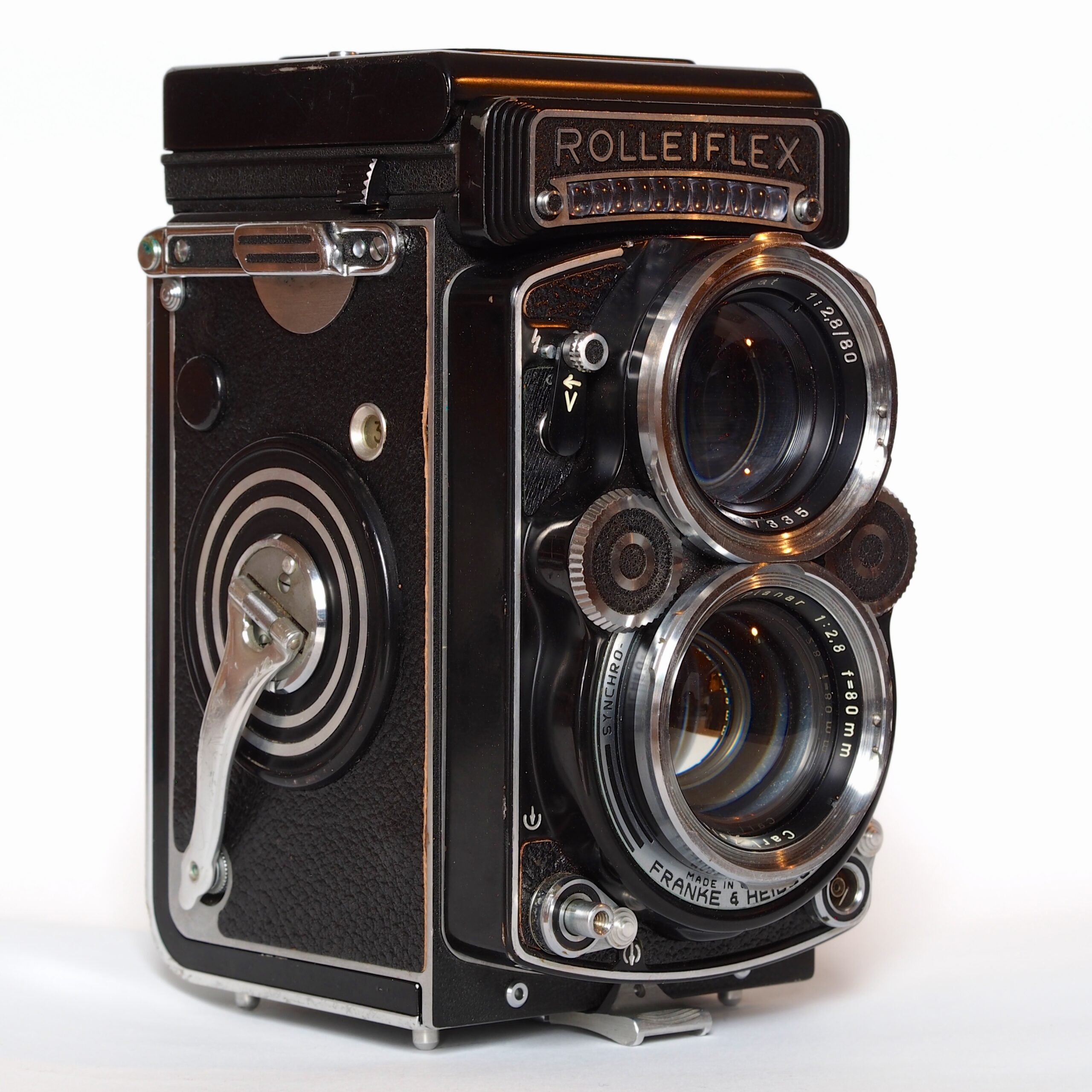
Quick Facts:
- Product: Rolleiflex 2.8GX Royal Urushi Gold
- Released: Around 1995, a special edition of the Rolleiflex 2.8GX
- Type: 6×6 medium format twin-lens reflex
- Lens: Carl Zeiss Planar 80mm f/2.8 HFT
- Shutter: Seiko leaf shutter, the first GX to use one
- Finish: Hand-applied blue urushi lacquer, brown reptile-pattern leatherette, 24-karat gold-plated metal
- Production: 130 units, of 150 planned
- Best for: Collectors of rare and luxury cameras
6 min read
In This Article
Rolleiflex 2.8GX Royal Urushi Gold Overview: A Gold-Plated Rolleiflex Like No Other
The Rolleiflex 2.8GX Royal Urushi Gold is the most lavish version of one of history’s most respected camera lines. Built as a special edition around 1995, it wraps a fully working 6×6 twin-lens reflex in hand-applied blue Japanese urushi lacquer, brown reptile-pattern leatherette, and 24-karat gold-plated metal. Because only 130 left the factory, it counts among the rarest Rolleiflex cameras ever produced.
This was not a hollow showpiece. Underneath the lacquer and gold sat the same Carl Zeiss Planar optics and precise mechanics found in the standard GX. So a collector who loaded film got the same experience as any other Rolleiflex, even if almost no one ever did.
For collectors of rare and luxury cameras, few objects carry this mix of artistry and scarcity. It blends a hand-lacquer tradition, precious metal, and a storied German camera into a single piece. Among the rarest and strangest cameras ever sold, this gold Rolleiflex holds a special place.
Specs at a Glance
| Specification | Details |
|---|---|
| Model | Rolleiflex 2.8GX Royal Urushi Gold |
| Released | Around 1995 |
| Format | 12 frames of 6×6 on 120 film |
| Taking lens | Carl Zeiss Planar 80mm f/2.8 HFT |
| Shutter | Seiko leaf shutter, 1 to 1/500 sec and B |
| Metering | Center-weighted, silicon photo diodes, LED display |
| Finish | Blue urushi finish, reptile pattern, 24k gold |
| Production | 130 units, of 150 planned |
Why Only 130 Rolleiflex 2.8GX Royal Urushi Gold Cameras Were Made
The numbers tell the rarity story plainly. Rollei planned 150 of these cameras, yet only 130 ever left the factory. This makes the Royal Urushi Gold one of the scarcest Rolleiflex models on the collector market.
Timing played a major role. By the mid-1990s, Rollei Fototechnic GmbH had survived a 1981 bankruptcy and leaned heavily on special editions aimed at collectors. Because each gold-and-lacquer body took skilled hand finishing, output stayed tiny and costs ran high. As a result, the company built these in small batches.
Today the survivors trade as trophy pieces rather than working tools. Pristine examples appear rarely, and they command prices far above a standard GX, much like the wider surge in vintage camera values. For collectors chasing the rarest Rolleiflex, this edition sits near the top.
Urushi Lacquer, Lizard Pattern, and 24-Karat Gold
The finish is what sets this camera apart. Skilled artisans coated it by hand with deep blue Japanese urushi, a natural tree-sap lacquer prized for its depth and durability. Each body therefore varies slightly, since the lacquer is applied and polished by hand rather than sprayed.
Brown reptile-pattern leatherette covers the panels where standard cameras use plain covering. The metal trim carries a layer of 24k gold, giving the body its warm shine. Together these materials turn a precision instrument into a display piece.
Urushi is the same lacquer tradition used on fine Japanese art objects, which explains the camera’s reputation among collectors. The process takes patience and skill, so few cameras have ever received this treatment. This edition remains one of the most beautiful examples.
A Working 2.8GX Underneath the Gold
Strip away the luxury, and the 2.8GX is a serious camera. Rollei introduced the GX in 1987 as a modern successor to the classic 2.8F, keeping the twin-lens reflex layout behind the line’s fame. The Royal Urushi Gold uses this same proven body.
Its optics stayed first-rate. A Carl Zeiss Planar 80mm f/2.8 HFT served as the taking lens, paired with a matching viewing lens above it. This edition also introduced a Seiko leaf shutter to the GX line, running speeds from 1 second to 1/500 plus bulb.
Modern metering rounded out the package. Silicon photo diodes behind the mirror fed a center-weighted meter with an LED readout in the viewfinder, so exposure felt current for the era. For the place of the Rolleiflex line in the broader story, see our camera history timeline.
Not the Same as the Later “2,8 Royal”
Collectors often confuse two similar-sounding Rolleiflex editions. The Royal Urushi Gold covered here is the 1995 edition, with roughly 130 units and a hand-lacquered, gold-trimmed finish. It is genuinely rare.
The later Rolleiflex “2,8 Royal” is a different camera. Rollei produced it from 1996 to 2000 in around 1,000 units, also with urushi finish and gold trim, yet in far larger numbers. So the two look related but sit at sharply different rarity levels.
This distinction matters at auction. A listing blurring the two will mislead a buyer about scarcity and value, so checking the year and production run is essential before any purchase.
How It Ranks Among Rare Rolleiflex Editions
Rollei released many collector editions of the GX, and most were far less exclusive. The “60 Years Rolleiflex” edition of 1989 ran to 1,500 units, while the later “2,8 Royal” reached about 1,000. Against those numbers, a 130-unit run looks genuinely tiny.
Only a handful of GX editions approach this scarcity. The 1994 “Gold Expression” edition, for example, saw only 33 units, so a few editions are rarer still. Even so, the Royal Urushi Gold stands out as the rarest of the urushi-finished GX editions, pairing its 130-unit run with a hand-applied finish.
Against the wider field, this camera competes with the most collectible medium format bodies of all. It belongs in the same conversation as the other icons on our list of the best cameras of all time, valued for artistry and rarity rather than raw specs.
Final Verdict
The Royal Urushi Gold is a collector’s object first and a camera second. Its hand-applied lacquer, reptile-pattern leather, gold trim, and 130-unit production give it a character almost no other Rolleiflex will match. For anyone who values artistry and scarcity, it is a landmark piece.
As a tool, the verdict is simple. The camera shoots like any capable 2.8GX, yet its rarity and finish make daily use unthinkable. Surviving examples belong in display cases and collections, not in a working bag.
Still, the camera rewards anyone who admires fine workmanship. It shows how far a maker will go to turn a precision instrument into art. If you want to shoot a Rolleiflex, a standard 2.8GX or a classic 2.8F delivers the same images for a tiny fraction of the price.
Frequently Asked Questions
How many Rolleiflex 2.8GX Royal Urushi Gold cameras were made?
Rollei planned 150, but only 130 left the factory. This small number makes the Royal Urushi Gold one of the rarest Rolleiflex cameras ever produced.
What is urushi lacquer?
Urushi is a traditional Japanese lacquer made from tree sap, applied and polished by hand. It is prized for depth and durability, and the same finish appears on fine Japanese art objects.
What lens does the 2.8GX use?
The Rolleiflex 2.8GX uses a Carl Zeiss Planar 80mm f/2.8 HFT taking lens. Its Royal Urushi Gold version carries the same optics behind a gold-trimmed body.
Is the Royal Urushi Gold the same as the “2,8 Royal”?
No. The 1995 Royal Urushi Gold ran to roughly 130 units, while the later “2,8 Royal” of 1996 to 2000 reached about 1,000. Collectors often confuse the two, yet they differ greatly in rarity.
What is the rarest Rolleiflex?
Several gold and special editions compete for the title. With only 130 units and a hand-lacquered finish, the Royal Urushi Gold ranks among the rarest cameras Rollei ever made.
Is the camera still usable today?
Yes, mechanically it works like a standard 2.8GX. In practice, the rarity and finish mean owners display these cameras rather than risk wear from shooting.

