


Quick Facts:
- Product: Leica M for (RED)
- Designers: Jony Ive and Marc Newson
- Created: 2013, for the (RED) charity auction
- Base camera: Leica M (Typ 240), 24MP full-frame CMOS
- Body: Laser-machined aluminum with more than 21,000 dimples
- Lens: Reworked APO-Summicron-M 50mm f/2 ASPH
- Production: One unit, a genuine one-of-a-kind
- Sold for: $1.8 million at Sotheby’s
6 min read
In This Article
Leica M for (RED) Overview: A One-of-a-Kind From Apple’s Designer
The Leica M for (RED) is the only camera on this list with a production run of exactly one. Apple design chief Jony Ive and industrial designer Marc Newson built it in 2013 for the (RED) charity auction. They started with a Leica M and reimagined almost every external surface, then sold the single result for $1.8 million.
This was not a limited edition or a special color. It was a ground-up redesign of one of the most recognizable cameras in the world, carried out by two of the most influential product designers alive. The pairing alone made headlines, because Ive rarely lent his name to anything outside Apple.
For collectors, the appeal is simple. You cannot buy a second one, and you never will. Among the rarest and strangest cameras ever made, a true one-off designed by the man behind the iPhone holds a place few others can match.
Specs at a Glance
| Specification | Details |
|---|---|
| Model | Leica M for (RED) |
| Designers | Jony Ive and Marc Newson |
| Created | 2013 |
| Base camera | Leica M (Typ 240) |
| Sensor | 24MP full-frame CMOS |
| Body | Laser-machined aluminum, 21,000+ dimples |
| Lens | APO-Summicron-M 50mm f/2 ASPH, reworked |
| Production | One unit |
| Sale price | $1.8 million (Sotheby’s) |
Machined From a Single Block of Aluminum

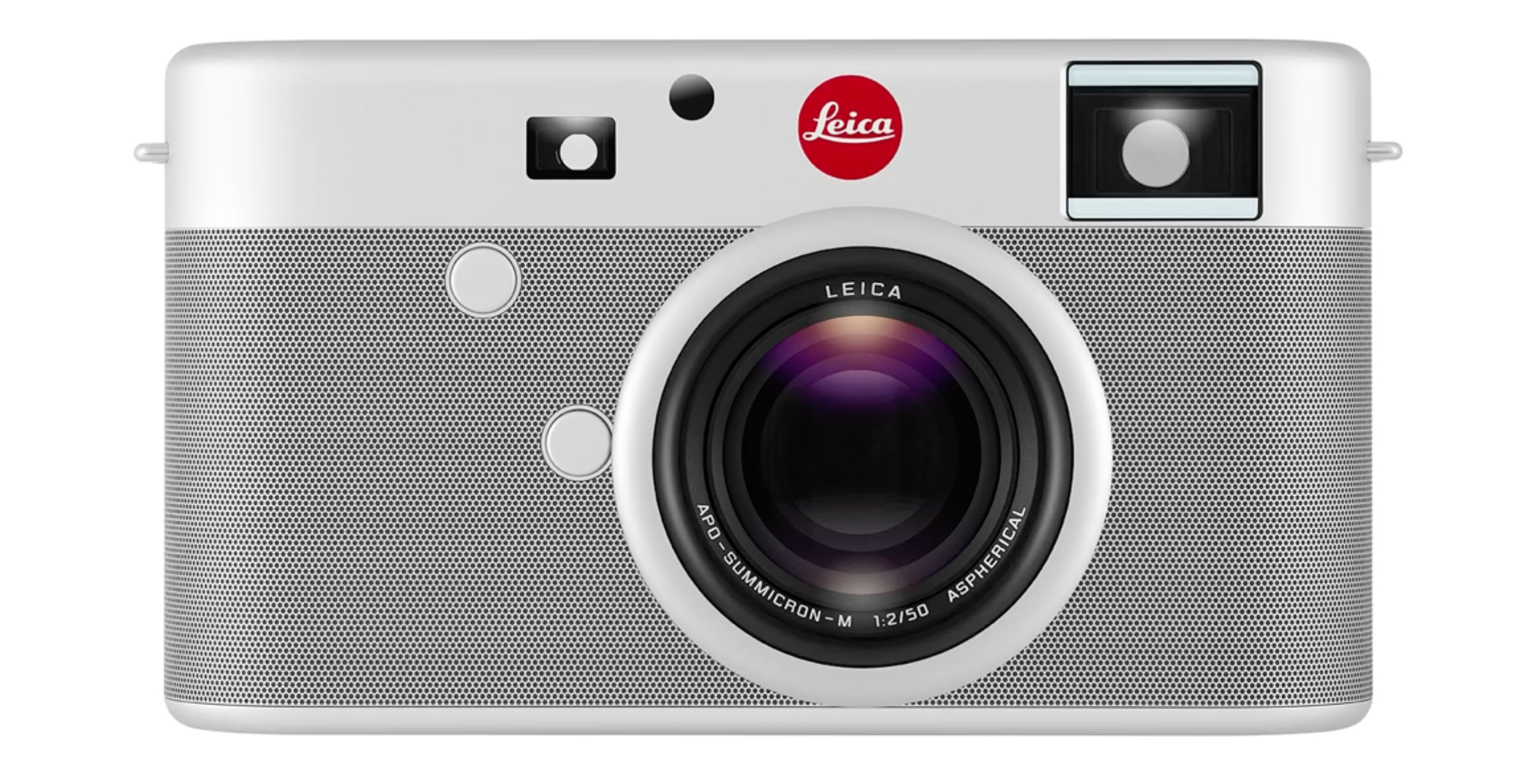
The body is the headline feature. Ive and Newson replaced Leica’s traditional leather covering with a shell of laser-machined aluminum, the same material family Apple uses for its products. The surface carries more than 21,000 tiny hemispherical dimples, which serve as grip texture and give the camera its unmistakable look.
The pattern is functional as well as decorative. Those thousands of small dimples create a tactile surface that holds in the hand without the leather wrap Leica has used for decades. It is a clear example of Ive’s design language, where the way a product feels matters as much as the way it looks.
The redesign extended to the glass. The camera shipped with a reworked APO-Summicron-M 50mm f/2 ASPH lens, finished to match the aluminum body rather than the standard black. The result reads as a single coherent object, not a stock camera with a new skin, which is part of why it commands attention in any list of the most notable cameras ever built.
561 Models and 2,149 Hours of Work
The numbers behind the build are staggering for a single camera. Leica reported that the project produced 561 models and nearly 1,000 prototype parts before the final piece was finished. That is an enormous amount of iteration for an object that exists in a quantity of one.
A large team carried the work. By Leica’s account, the designers worked with around 55 engineers, and the group logged a combined 2,149 hours over a nine-month period. The intensive build phase itself took 85 days. Each of those figures underlines how far this went beyond a simple cosmetic project.
This level of effort explains the price as much as the names do. Buyers were not paying only for a camera. They were paying for hundreds of prototypes, thousands of engineering hours, and a finished object that no factory line ever touched twice.
The $1.8 Million Sotheby’s Sale
The camera went under the hammer at Sotheby’s in New York in November 2013. It was the centerpiece of that year’s (RED) auction, an annual event that channels money to The Global Fund to fight AIDS, Tuberculosis and Malaria.
The result beat expectations by a wide margin. Pre-sale estimates put the camera at $500,000 to $750,000, yet the final price reached $1.8 million, more than double the high estimate. The 2013 (RED) auction as a whole raised roughly $12.9 million for the cause.
The sale cemented the camera’s status. A price near $1.8 million placed it among the most valuable cameras ever sold at auction, and it did so for a digital body rather than a vintage rarity. For context on where film classics land, see our piece on the rising tide of vintage camera values.
Built on the Leica M Typ 240
Under the aluminum sat a fully capable camera. The starting point was the Leica M, also known as the Typ 240, the company’s flagship digital rangefinder of the era. It carried a 24-megapixel full-frame CMOS sensor and the classic M-mount that dates back to 1954.
That foundation mattered. The Typ 240 was a serious working camera in its own right, used by professionals and enthusiasts who valued the rangefinder approach. Ive and Newson did not build a prop. They reskinned a real, shootable Leica.
The M line carries deep history. The rangefinder Leica helped define 35mm photography, a thread we trace in our history of photography timeline. The (RED) camera placed that heritage in the hands of a designer best known for consumer technology, an unusual meeting of two worlds.
Why One Camera Is Worth Millions
Most rare cameras are scarce because few were made. This one is rarer than that, because exactly one exists. There is no production run, no second example, and no realistic path to a duplicate, which makes it unique in the truest sense.
Provenance adds to the value. The Ive and Newson partnership, the charitable purpose, and the public Sotheby’s sale all gave the camera a documented story. Collectors pay for that narrative as much as for the object, and a story this clear is rare.
The design pedigree seals it. Ive shaped products owned by hundreds of millions of people, yet he applied that eye to a camera only once. As a result, the Leica M for (RED) sits in a category of its own, a one-off where rarity, design, and cause all point the same direction. According to Leica’s own account of the project, the goal from the start was a singular object built to raise money for a global cause.
Final Verdict
The Leica M for (RED) is less a camera than a design statement that happens to take pictures. Its machined aluminum body, dimpled surface, and matching lens show what two world-class designers do when given a free hand and a legendary platform. For collectors of design and provenance, nothing else compares.
The practical side hardly matters here. The camera could shoot like any Leica M Typ 240, yet its value and uniqueness mean it will live in a display case, not a camera bag. No owner would risk a scratch on a $1.8 million one-off.
Still, the camera earns its place in any conversation about rare and remarkable gear. It proves that a single object, built with enough vision and effort, can carry the weight of millions. Few cameras tell a cleaner story about where design, scarcity, and purpose meet.
Frequently Asked Questions
What is the Leica M for (RED)?
It is a one-off Leica M digital camera designed by Jony Ive and Marc Newson in 2013. They rebuilt the body in laser-machined aluminum and sold the single result at a Sotheby’s charity auction to benefit The Global Fund.
How much did the Leica M for (RED) sell for?
The camera sold for $1.8 million at Sotheby’s in November 2013. That figure more than doubled the pre-sale estimate of $500,000 to $750,000.
How many were made?
Only one was made. The Leica M for (RED) is a genuine one-of-a-kind, with no production run and no second example, which is the source of much of its value.
What camera is it based on?
It is based on the Leica M, also called the Typ 240, a 24-megapixel full-frame digital rangefinder. Ive and Newson kept the working camera underneath and redesigned the exterior.
What makes the body different?
The body is laser-machined aluminum rather than Leica’s usual leather-wrapped finish. Its surface holds more than 21,000 small dimples that provide grip and give the camera a unique look.
Who are Jony Ive and Marc Newson?
Jony Ive led design at Apple for decades and shaped products like the iPhone. Marc Newson is a celebrated industrial designer and a longtime friend and collaborator of Ive. The Leica was one of their joint projects.

 from a single block of aluminum. It sold for $1.8 million at Sotheby's. Here is the full story.)