


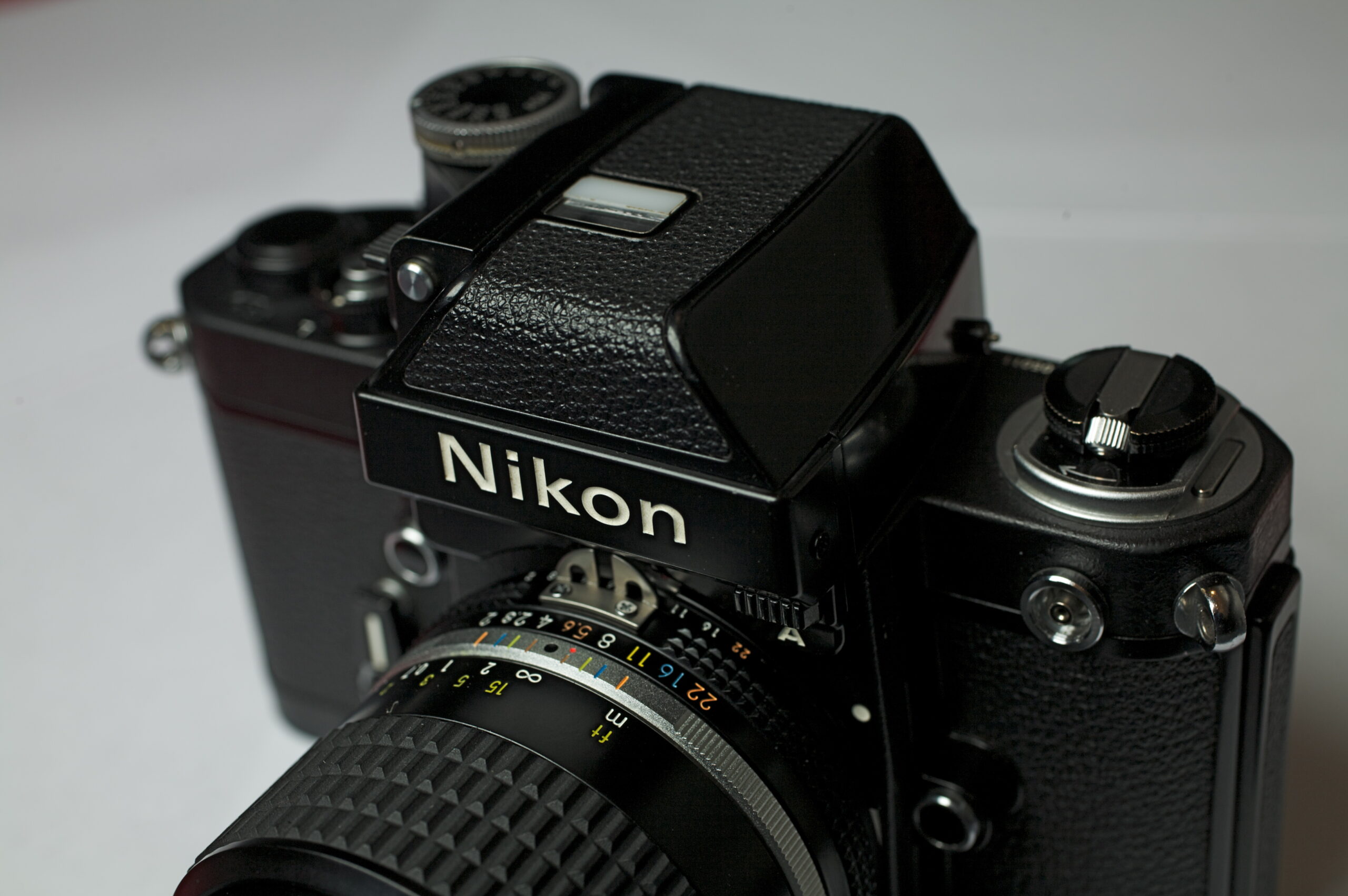
Quick Facts:
- Product: Nikon F2 Titan (model code F2/T)
- Released: 1976, based on the 1971 Nikon F2
- Type: Professional 35mm SLR
- Titanium parts: Shutter blades plus titanium-clad top, bottom, back, and prism
- Finish: Distinctive mottled black
- Variants: “Titan” nameplate, no-name, and a high-speed pellicle mirror version
- Production: Never officially confirmed; estimates run to a few thousand
- Best for: Collectors of rugged professional Nikons
6 min read
In This Article
Nikon F2 Titan Overview: A Pro SLR Armored in Titanium
The Nikon F2 Titan is among the toughest professional 35mm SLRs Nikon built in the film era. Introduced in 1976, it added titanium-clad covers to the top, bottom, back, and prism of the standard F2. Those panels joined the camera’s existing titanium shutter blades. Because Nikon built it in tiny numbers, it ranks among the rarest and most desirable Nikons for collectors.
This was a tool built for abuse. Photographers working in heat, cold, dust, and hard field conditions needed a body able to survive, so Nikon turned to a metal far harder than the usual brass. The result looked different too, wearing a distinctive mottled black finish instead of chrome or smooth paint.
For collectors of rugged professional Nikons, few bodies carry this much appeal. It blends a legendary mechanical camera, an exotic material, and genuine scarcity into one package. Among the rarest and strangest cameras ever made, the titanium Nikon holds a respected place.
Specs at a Glance
| Specification | Details |
|---|---|
| Model | Nikon F2 Titan (F2/T) |
| Released | 1976 |
| Type | Professional 35mm SLR |
| Base camera | Nikon F2 (introduced 1971) |
| Titanium parts | Shutter, top, bottom, back, prism cladding |
| Finish | Mottled black |
| Variants | Titan nameplate, no-name, high-speed pellicle mirror |
| Production | Not officially confirmed; a few thousand |
Why Nikon Reached for Titanium
Titanium solved a durability problem. A standard camera uses brass top and bottom plates, which dent and wear under hard use. Because titanium is far stronger for its weight, it resists the dents and scrapes hard use brings.
Field conditions drove the choice. Press, expedition, and scientific photographers pushed their gear through extreme temperatures and rough handling, so a tougher shell extended the working life of the camera. The titanium shutter, already used on the standard F2, added the same resilience to the most stressed moving part.
Appearance changed too. The F2 Titan wore a thick, textured mottled black finish unique to the model, applied over its titanium shell. This finish now serves as an instant visual cue for collectors hunting the real thing.
How Rare the Nikon F2 Titan Is
Production stayed small throughout the run. Nikon never officially confirmed the total, and credible estimates run only to a few thousand bodies across every version. Next to the roughly 816,000 standard F2 cameras Nikon sold, the Titan figure is tiny, and this scarcity anchors the camera’s collector value.
Demand makes it scarcer still. Working professionals bought these to use, not to preserve, so clean and unmodified examples are now hard to find. As a result, a well-kept F2 Titan often sells for several times the price of a standard F2.
Condition and originality drive the price. Buyers should weigh shutter wear, finish damage, and matching parts before committing. Our guide to what to check when buying used lays out the same checks. For a body this rare, those details separate a fair deal from an overpriced one, in line with the wider rise in vintage camera values.
Titan Nameplate, No-Name, and High Speed
Collectors track three main flavors of the camera. The best known carries a “Titan” engraving on the front, which makes the model instantly identifiable and tends to draw the most interest. So this nameplate version is the one most buyers picture first.
A second version skips the engraving entirely. Known as the “no-name” Titan, it wears the same titanium construction without the front script, and some collectors prize its cleaner look. Both share the identical rugged build underneath.
A third, far rarer branch took a different path. Nikon also built high-speed F2 bodies with a fixed pellicle mirror, a design letting the camera fire rapid bursts without a moving mirror. These specialized models are scarce and sit in their own collecting niche.
Built on the Legendary Nikon F2

The titanium shell wrapped an already great camera. Nikon launched the F2 in 1971 as the successor to the original Nikon F, the 1959 body proving the 35mm SLR suited professionals. The F2 refined the formula with a faster shutter, easier loading, and a wide range of finders and motor drives.
Mechanical reliability defined the platform. The F2 ran without batteries for its core shooting functions, relying on a precise mechanical shutter rather than electronics. For working pros, the camera kept firing in cold or remote conditions where battery-dependent bodies failed.
The system mattered as much as the body. Nikon backed the F2 with a deep lineup of F-mount lenses, finders, screens, and drives, so a photographer configured it for almost any job. For the place of the Nikon F line in the wider story, see our history of the 35mm SLR.
Nikon F2 Titan vs. the Standard F2
The two cameras share their core, yet differ where it counts for durability. A standard F2 uses brass plates and chrome or black paint, while the Titan adds titanium cladding and its signature mottled finish. Mechanically, both run the same proven shutter and controls.
The difference shows up in toughness and price. It resists dents and wear better, which mattered to field professionals, and today it costs far more than a standard F2 because so few exist. For most shooters, a regular F2 delivers the same images at a fraction of the cost.
Collectors value each for different reasons. A standard F2 remains a superb, affordable mechanical SLR, while the Titan is a scarce trophy with a story. Both earn a place in any discussion of the best cameras of all time.
Final Verdict
The F2 Titan is a collector’s prize built on a working professional’s tool. Its titanium construction, mottled finish, and tiny production give it a character no standard F2 will claim. For anyone who loves rugged mechanical Nikons, it is a landmark camera.
The practical reality is simpler. In use, the Titan shoots like any F2, yet its rarity and price push it toward the display shelf rather than daily field work. Buyers also need to inspect condition and originality carefully, since fakes and worn examples exist.
Still, the F2 Titan rewards anyone drawn to engineering and scarcity. It shows how far Nikon went to build a camera able to outlast its owner. If you mainly want to shoot, a standard Nikon F2 gives you the same legendary mechanics for far less money.
Frequently Asked Questions
What is the Nikon F2 Titan?
The F2 Titan is a rare professional 35mm SLR from 1976. It added titanium-clad covers to the standard Nikon F2, which already used a titanium shutter, and Nikon built only a few thousand.
What is the difference between the “Titan” and “no-name” versions?
The Titan version carries a “Titan” engraving on the front, while the no-name version has the same titanium build without the script. Both are rare, and collectors value each for different reasons.
How many F2 Titan cameras were made?
Nikon never officially confirmed the total, and credible estimates run to a few thousand across all versions. This small number, set against huge standard F2 production, explains the camera’s strong collector demand.
Why did Nikon use titanium?
Titanium is far stronger for its weight than the usual brass, so it survives the dents and wear of hard field use. Nikon clad the top, bottom, back, and prism in it, and the F2 already used a titanium shutter.
What is the high-speed F2?
Nikon built rare high-speed F2 bodies with a fixed pellicle mirror, which let the camera shoot fast bursts without a moving mirror. These specialized models are scarce and collected separately.
Is the F2 Titan good to shoot today?
Mechanically it works like any F2, so it shoots beautifully. In practice, the rarity and value mean most owners display these cameras rather than risk wear from regular use.

