


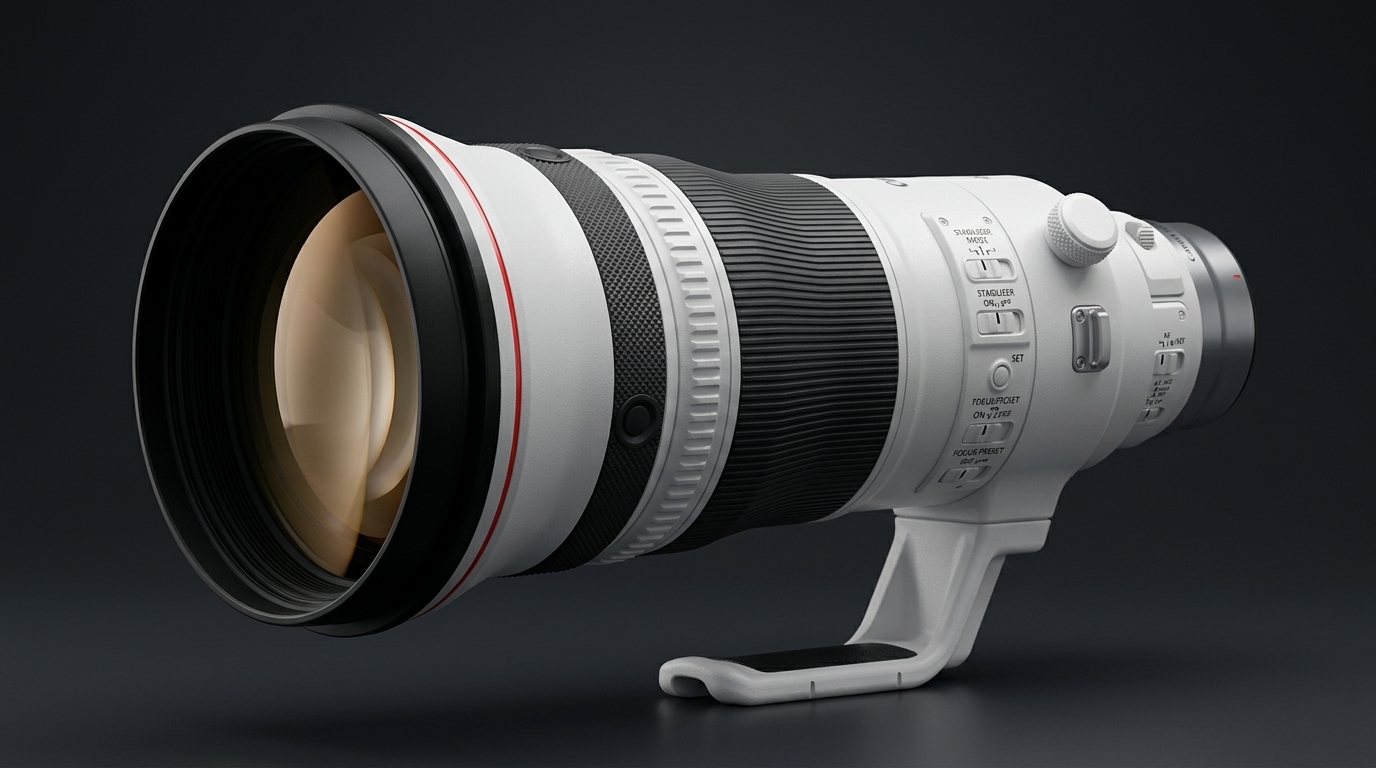
Quick Facts:
- Lenses: Canon RF 400mm f/2.8L IS USM and RF 600mm f/4L IS USM (successors rumored)
- Rumored feature: Built-in teleconverter in each lens
- Also teased: A separate, undisclosed “first-ever” feature
- Expected announcement: Late 2026
- Expected shipping: Q1 2027
- Current weights: 2.89 kg (6.4 lb) for the 400mm, 3.09 kg (6.8 lb) for the 600mm
- Launch prices (2021): $12,000 (400mm), $13,000 (600mm)
- Also rumored: An RF 500mm prime and a 300-600mm zoom
- Best for: Wildlife, sports, and bird photographers who need maximum reach
8 min read
In This Article
- Canon RF 400mm f/2.8 and 600mm f/4 Overview
- Current Big White Specs at a Glance
- The Built-In Teleconverter Rumor
- When Will the New Big Whites Arrive?
- A Rumored RF 500mm Prime and 300-600mm Zoom
- What the Update Means for Owners Today
- Canon RF 400mm f/2.8 vs. the Rumored Successor
- What to Watch Next
- Frequently Asked Questions
Canon RF 400mm f/2.8 and 600mm f/4 Overview
Canon’s two flagship super-telephoto primes, the Canon RF 400mm f/2.8 and the RF 600mm f/4, are reportedly heading for replacement. Better still, the successors should add a built-in teleconverter. According to Canon Rumors, new versions should start shipping in early 2027. An announcement might land late in 2026. For wildlife, sports, and bird photographers, this rumor matters. Both lenses sit at the top of Canon’s RF telephoto range.
Sources point to one headline change above all others: a built-in teleconverter inside each lens. Canon has also reportedly promised a “first-ever” feature for the pair. No one outside the company knows yet what it involves. Both lenses would keep their core identity as professional super-telephotos. Therefore, the appeal stays with shooters who need maximum reach and strong low-light performance.
Pricing context sets expectations early. The current Canon RF 400mm f/2.8 launched at $12,000 in 2021. Meanwhile, the RF 600mm f/4 arrived at $13,000. Successors with extra glass inside rarely get cheaper, so plan for higher numbers. For a sense of how large these optics run, see our roundup of the largest super-telephoto lenses ever built.
These lenses serve a narrow but serious audience. Field sports shooters, safari photographers, and birders rely on this reach. They buy into the system for years at a time. Because of this commitment, even a rumor moves buying decisions. Owners weigh selling before resale values dip, while buyers wait to size up the successor.
Current Big White Specs at a Glance
Before the rumored successors arrive, the current pair sets the baseline. The numbers below show what the next generation has to beat on weight, filter handling, and stabilization. Notably, both lenses already use a lightweight design with the heaviest elements moved toward the camera for better balance.
| Specification | RF 400mm f/2.8L IS USM | RF 600mm f/4L IS USM |
|---|---|---|
| Mount | Canon RF | Canon RF |
| Focal length | 400mm | 600mm |
| Maximum aperture | f/2.8 | f/4 |
| Stabilization | Optical IS | Optical IS |
| Filter | 52mm drop-in | 52mm drop-in |
| Weight | 2.89 kg (6.4 lb) | 3.09 kg (6.8 lb) |
| Launch price (2021) | $12,000 | $13,000 |
Shop the Current 400mm Used
Canon RF 400mm f/2.8L IS USM at MPB
Resale values soften once Canon names a successor. Buy a clean used copy now, with a six-month warranty and condition grades you check before stock moves.
The Built-In Teleconverter Rumor
A built-in teleconverter sits at the center of this story. Today, you slide a separate 1.4x or 2x converter between the lens and body. The swap costs you time and risks dust on the sensor. A built-in unit flips into the light path with a switch. As a result, you change reach without breaking down the rig. For a primer on the trade-offs, our guide on how teleconverters affect reach and aperture covers the basics.
The math explains the appeal. A 400mm f/2.8 with a 1.4x converter becomes a 560mm f/4. Likewise, a 600mm f/4 with the same converter reaches 840mm f/5.6. With the glass built in, you keep weather sealing intact and switch in a fraction of a second. Nikon already ships this idea in its Z 400mm f/2.8 TC VR S and Z 600mm f/4 TC VR S. Each carries an internal 1.4x, so the concept has a working precedent.
Forum speculation goes further. Some readers hope for a dual converter offering both 1.4x and 2x in one barrel. Canon has not confirmed any of this. The “first-ever” feature might turn out to be something ordinary, such as a new coating or a faster focus motor. Still, a built-in converter alone would reshape how pros pack for a shoot.
When Will the New Big Whites Arrive?
Timing remains the softest part of the rumor. People who spoke with Canon Rumors expect shipping in the first quarter of 2027. An announcement might come in late 2026. Development announcements have surfaced before without leading to a product, so treat any date as a moving target.
Stock patterns add useful context. Both the RF 400mm f/2.8 and the RF 600mm f/4 have been hard to find at major retailers. Yet both sit in stock at most stores right now. These lenses appear to be built in batches rather than produced continuously. This pattern explains the on-and-off availability. Canon Professional Services also pulls dozens of copies for major sporting events, and those loans drain the supply chain further.
Because Canon favors big events for launches, watch the back half of 2026 closely. A late-year reveal would line the new lenses up for spring 2027 wildlife and sports seasons. If you shoot a winter event calendar, plan around the current bodies and glass, since a fresh announcement rarely means immediate availability.
A Rumored RF 500mm Prime and 300-600mm Zoom
One more wrinkle sits inside this rumor. Canon is reportedly looking at a 500mm “big white” prime, though the source carries lower confidence on this point. Canon’s old EF 500mm f/4L IS II USM served as a lighter alternative to the 400mm and 600mm primes. It now sits discontinued, leaving an obvious hole in the RF lineup.
The RF range also lacks an affordable Canon super-telephoto lens. The brand needs options in the $5,000 to $6,000 zone, where birders and emerging pros shop. Reporting has repeatedly pointed to a 300-600mm zoom with a fixed aperture. Such a lens would cover wide reach in one barrel. To see how focal length matters in the field, read our breakdown of birds-in-flight technique and reach. It shows where 500mm and 600mm earn their keep.
None of these slower or zoom options would carry the bulk of the f/2.8 and f/4 primes. Instead, they would give wildlife shooters a lighter, cheaper path into serious reach. For now, treat the 500mm prime as the least certain item on this list.
What the Update Means for Owners Today
If you already own a current big white, a successor announcement changes your math in two ways. First, resale values on the existing RF 400mm f/2.8 and RF 600mm f/4 tend to soften once a replacement appears. Therefore, an early sale protects more of your investment. Second, demand for clean used copies often rises among buyers who skip the premium of a new model.
For buyers on a budget, the used market becomes the smart entry point. A current RF 600mm f/4 in excellent condition still delivers reference-grade results. It also pairs with the same bodies as the rumored successor. Our guide to the best Canon bodies for wildlife and sports names the R-series cameras these lenses mount on. You also avoid the launch markup applied to every new big white.
Timing the trade is the hard part. Sell too early and you sit lens-less through a busy season. Wait too long and the next-gen news erodes your price. A reputable used dealer with transparent grading takes most of the guesswork out of either move.
Shop the Current 600mm Used
Canon RF 600mm f/4L IS USM at MPB
A used 600mm f/4 delivers pro-grade reach for thousands less than a new copy. Set a stock alert at MPB so you catch one before prices move on the rumor.
Canon RF 400mm f/2.8 vs. the Rumored Successor
How should you weigh the current lens against an unconfirmed replacement? On optics, the existing Canon RF 400mm f/2.8 already ranks among the sharpest super-telephotos Canon has shipped. Therefore, the successor has a high bar to clear. The headline difference comes down to the built-in teleconverter. It would turn one prime into two effective focal lengths without a separate accessory.
On price and timing, the gap favors the current lens for now. You buy a known quantity today at a known number. Meanwhile, the successor arrives at an unknown premium no sooner than 2027. For a working pro with deadlines this season, waiting carries real cost. For a patient buyer chasing the latest reach trick, the new model earns the wait.
Weight is the wildcard. Canon trimmed the current big white lenses hard, and adding internal converter elements pushes back against those gains. If the successor holds the line near today’s 2.89 kg, the upgrade looks clean. If it gains noticeable bulk, plenty of shooters will stay put with the current glass and a clip-in converter.
What to Watch Next
This rumor gives wildlife and sports photographers a clear reason to pay attention through late 2026. The built-in teleconverter would mark a real shift for Canon’s big white lenses. It would also bring the RF system in line with what Nikon already offers. For the audience these lenses serve, this convenience translates directly into keeper rates on fast, unpredictable subjects.
Hold your expectations on dates and pricing, though. Canon has floated development plans before without a product following, and super-telephoto launches slip more often than they hit. A late-2026 announcement with Q1 2027 shipping reads as plausible, not promised, so build your season around current gear.
The smarter near-term play sits in value. A used Canon super-telephoto lens delivers professional results today at a real discount. Good options include the RF 400mm f/2.8 and the RF 600mm f/4. Each holds resale strength if you later trade up. If a lighter, cheaper option appeals more than a flagship prime, watch the rumored 300-600mm zoom. The possible RF 500mm is worth tracking too.
Shooters who need an answer now should buy a clean used 600mm f/4. It remains the most sensible pick in this class. Watch Canon’s late-2026 calendar, then decide whether the built-in teleconverter justifies a step up.
Frequently Asked Questions
Will Canon release new RF 400mm and 600mm lenses in 2027?
Reports suggest the new versions should start shipping in the first quarter of 2027. An announcement might land in late 2026. Canon has not confirmed any of this, so treat the timeline as a rumor rather than a firm date.
Do the new Canon RF big white lenses have a built-in teleconverter?
Sources indicate both successors will include a built-in teleconverter. A 1.4x unit would turn the 400mm into a 560mm f/4. Likewise, the 600mm would reach an 840mm f/5.6 with no separate accessory.
Is Canon making an RF 500mm f/4 prime lens?
One source points to a 500mm “big white” prime. Still, confidence on this detail runs lower than on the 400mm and 600mm updates. The discontinued EF 500mm f/4L IS II USM leaves a clear gap, so the move would fit the lineup.
How much will the new Canon RF 400mm f/2.8 cost?
Canon has not announced pricing. The current model launched at $12,000 in 2021. Since the successor adds internal converter glass, expect a higher figure rather than a lower one.
How heavy is the current Canon RF 600mm f/4?
The current RF 600mm f/4L IS USM weighs about 3.09 kg (6.8 lb). The RF 400mm f/2.8L IS USM weighs about 2.89 kg (6.4 lb). Adding a built-in teleconverter might affect the successor’s final weight.
Should you buy a current big white or wait for the new one?
If you shoot professionally this season, a current lens bought used delivers reference results today and holds strong resale value. If you want the built-in teleconverter and are willing to wait until 2027, the successor is worth watching.

