


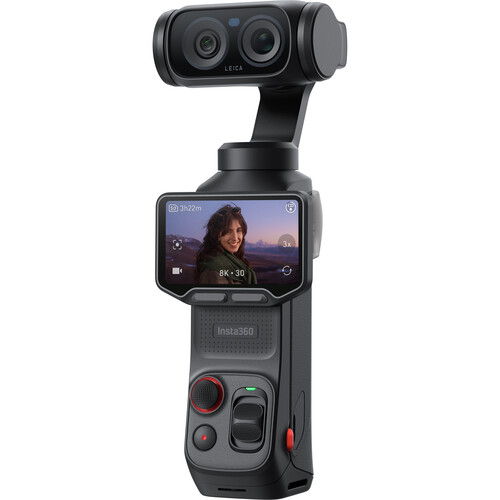
Quick Facts:
- Product: Insta360 Luna Ultra gimbal camera
- Sensors: Dual lenses, 1-inch CMOS plus 1/1.3-inch CMOS
- Top video: 8K30, with 4K120 slow motion
- Optics: Leica-engineered, f/1.8 main lens, 3x optical zoom
- Screen: Detachable 2-inch OLED, wireless monitor to 65 feet
- Battery: Up to 4 hours of recording
- Colors: Cosmic Black, White
- Price: $769.99 (Standard Combo at B&H)
- Best for: Solo content creators and vloggers
6 min read
In This Article
Insta360 Luna Ultra Overview: A Pocket Gimbal Built for Creators
The Insta360 Luna Ultra is a pocket-sized gimbal camera built for solo creators, vloggers, and run-and-gun shooters. It pairs a three-axis stabilized gimbal with dual Leica-engineered lenses and records video up to 8K30. B&H now lists the camera for $769.99, even though Insta360 has not formally announced the price or release date. For buyers weighing a compact creator rig, this listing offers the first hard look at specs and cost.
Insta360 aims the Luna Ultra squarely at the DJI Osmo Pocket line, the best-known name in pocket gimbals. However, the new camera raises the stakes with a larger 1-inch main sensor and a second telephoto lens. Most pocket gimbals ship with a single fixed lens, so the dual-lens design marks a real difference. Creators who shoot interviews, travel clips, and street footage gain framing flexibility without swapping gear. Our earlier Luna Ultra leak details outline the first reports.
Priced at $769.99 for the Standard Combo, the Luna Ultra sits above entry-level vlogging cameras and below a full mirrorless kit. The bundle ships in a Cosmic Black finish, while Insta360 also offers a white colorway. Because the screen detaches and works as a wireless monitor, a single operator frames shots from up to 65 feet away. For one-person shoots, this turns an awkward setup into a quick one.
Key Specs at a Glance

The numbers below come from the B&H product listing, the most complete public source available before Insta360’s official announcement. Together they outline a camera with capability beyond its size.
| Specification | Details |
|---|---|
| Camera type | Three-axis stabilized gimbal camera |
| Sensors | 1-inch CMOS (main) and 1/1.3-inch CMOS (telephoto) |
| Main lens | Leica f/1.8, 3x optical zoom across five steps, telephoto macro |
| Zoom range | Up to 12x zoom, with 6x lossless zoom |
| Top video | 8K30, 4K120 slow motion, 4K60 PureVideo |
| Color and HDR | 10-bit I-Log, Dolby Vision, up to 14 stops dynamic range |
| Screen | Detachable 2-inch OLED touchscreen, wireless to 65 feet |
| Audio | Built-in wireless mic, Mic Pro transmitter support |
| Battery | Up to 4 hours of recording |
| Weight and mount | 1.43 lb package weight, 1/4″-20 tripod thread, USB-C |
| Price | $769.99 (Standard Combo, Cosmic Black) |
Leica Partnership and Imaging Features

Insta360 co-engineered the Luna and Luna Ultra optics with Leica, the same partnership behind the Ace Pro 2 action camera. In March 2025, the two firms announced an extension of their imaging deal and promised new products. The Luna series is the result. For the Luna Ultra, Leica’s work covers both lenses, while the single-lens Luna uses one Leica optic.
The imaging feature set leans professional. Specifically, the Luna Ultra records 10-bit I-Log footage, supports Dolby Vision HDR, and reaches up to 14 stops of dynamic range. Built-in Leica color profiles bake film-style looks into clips, while extra cinematic profiles widen the creative options. Editors also gain ACES workflow compatibility, which keeps color consistent across a professional pipeline. For a device this small, the spec sheet matches gear from a much larger camera.
The Detachable Screen Sets It Apart
The 2-inch OLED touchscreen pulls off the body and becomes a wireless monitor. From up to 65 feet away, it shows a live HD feed and controls the camera. A built-in wireless microphone sits inside the screen module, so it records clean dialogue at a distance. For solo vloggers, this combination removes the need for a separate monitor and a second mic.
Insta360 frames the screen as three tools in one: a monitor, a controller, and an audio capture device. Most rivals force creators to add accessories for the same result. Here, the parts travel together in one pocketable package. Run-and-gun shooters benefit most, because fewer items mean faster setups and lighter bags.
A Strange Soft Launch Through B&H
The Luna Ultra reached store shelves before its own maker detailed it. B&H lists the camera as in stock, with full specifications and the $769.99 price. Insta360, meanwhile, has stayed quiet on pricing and availability. This reversal of the usual launch order has puzzled the industry since the camera first appeared behind frosted glass at NAB 2026.
The likeliest explanation points to DJI. Insta360 appears locked in a standoff with its rival, whose Osmo Pocket 4P remains under wraps too. Both brands seem to hold details back, each waiting for the other to move first. This theory does not fully explain why the Luna Ultra reached a retailer before any announcement, so treat it as informed speculation. For shoppers, the practical takeaway stays simple. The camera is buyable now, and the specs are public, even without a formal launch.
Luna vs Luna Ultra: What Differs
Insta360 sells two Luna models, and the difference comes down to lenses. The standard Luna uses a single Leica wide-angle lens with a 1-inch sensor. By contrast, the Luna Ultra adds a second telephoto lens built around a 1/1.3-inch sensor, which feeds its zoom range.
This second lens changes how you shoot. With the Luna Ultra, you reach up to 12x zoom and 6x lossless zoom for tight close-ups. The main f/1.8 lens also offers 3x optical zoom across five steps plus a telephoto macro mode. Buyers who want reach and framing range should pick the Ultra, while those who shoot mostly wide scenes save money with the standard Luna.
Insta360 Luna Ultra vs DJI Osmo Pocket: Which Fits You?
The Luna Ultra and the DJI Osmo Pocket target the same creator. Both pack a stabilized gimbal into a pocket body and chase vloggers and travelers. The biggest gap is the lens count. While the Osmo Pocket 3 ships with one 1-inch lens, the Luna Ultra carries two, including a dedicated telephoto.
Resolution marks the second difference. The Luna Ultra tops out at 8K30, while the Osmo Pocket 3 maxes at 4K120. Higher resolution helps creators crop and reframe in post. Yet DJI holds advantages in software maturity and a deep accessory ecosystem built over several generations. DJI’s own response, the dual-camera Osmo Pocket 4P, waits in a similar holding pattern, which keeps both timelines murky.
Price tips the decision too. At $769.99, the Luna Ultra costs more than a standard Osmo Pocket 3 kit. For buyers who value zoom reach and 8K capture, the premium makes sense. For those who want a proven, simpler tool, DJI’s track record still appeals. Compare how the Luna stacks up against the DJI Pocket 4, then read our DJI Osmo Pocket 3 review for the full picture.
What the Quiet Launch Means for Buyers
The Luna Ultra arrives as a capable creator camera with a strange launch story. Its dual Leica lenses, 8K30 video, and detachable screen give solo shooters tools usually reserved for larger rigs. At $769.99, it competes directly with DJI’s pocket gimbals while offering more reach and resolution.
The quiet rollout creates one practical wrinkle. Insta360 has not made an official announcement, so early buyers lean on retailer information for now. Anyone comfortable buying before a formal announcement gains first access to a feature-rich camera. Specs sourced from the B&H product listing match the details Insta360 has confirmed so far.
For most creators, the smarter move is patience. Waiting for the official launch should bring clearer pricing tiers, accessory bundles, and hands-on reviews. Shoppers who need a pocket gimbal today, though, already have a real option on the shelf. The Luna Ultra is here, priced, and ready, even while its maker stays oddly silent.
Frequently Asked Questions
How much does the Insta360 Luna Ultra cost?
B&H lists the Luna Ultra Standard Combo at $769.99 in Cosmic Black. Insta360 has not published an official price yet. Final pricing might change once the company announces the camera formally.
When is the Luna Ultra release date?
Insta360 has not confirmed an official release date. Still, B&H already lists the camera as in stock, so buyers order it now. A formal launch announcement is expected soon.
What sensors does the Insta360 Luna Ultra use?
The Luna Ultra uses two sensors. Its main wide lens pairs with a 1-inch CMOS sensor, while the telephoto lens uses a 1/1.3-inch CMOS sensor. Together they support up to 8K30 video and strong low-light results.
Is the Insta360 Luna Ultra better than the DJI Osmo Pocket 3?
The Luna Ultra offers a second telephoto lens and 8K30 recording, which the Osmo Pocket 3 lacks. However, DJI brings mature software and a wide accessory range. Your choice depends on whether zoom reach or ecosystem maturity matters more to you.
Did Leica help design the Luna Ultra?
Yes. Insta360 co-engineered the Luna Ultra lenses with Leica, extending a partnership announced in March 2025. The same collaboration produced the Insta360 Ace Pro 2 action camera.
Where do you buy the Insta360 Luna Ultra?
B&H currently sells the Luna Ultra and lists it as in stock. Insta360 has not opened official sales channels with full details yet. For now, the retailer listing offers the most complete information.

