


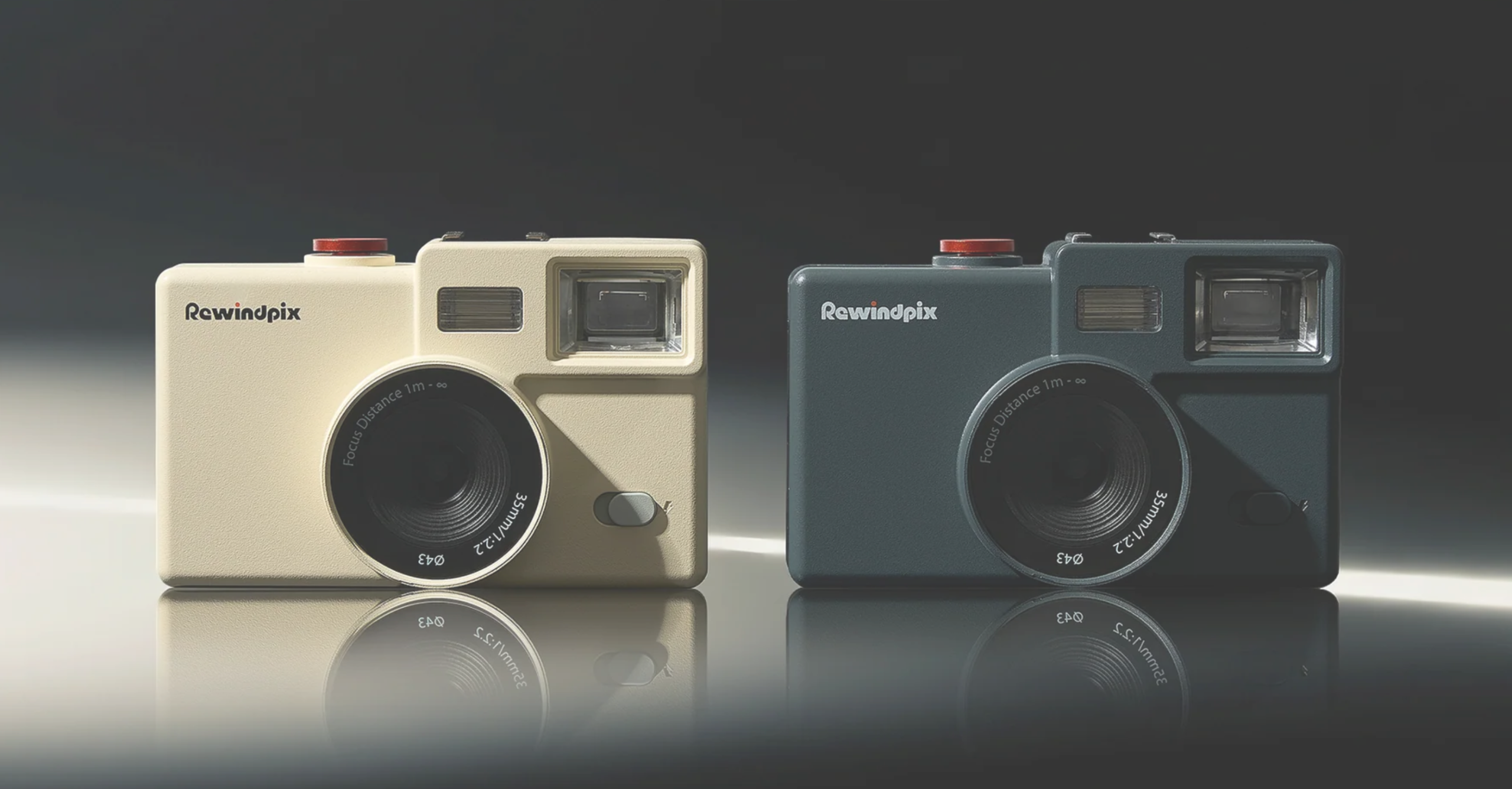
Quick Verdict: The Rewindpix camera is a screen-free digital compact built to feel like a disposable film body, and Kickstarter backers have pushed it past $870,000 above its funding goal with nearly $900,000 raised. Backers pay $99, retail buyers will pay $169 starting in June 2026, and the 13MP 1/3.06-inch sensor trades modern sharpness for a deliberate analog shooting experience. Buy it for the optical viewfinder, the mechanical winder, and the swappable film looks, not the resolution.
Last updated: April 2026 | 8 min read
In This Review
- Rewindpix Camera Overview: Why Backers Pushed Past $870K
- Key Specs at a Glance
- Sensor, Lens, and Image Quality
- Optical Viewfinder and Mechanical Controls
- How Film Mode and Swappable Filters Work
- Pricing, Shipping, and Backer Perks
- Watch the Rewindpix Camera in Action
- Rewindpix vs. CampSnap and Modern Compacts
- Pros and Cons
- Final Verdict
- Frequently Asked Questions
Rewindpix Camera Overview: Why Backers Pushed Past $870K
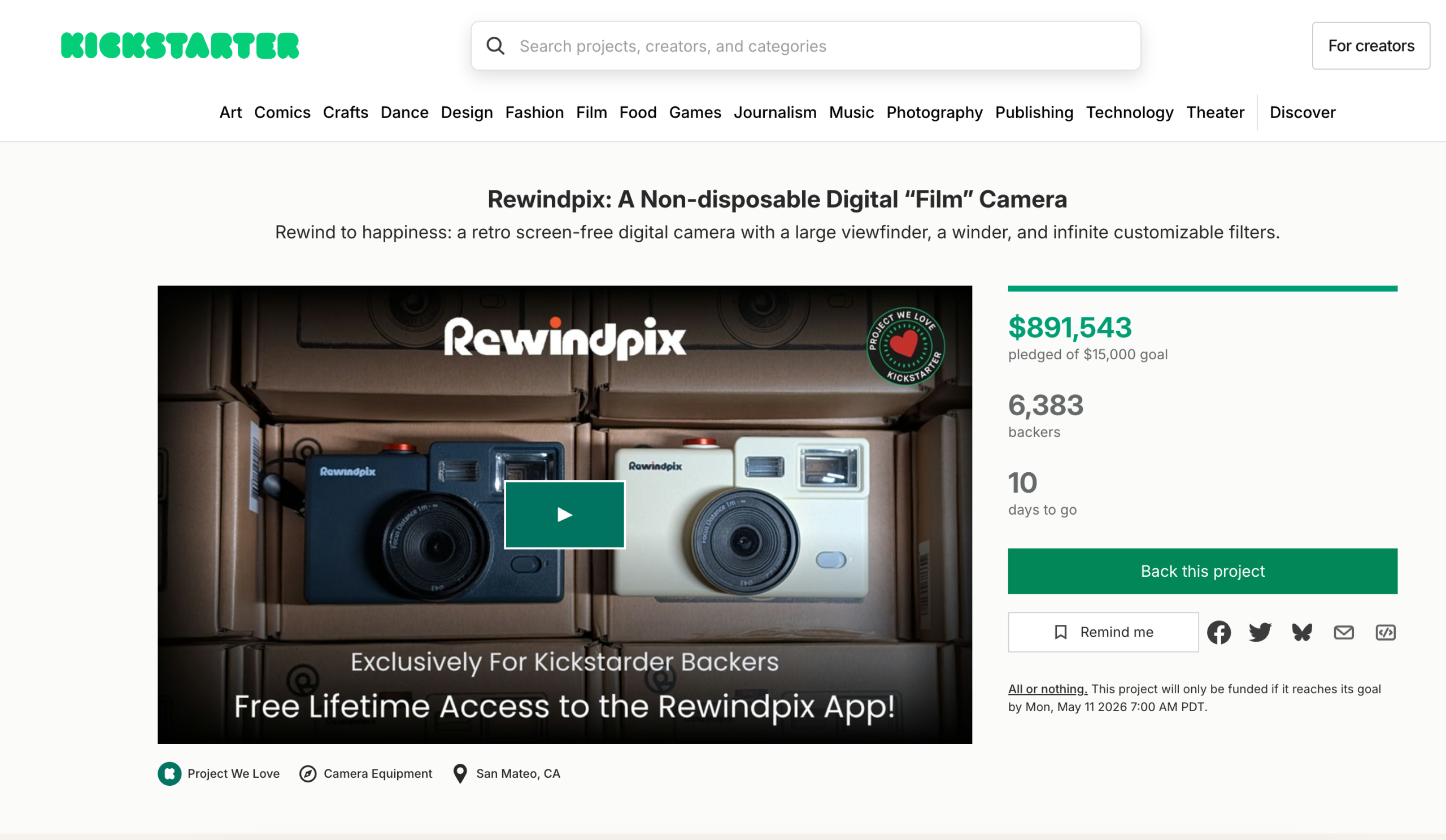
The Rewindpix camera, a pocket-sized digital compact built to feel like a disposable film body, has pulled in nearly $900,000 on Kickstarter with about a week and a half left in its campaign. Photographer and designer Xiao Liu launched the project in April 2026 after teasing it through his rewindpix.com blog in December 2025. Within days, backers pushed funding more than $870,000 above the original goal, putting the project among the most-funded photography campaigns of the year.
This retro digital camera targets photographers who miss the rhythm of 1990s and early-2000s point-and-shoot compacts. Specifically, you shoot through an optical viewfinder, advance a mechanical winder between frames, and review images later through a paired smartphone app. Reviewers with beta units describe a slow-paced, deliberate shooting experience similar to loading a real roll of 35mm color negative film.
For backers, the price sits at $99, while retail buyers will pay $169 once units ship in June 2026. By comparison, a high-end compact like the Ricoh GR III plays in a different tier at over $1,000. Therefore, this digital film camera sells the analog feel and the look of a disposable, not modern sensor performance.
If you have followed the recent revival of point-and-shoot bodies covered in our 35mm film camera roundup, the appeal of this screen-free camera will feel familiar. Above all, the Rewindpix matters because it shows real money flowing toward a stripped-down compact digital camera with no zoom, no autofocus modes, and no video.
Key Specs at a Glance
| Specification | Details |
|---|---|
| Sensor | 13MP Sony IMX258, 1/3.06-inch |
| Lens | 35mm equivalent, fixed f/2.2, glass and plastic elements |
| Shutter Speed Range | 1 second to 1/2,000 second |
| Focus Range | 1 meter to infinity |
| Optical Viewfinder | 25 x 20mm, 3:2 aspect, 0.78x magnification |
| Flash | Built-in Xenon |
| Body | Metal and PVC, 185 grams (6.5 oz) |
| Dimensions | 110 x 65 x 35mm (4.3 x 2.6 x 1.4 in) |
| Internal Storage | 1,200+ photos |
| Battery Life | ~300 shots, ~250 with flash |
| Kickstarter Price | $99 |
| Retail Price (MSRP) | $169 |
Sensor, Lens, and Image Quality
This compact digital camera uses a 13-megapixel Sony IMX258 sensor in a 1/3.06-inch format. For context, the IMX258 is a smartphone-class sensor, closer in size to a phone module than to a Micro Four Thirds or APS-C body. As a result, expect noise in low light, limited dynamic range, and image quality nowhere near a modern mirrorless body.
However, this limitation is the design point. Liu has spoken openly about choosing the smaller sensor to preserve the look of early consumer compacts. Beta reviewers report the soft corners, lower resolution, and warmer color rendering evoke 1990s prints from Kodak Gold or Fujifilm Superia, and the grain structure mirrors the look of scanned 35mm color negative film.
The fixed lens is a 35mm-equivalent f/2.2 design with a mix of glass and plastic elements. Shutter speeds run from 1 second to 1/2,000 second, while the focus range covers 1 meter to infinity. There is no autofocus motor; instead, the deep depth of field from the small sensor keeps most subjects acceptably sharp beyond the 1-meter mark.
In daylight, beta reviewers report results similar to a scanned disposable. Indoor and night shots rely heavily on the built-in Xenon flash, which produces the harsh, direct look common to 35mm point-and-shoot cameras from the late 1990s.
Optical Viewfinder and Mechanical Controls
The optical viewfinder measures 25 by 20 millimeters with a 3:2 aspect ratio, 0.78x magnification, and printed frame guidelines. According to Liu, it ranks among the largest optical viewfinders in this size class. Reviewers with beta units have praised the brightness and the ease of composition, especially compared to phone displays in direct sunlight.
Because there is no rear LCD, the viewfinder is your only way to frame a shot. Therefore, you slow down. You raise the camera, line up the subject through the bright finder, and press the oversized shutter button. Liu sells the shutter button as swappable, so you choose a color or texture to match your preference.
A mechanical winder advances each frame after exposure, mimicking the click and resistance of a film body. While the mechanism is decorative because no real film moves, it forces you to commit to one frame at a time. If you want a refresher on why photographers debate this style of finder, our forum discussion on optical versus electronic viewfinders covers the trade-offs.
How Film Mode and Swappable Filters Work
Film Mode is the centerpiece feature of the Rewindpix camera. Specifically, you load a virtual roll of up to 36 frames, pick from a set of film-style filter profiles, and shoot until the roll is full. A physical switch lets you swap between three loaded filter presets mid-roll, but you cannot preview the result on the camera itself.
The companion smartphone app handles the heavy lifting. Through the app, you browse images after the fact, select which filter profiles live on the camera, and load custom film stocks created by the Rewindpix team or community contributors. Liu has described future support for community-made stocks similar to the way Fujifilm shooters trade film simulation recipes for the X100 series.
At launch, the Rewindpix advertises 36 presets covering a mix of warm, cool, contrasty, and washed-out looks meant to evoke specific film emulsions and disposable cameras from the late 1990s and early 2000s. Beta testers report the presets are tuned with restraint, so the differences between filters feel like swapping film stocks rather than applying heavy Instagram filters.
Because the presets bake into the JPEG before you transfer it, you commit to a look at the moment of capture. Consequently, the experience pushes you toward intentional shooting in a way editing-first workflows do not.
Pricing, Shipping, and Backer Perks
Early Rewindpix Kickstarter backers locked in the camera for $99, which is roughly 41% off the eventual MSRP. After the campaign closes, the retail price will move to $169 through rewindpix.com and select photography retailers. Shipping to backers is scheduled to begin in June 2026.
By comparison, the closest competitor in spirit is the CampSnap, a screen-free digital compact priced around $65 with simpler controls and no swappable film stocks. The Rewindpix sits a tier above with the optical viewfinder, the larger flash, the mechanical winder, and the app-based filter system. Therefore, the $34 price gap reflects more hardware and more software, not a markup for the brand.
Rewindpix Kickstarter backers also receive early access to community film stocks and the ability to vote on future preset packs. Beyond the camera itself, no separate accessories ship in the base pledge, although Liu has mentioned a leather case and a wrist strap as planned add-ons.
Watch the Rewindpix Camera in Action
To see how the spec sheet plays out in real-world shooting, beta units shipped to several photography YouTubers earlier this year. Specifically, two videos give you a clear sense of how this screen-free camera handles in daily use.
The first follows a beta tester carrying the camera through a full day of street and travel shooting:
The second runs through a longer beta test from a more skeptical reviewer, including the moments where the camera surprised them and the moments where it fell short:
Rewindpix vs. CampSnap and Modern Compacts
Two product categories sit closest to the Rewindpix. First, the screen-free novelty digicams like the CampSnap, priced around $65 to $90. Second, premium compacts like the Ricoh GR III and the Fujifilm X-M5 at $1,000 and up. This retro digital camera splits the difference in priorities, not in price.
Compared to the CampSnap, the Rewindpix offers a real optical viewfinder, a Xenon flash, a mechanical winder, and a 36-preset filter system loaded through the companion app. The CampSnap, by contrast, ships with a fixed look and no viewfinder. As a result, the Rewindpix delivers more flexibility for $34 more at retail.
Compared to the Ricoh GR III, the Rewindpix is in another category entirely. Specifically, the GR III gives you a large APS-C sensor, snap focus, RAW capture, and image quality good enough for fine-art printing. The Rewindpix gives you a 1/3.06-inch sensor, fixed JPEGs, and a deliberate point-and-shoot experience. Therefore, choose the GR III for serious photography and the Rewindpix for a different kind of shooting altogether.
If you want a small, capable body for everyday use, our guide to the best affordable compact cameras covers options at multiple price points.
Pros and Cons
Pros
- Bright 25 x 20mm optical viewfinder, larger than most pocket compacts
- Mechanical winder enforces a slower, more deliberate shooting rhythm
- 36 swappable film-style presets through the companion app
- Built-in Xenon flash produces authentic 1990s disposable look
- $99 Kickstarter price undercuts the $169 retail by 41%
- Compact 185-gram body fits comfortably in a coat pocket
- Internal storage holds 1,200+ photos before transfer
Cons
- 13MP 1/3.06-inch sensor produces noisy low-light images
- No rear LCD means no in-camera review or instant feedback
- Crowdfunded shipping timelines often slip past announced dates
- JPEG-only output bakes the filter into every frame
Final Verdict
The Rewindpix camera is built for one specific photographer: someone who wants the slowness, surprise, and look of a 1990s point-and-shoot without the recurring cost of buying and developing real film. If you fit this description, the $99 Kickstarter pledge or even the $169 retail price will feel like a fair trade for a body engineered to resist the conveniences of modern digital capture.
However, the Rewindpix is the wrong camera for almost every other use case. Specifically, the small sensor will frustrate anyone shooting in low light, the fixed lens limits creative framing, and the lack of a rear screen means you wait until the next app sync to see your images. For working photographers, content creators who need flexibility, and anyone serious about image quality, a used Ricoh GR III, a Fujifilm X100VI, or the X-M5 will serve you better.
The Rewindpix Kickstarter surge past $870,000 above goal also signals real demand for stripped-down, intentional cameras. Therefore, even if the Rewindpix slips its June ship date or struggles with quality control, the campaign has already proven the appetite exists. Other camera makers will notice.
For the right buyer, this digital film camera is a thoughtful, focused tool. Otherwise, look at our roundup of the best affordable compact cameras for a more flexible alternative at a similar price point.
Frequently Asked Questions
How much does the Rewindpix camera cost?
Kickstarter backers paid $99 for the Rewindpix camera, while retail buyers will pay $169 once units ship through rewindpix.com and select photography retailers. The $99 backer pricing represents a 41% discount off the eventual MSRP.
When does the Rewindpix camera ship to backers?
Rewindpix has stated shipping to Kickstarter backers begins in June 2026. However, crowdfunded camera projects frequently slip past announced dates because of supply chain issues, quality control delays, and certification requirements. Plan for a possible 1 to 3 month delay beyond the stated ship window.
Is the Rewindpix a real film camera?
No. The Rewindpix is a digital film camera, meaning it captures images on a 13MP Sony IMX258 sensor while mimicking the controls and output of a film body. Specifically, you wind a mechanical lever between frames and load virtual rolls of 36 shots, but no real film moves through the camera.
How many photos does the Rewindpix store?
Internal storage holds more than 1,200 photos before you need to transfer images through the companion app. Battery life lands at roughly 300 shots per charge without flash, dropping to about 250 shots with the Xenon flash firing.
What sensor does the Rewindpix camera use?
The Rewindpix uses the Sony IMX258, a 13-megapixel 1/3.06-inch sensor commonly found in smartphone modules. Because the sensor is small by camera standards, image quality lags behind APS-C and Micro Four Thirds bodies, especially in low light. Liu chose the smaller sensor specifically to evoke the look of early-2000s consumer compacts.
Does the Rewindpix camera work without a phone?
You shoot with the Rewindpix entirely without a phone, however, the companion app handles image transfer, filter loading, and review. Without the app, you lose access to image previews, custom film stocks, and the option to swap presets. Therefore, plan to pair the camera with a smartphone for the full experience.
Disclaimer: PhotographyTalk is not affiliated with Rewindpix or its Kickstarter campaign and receives no compensation for this coverage. Backing a crowdfunded project differs from buying a finished product. Crowdfunded cameras frequently miss announced ship dates, change specifications during production, or fail to deliver. Review the Kickstarter campaign page, the creator’s track record, and recent backer updates before you pledge. PhotographyTalk does not endorse any specific Kickstarter campaign and assumes no responsibility for backer outcomes.

