


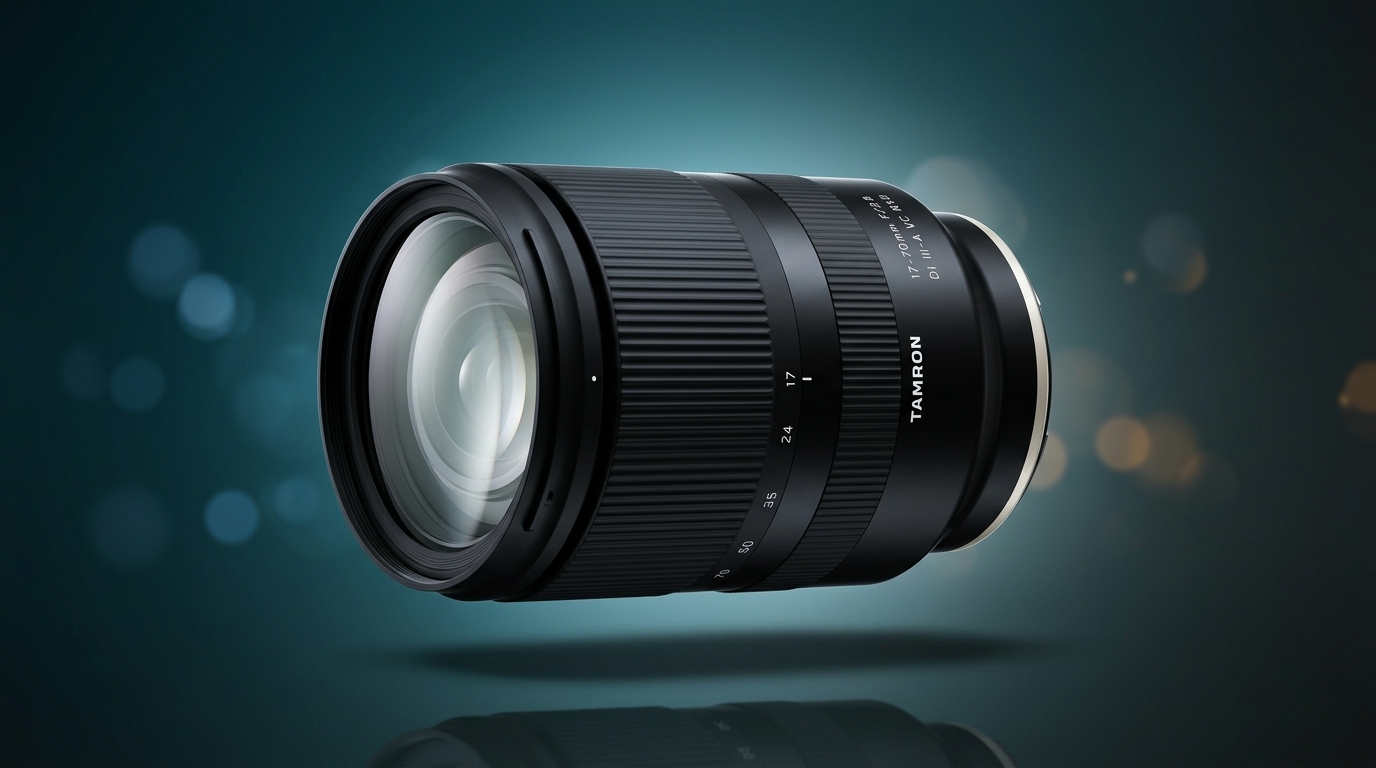
Quick Facts:
- Product: Tamron 17-70mm f/2.8 Di III-A VC RXD (Model B070)
- Mounts: Sony E, Fujifilm X, Nikon Z, Canon RF
- Format: APS-C standard zoom
- Aperture: Constant f/2.8
- Stabilization: Yes (Tamron VC)
- Weight: 525g to 540g depending on mount
- Filter thread: 67mm
- Price: $749 / €649 / £549 (RF and Z, new)
- RF and Z ship date: July 2, 2026
- Best for: APS-C shooters who want one travel zoom with reach
6 min read
In This Review
Tamron 17-70mm f/2.8 Overview: One Zoom, Now Four Mounts

The Tamron 17-70mm f/2.8 Di III-A VC RXD finally reaches the Canon RF mount and Nikon Z mount on July 2, 2026. For years, only Sony E and Fujifilm X owners enjoyed this APS-C standard zoom. Now all four mounts share the same fast, constant f/2.8 zoom. Moreover, because of its 4.1x range, one lens covers wide scenes through short telephoto portraits.
Who needs it? Specifically, crop-sensor owners who want a single travel lens benefit most. For example, a Canon EOS R7 or R10 user gets a 27-112mm equivalent range. Meanwhile, Nikon Z50 II and Zfc shooters get a 25.5-105mm equivalent field of view. Sony a6700 and Fujifilm X-T5 owners have had access since 2021 and 2022. If you weigh one zoom against several primes, our guide on choosing a zoom over primes helps frame the decision.
At $749, the lens undercuts most first-party f/2.8 zooms. However, the Sony E and Fujifilm X versions launched higher, at $799.99. Used copies now sell well below both figures, which we cover in the buying section below.
For example, the 4.1x range runs wider and longer than the Sigma 18-50mm f/2.8. At 17mm, you frame a wide landscape. Then at 70mm, you isolate a portrait with soft background blur. Therefore, one lens covers a room, a street, and a headshot without a swap.
Key Specs at a Glance
| Specification | Details |
|---|---|
| Model | B070 |
| Focal length | 17-70mm |
| Maximum aperture | f/2.8 constant |
| Minimum aperture | f/22 |
| Optical design | 16 elements in 12 groups |
| Aperture blades | 9, circular |
| Minimum focus | 0.19m wide / 0.39m tele |
| Maximum magnification | 1:4.8 wide / 1:5.2 tele |
| Stabilization | Yes (VC) |
| Filter size | 67mm |
| Maximum diameter | 74.6mm |
| Weather sealing | Moisture-resistant build, fluorine front coating |
| Price (RF/Z, new) | $749 / €649 / £549 |
Shop Used and Save
Find Used Tamron Lenses at MPB
MPB lists graded, warranty-backed Tamron zooms across every mount, often hundreds below the new price.
The Tamron 17-70mm f/2.8 Across Four Mounts

The optics stay identical on every mount. However, the housing changes slightly to fit each system. Sony E arrived first, on January 14, 2021. Then Fujifilm X followed on July 8, 2022. Finally, the Nikon Z mount and Canon RF mount versions both ship on July 2, 2026. As a result, every major APS-C system now shares the same lens.
Crop factor shifts the equivalent reach. On the Canon RF mount, the 1.6x sensor yields a 27.2-112mm equivalent. Meanwhile, on Sony E, Nikon Z, and Fujifilm X, the 1.5x sensor yields a 25.5-105mm equivalent. For Canon shooters pairing it with the R7, our roundup of the best Canon EOS R7 lenses adds useful context. Sony owners running a Sony APS-C body like the a6400 get the same handling reviewers praised in 2021.
Size and weight vary little between versions. The Canon RF copy measures 117.3mm long. The Sony E copy is 119.3mm, the Fujifilm X copy 119.6mm, and the Nikon Z copy 121.3mm. Weight ranges from 525g on Sony E to 540g on Nikon Z, with RF and X at 530g. Notably, the Nikon Z and Canon RF versions add an AF/MF switch and a VC on/off switch. In addition, both new mounts support firmware updates through the Tamron Lens Utility.
Image Quality and Optical Performance
Tamron builds this lens with 16 elements in 12 groups. Specifically, the 9-blade circular diaphragm keeps out-of-focus highlights round. At 17mm, the official Tamron MTF data shows strong, even sharpness across most of the frame, with softness only in the extreme corners at fine detail levels. At 70mm, the periphery dips, yet corner detail recovers. For crop-sensor work, real-world results stay excellent.
Notably, close focus is a standout. The lens reaches 0.19m at the wide end for a 1:4.8 magnification. Therefore, you fill the frame with small subjects and blur the background. For travel, food, and detail shots, this flexibility matters. The 17mm wide end also suits scenic work, so pair this read with our notes on the landscape photography lens choices crop shooters reach for.
Against the Sigma 18-50mm f/2.8, reviewers note a clear pattern. The Sigma edges ahead in corner sharpness. Meanwhile, the Tamron shows less vignetting and adds reach plus stabilization. Center sharpness between the two stays close. As a result, your priority decides the winner.
Save on This Zoom
Used Tamron 17-70mm Stock at MPB
Earlier Sony E and Fujifilm X copies appear used at MPB with a six-month warranty and condition grading.
Autofocus, Stabilization, and Video
The RXD stepping motor drives quiet, quick autofocus. For stills, it locks reliably in good light. Tamron’s VC stabilization steadies handheld frames, which helps in dim rooms and at slower shutter speeds. Because many crop bodies lack in-body stabilization, this built-in VC adds real value.
Video shooters get two specific benefits. First, Tamron suppresses focus breathing, so the frame holds steady during focus pulls. Second, the constant f/2.8 zoom keeps exposure stable as you work. However, Tamron notes one caveat on the Canon RF and Nikon Z versions: autofocus might track less responsively while you zoom during video. For most run-and-gun clips, the lens still performs well.
Build quality supports outdoor use. In addition, moisture-resistant construction and a fluorine front coating shrug off light rain and fingerprints. The unified 67mm filter thread also keeps accessory costs down across Tamron’s lineup. Since the barrel stays compact, you carry it all day without strain.
Watch the Tamron 17-70mm f/2.8 in Action
For a real-world look, this hands-on Nikon Z review from Adrian Alford Photography walks through the zoom range, autofocus, and video use.
Tamron 17-70mm f/2.8 vs. Sigma 18-50mm f/2.8: Which Should You Pick?
These two zooms top most APS-C shortlists, yet they serve different priorities. The Tamron brings a longer 4.1x range, built-in VC stabilization, and lower vignetting. However, it weighs about 530g and runs larger. Conversely, the Sigma 18-50mm f/2.8 weighs roughly 290g, fits a jacket pocket, and shows sharper corners, although it drops stabilization and tops out at 50mm.
Price separates them too. The Sigma sells around $584, while the Tamron lists at $749 new. For video and low light without in-body stabilization, the Tamron’s VC justifies the gap. For street and travel where size wins, the Sigma stays compelling.
Pick the Tamron for reach, stabilization, and weather resistance. Choose the Sigma for the smallest, lightest f/2.8 kit. Either way, the used market narrows the price difference, especially on older Sony E copies.
Final Verdict
The Tamron 17-70mm f/2.8 suits APS-C shooters who want one lens for travel, family, and everyday work. Its biggest strength is range. The 17-70mm span covers wide rooms through flattering portraits, and this constant f/2.8 zoom holds light steady throughout. For Canon RF and Nikon Z owners, this fills a long-standing gap in fast crop zooms.
Trade-offs exist. The lens runs larger and heavier than the Sigma 18-50mm f/2.8, so size-first shooters might look elsewhere. Corner sharpness at 70mm also trails the best primes. For most users, though, neither point breaks the deal.
On value, $749 buys reach, stabilization, and weather sealing in one package. Also, used copies stretch the budget, since Sony E and Fujifilm X versions have circulated since 2021 and 2022. Because the optics match across mounts, a used earlier copy delivers the same images.
Buy the Tamron 17-70mm f/2.8 if you want a versatile, stabilized travel zoom. If pocketability outranks reach, consider the Sigma 18-50mm f/2.8 instead. For everyone else, this Tamron earns a spot in the bag.
Ready to Buy?
Check Used Tamron 17-70mm Prices
MPB grades every lens, ships fast, and backs each one with a six-month warranty. Browse current Tamron stock now.
Frequently Asked Questions
Is the Tamron 17-70mm full frame?
No. This lens is an APS-C standard zoom, built for crop-sensor bodies. On a full-frame camera, therefore, it works only in crop mode. For full-frame coverage instead, look at Tamron’s 28-75mm f/2.8.
Does the Tamron 17-70mm work on Canon RF?
Yes. Tamron officially announced the Canon RF mount version on June 24, 2026, and it ships July 2, 2026. Specifically, it mounts on RF-S bodies like the EOS R7, R10, and R50, giving a 27.2-112mm equivalent range.
What is the 35mm equivalent of the Tamron 17-70mm?
On Canon RF, the 1.6x crop gives a 27.2-112mm equivalent. Meanwhile, on Sony E, Nikon Z, and Fujifilm X, the 1.5x crop gives a 25.5-105mm equivalent. Both ranges suit wide scenes through short telephoto.
Is the Tamron 17-70mm good for video?
Yes. Because the constant f/2.8 zoom holds exposure while you work, and Tamron suppresses focus breathing, footage stays clean. In addition, VC stabilization steadies handheld clips. On RF and Z, however, autofocus might track less responsively while zooming during video.
How much does the Tamron 17-70mm cost?
The new Canon RF and Nikon Z versions list at $749 / €649 / £549. However, the earlier Sony E and Fujifilm X versions launched at $799.99. Used Tamron lenses at MPB sell well below those figures.
Which mounts is the Tamron 17-70mm available for?
Four mounts hold it now: Sony E since 2021, Fujifilm X since 2022, and Nikon Z and Canon RF from July 2, 2026. Because the optical design stays the same across all four, image quality matches.

