


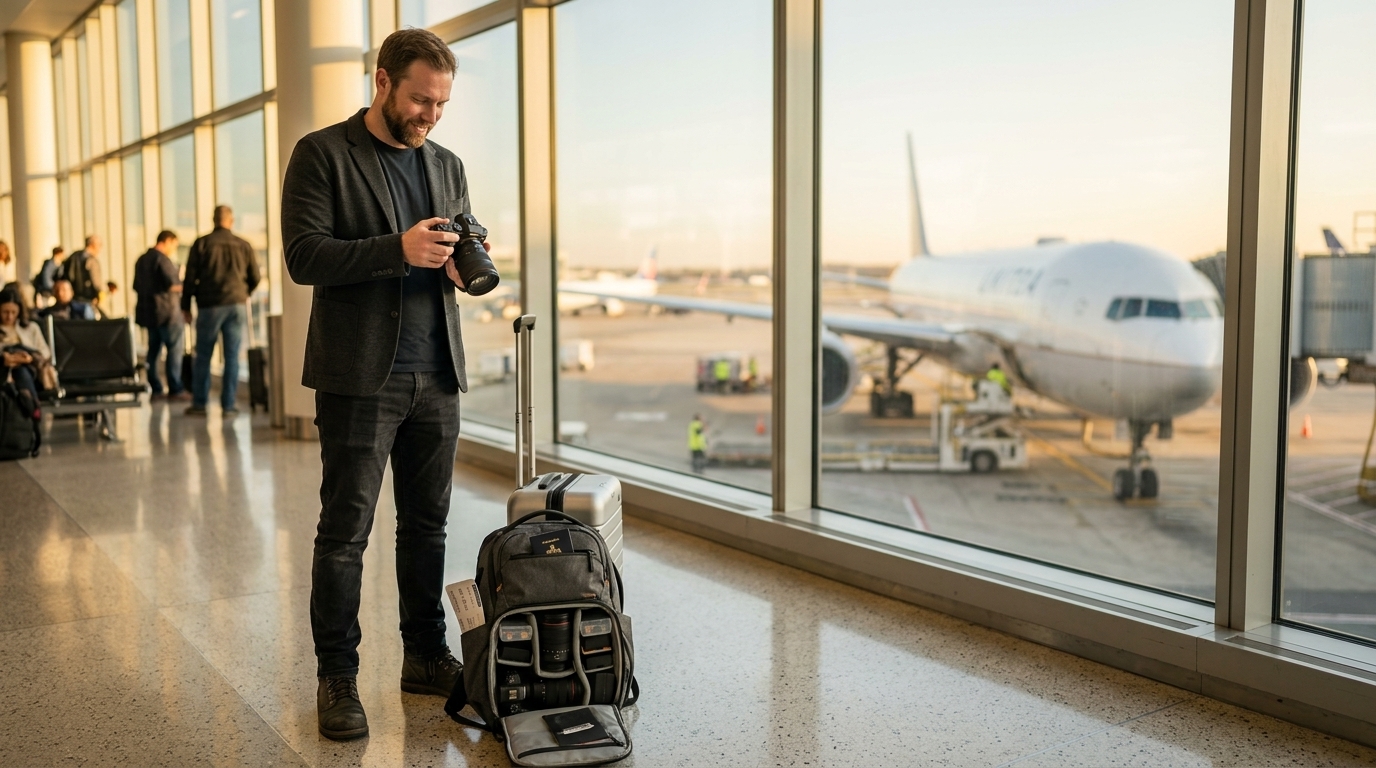
Quick Facts:
- Topic: Flying with camera gear in 2026
- TSA rule: Digital cameras permitted in both carry-on and checked bags
- FAA battery limit: 100Wh lithium-ion in carry-on without approval
- Spare battery rule: Loose lithium batteries forbidden in checked bags
- Carry-on size: Roughly 22 x 14 x 9 inches on most US carriers
- Difficulty: Beginner-friendly once rules become clear
- Time to prep: 30 minutes before packing
- Best for: Photographers flying domestic or international with mirrorless or DSLR kits
9 min read
In This Guide
- Flying With Camera Gear: What You Need to Know in 2026
- Key Rules at a Glance
- TSA Camera Rules and FAA Lithium Battery Limits
- Carry-On Camera Bag and Packing Strategy
- Memory Cards and Backup Practices
- Pre-Flight Checklist for Flying With Camera Gear
- Checked vs Carry-On: Which Wins for Photography Equipment?
- Travel Resources for Photographers
- Pros and Cons of Flying With Photography Equipment
- Final Verdict
- Frequently Asked Questions
Flying With Camera Gear: What You Need to Know in 2026

Flying with camera gear has changed since I bought my first Nikon DSLR more than 17 years ago. Back then, you tossed a body into a duffel and walked through security without much thought. Today, TSA officers scan every electronic, FAA lithium-ion battery rules apply to every spare cell, and airlines enforce stricter carry-on dimensions on flights worldwide. However, the rules stay manageable once you sort out the basics.
I have flown to Norway, Italy, Switzerland, Russia, Mexico, and across Europe with mirrorless and DSLR kits. After airlines lost luggage on three separate trips, I made one rule for myself. My camera body, lenses, and every battery travel with me in the cabin. Checked bags hold clothes only. As a result, my workflow has stayed stable across roughly two dozen flights since 2022.
This guide pulls together the current TSA camera rules, FAA battery limits, airline policies, and pre-flight tactics built for photographers shooting on the move. Specifically, you will see exactly which gear belongs in carry-on, which battery sizes need airline approval, and how to pass security without sweating. Moreover, a full resource table at the end links every authoritative source you need before flying.
Above all, traveling with camera gear rewards photographers who plan thirty minutes ahead of packing. Skip this step and you risk a gate agent ordering a check at the worst possible moment. Plan ahead and you walk through security in under five minutes.
Key Rules at a Glance
Before diving into details, here is the at-a-glance summary every photographer needs. The numbers below come straight from FAA PackSafe documentation and TSA’s Digital Cameras item entry.
| Item | Rule |
|---|---|
| Digital camera body | Allowed in carry-on and checked |
| Camera lens | Allowed in either, carry-on recommended |
| Spare lithium-ion battery under 100Wh | Carry-on only, no quantity limit |
| Lithium-ion battery 100-160Wh | Carry-on only, airline approval, max 2 spares |
| Lithium-ion battery over 160Wh | Forbidden in passenger baggage |
| Travel tripod (folded under 22 inches) | Usually allowed in carry-on, officer discretion |
| Memory cards and SSDs | Allowed in either, carry-on strongly advised |
| Power banks | Carry-on only, same Wh limits as spare batteries |
Ready For a Travel-Friendly Kit?
Shop Used Compact Mirrorless Cameras at MPB
Save 30-50% on a Sony A7C II, Fujifilm X-T5, or Canon EOS R8 with a 6-month MPB warranty and free shipping.
TSA Camera Rules and FAA Lithium Battery Limits

The TSA camera rules are simple at the top level. Digital cameras pass through security in either carry-on or checked baggage. However, the screening officer keeps final discretion, so any oddly shaped lens or fragile body should ride in the cabin. Additionally, modern X-ray scanners do not harm sensors, memory cards, or lens elements.
Flying with camera batteries is where most photographers stumble. The FAA enforces watt-hour caps on spare lithium-ion cells through PackSafe regulations, and flying with camera batteries above 100Wh triggers extra steps. Specifically, batteries under 100Wh travel in carry-on without quantity limits for personal use. Larger cells between 100-160Wh require airline approval and a maximum of two spares. Anything over 160Wh is forbidden in passenger baggage entirely.
Reading the Watt-Hour Rating on Your Battery
Most modern camera batteries print their Wh rating on the side. The Canon LP-E6NH sits at roughly 15.4Wh. Sony’s NP-FZ100 holds about 16.4Wh. The Fujifilm NP-W235 reaches around 16Wh. For comparison, a typical 99Wh V-mount cinema battery sits right under the consumer limit, while a 150Wh V-mount needs airline pre-approval.
Protecting Spare Battery Terminals
Every spare cell needs terminal protection before going into your bag. Loose batteries rubbing against metal create short-circuit risk and trigger lithium thermal runaway. For example, electrical tape across the terminals or a dedicated plastic battery case both work. Personally, I use small silicone sleeves included with most third-party battery packs. As a result, I have never had a gate agent question my battery setup.
Carry-On Camera Bag and Packing Strategy
Choosing the right carry on camera bag changes everything about flying with photography equipment. A carry on camera bag fitting both airline limits and your shooting kit becomes the single most important purchase for travel photographers. Most US carriers cap carry-on dimensions at 22 x 14 x 9 inches. Personal items have a smaller envelope, often 17 x 10 x 9 inches under the seat. For this reason, a bag built to fit under the seat removes the risk of forced gate-checks when overhead bins fill up.
My current setup runs around 15 pounds with a Canon R5 body, two RF lenses, six batteries, a card wallet, and a 13-inch laptop. The bag holds everything yet stays inside the under-seat envelope for United and Delta. For travelers shopping for a new bag, the Peak Design Everyday Backpack V2 remains a strong option with carry-on-friendly dimensions and customizable dividers.
International carriers often cap carry-on weight at 7-10 kg (15-22 lbs). British Airways, Lufthansa, and Air France enforce these limits more strictly than US carriers. Therefore, weigh your kit at home with a luggage scale before flying internationally. Also, wear a vest or jacket with deep pockets. Pockets do not count toward baggage weight. Filters, extra batteries, and small primes ride happily in a coat pocket through security.
For deeper packing tips, see our essential tips for traveling with camera gear companion guide.
Memory Cards and Backup Practices
Memory cards belong in your carry-on, full stop. Checked bags get lost. My luggage went missing for three weeks on a return flight from Frankfurt in 2023. If those cards had ridden in the suitcase, every frame from the trip would have vanished with it. Since then, I run dual-card backup in-camera and carry a second physical copy on a portable SSD inside my camera bag.
The 3-2-1 rule applies even on a one-week trip. Three copies of every file, on two different media types, with one copy in a separate location. For travelers, the rule translates to in-camera dual-card recording, an evening sync to an SSD, and a hotel-night upload to cloud storage when WiFi cooperates. For dedicated portable storage options, see our roundup of the best external hard drives for photographers.
Pre-Flight Checklist for Flying With Camera Gear
Flying with camera gear becomes painless when you run a 30-minute pre-flight check the night before. The list below covers everything I do before international flights.
- Charge every battery to 50-80% (storage-friendly, not 100%)
- Tape terminals or seat batteries in protective cases
- Format every memory card after backup
- Weigh the full bag and confirm it fits the airline limit
- Photograph serial numbers for every body and lens for insurance
- Print or screenshot the FAA PackSafe page in case of dispute
- Check the destination country’s customs page for declaration thresholds
- Slot the tripod inside the bag if it folds under 22 inches; otherwise check it in a hard case
- Apply for TSA PreCheck or Global Entry well before flying; benefits compound across trips
Notably, the customs check matters most for high-value kits. Some countries require a customs declaration above $2,500-$10,000 in equipment value. Specifically, ATA Carnet paperwork solves this for working pros traveling with significant gear.
Save on Your Next Travel Camera
Used Sony A7C II From $1,769 at MPB
A compact 33MP full-frame travel body with 67 units in stock. Save hundreds versus buying new, with a free 6-month warranty.
Checked vs Carry-On: Which Wins for Photography Equipment?
Carry-on wins for nearly every photographer flying with camera gear. Three reasons make this a one-sided answer. First, checked bags get lost. Airlines mishandle roughly 6.9 bags per 1,000 passengers worldwide per SITA’s 2024 Baggage IT Insights report. Second, baggage handlers throw cases hard enough to crack sensors or bend lens mounts. Third, FAA rules forbid spare lithium batteries in checked bags, so leaving anything battery-powered behind in the hold creates a packing puzzle.
Checked bags do work for one category: bulky tripods over 22 inches folded and lighting stands. Pack those in a hard-sided case with foam, label it fragile, and accept the risk. For everything else, the cabin holds your kit. If you fly with a heavy professional setup, also consider shipping spares ahead via FedEx with insurance. The cost usually beats overweight baggage fees plus damage risk.
Travel Resources for Photographers
Every photographer should bookmark these resources before flying with camera gear. The table below pulls together the official rule pages, planning tools, and PhotographyTalk articles worth reading before your next trip.
| Resource | Purpose | Link |
|---|---|---|
| TSA Digital Cameras | Official US rules on camera bodies | tsa.gov |
| TSA What Can I Bring (full index) | Search any specific item by name | tsa.gov/whatcanibring |
| FAA PackSafe Lithium Batteries | Watt-hour rules and limits | faa.gov/packsafe |
| FAA Passenger Battery Card | Printable rule summary | faa.gov/airline-passengers |
| 49 CFR 175.10(a)(18) | Federal regulation text | ecfr.gov |
| Global Entry / TSA PreCheck | Expedited screening enrollment | ttp.cbp.dhs.gov |
| US State Department Travel | Country-by-country travel advisories | travel.state.gov |
| US CBP Customs Declaration | Form 4457 for valuable kit | cbp.gov |
| PhotographyTalk Travel Hub | All travel photography articles | photographytalk.com |
| Camera Carry Guide | Physical carry methods on location | how to carry your camera safely while traveling |
| AirTag / Apple Find My | Bag tracking for lost luggage | apple.com/airtag |
| SITA Baggage IT Insights 2024 | Annual airline baggage mishandling data | sita.aero |
Pros and Cons of Flying With Photography Equipment
Pros
- Modern X-ray scanners protect digital sensors and memory cards safely
- Camera bodies and lenses qualify for both carry-on and checked baggage
- Spare batteries under 100Wh face no quantity limit in carry-on
- TSA PreCheck speeds screening to roughly 5 minutes for enrolled travelers
- Compact mirrorless kits weigh 30-50% less than equivalent DSLR setups
- Most carry-on camera bags slot under the seat for guaranteed cabin access
Cons
- International airlines cap carry-on weight at 7-10 kg, tighter than US carriers
- Lithium batteries over 100Wh require airline approval and add planning time
- Officer discretion overrides written rules at the checkpoint
- Checked bag mishandling rates run roughly 6.9 per 1,000 passengers per SITA 2024 data
- Film over ISO 800 fogs after multiple X-ray scans
Final Verdict
Flying with camera gear in 2026 works reliably if you build one habit: every body, lens, battery, and memory card travels in the cabin. After 17 years of flights through US, European, Middle Eastern, and Mexican airports, this single rule has saved me more frustration than any other.
The FAA rules around lithium-ion batteries form the trickiest piece. However, the math stays simple. Cells under 100Wh face no carry-on quantity limit. Cells between 100-160Wh need airline approval and cap at two spares. Anything heavier stays home or ships via cargo. For 99% of photographers shooting on mirrorless bodies, every battery in your kit sits well under 100Wh.
Compact mirrorless cameras win for flying every time. Specifically, a Sony A7C II body weighs 514 grams. A Fujifilm X-T5 weighs 557 grams. A Canon EOS R8 weighs 461 grams. Compared to a comparable DSLR kit at 900-1,200 grams, you cut roughly half the weight while keeping similar image quality. Used examples from MPB run $874 to $1,999 depending on model, which often saves 30-50% versus buying new.
For photographers building a first travel kit, start with a used compact body, one zoom lens covering 24-105mm equivalent, and a carry-on bag under 22 x 14 x 9 inches. Add the resources table to your phone’s bookmarks. After two trips, the workflow becomes muscle memory and security stops feeling like a gauntlet.
Ready to Buy?
Browse Used Travel Cameras at MPB
216 used mirrorless bodies in stock with free 6-month warranty, plastic-free shipping, and a 14-day return window.
Frequently Asked Questions
Is a camera allowed on a plane in 2026?
Yes. TSA allows digital cameras in both carry-on and checked baggage. However, the screening officer holds final discretion, so a camera body always rides safer in the cabin where you control handling. Modern X-ray scanners cause zero damage to digital sensors, memory cards, or lens optics.
How many spare camera batteries are allowed on a plane?
For spare lithium-ion batteries under 100Wh, no federal quantity limit applies for personal use. However, every spare cell must ride in carry-on, never checked. Batteries between 100-160Wh require airline approval and cap at two spares per passenger. Anything over 160Wh stays off the aircraft entirely.
Will airport X-rays damage my camera or memory cards?
No, modern X-ray scanners do not harm digital cameras, lenses, sensors, or memory cards. Undeveloped film tells a different story. High-speed film above ISO 800 fogs after multiple scans. For film, ask security for a hand inspection at the checkpoint.
How do I fly with photography equipment internationally?
Flying with photography equipment internationally adds three checks beyond domestic flights. First, confirm the destination country’s customs declaration threshold (often $2,500 to $10,000 in gear value). Second, verify the carrier’s carry-on weight limit, often 7-10 kg. Third, file CBP Form 4457 before leaving the US to register your gear before departure.
Is a tripod allowed on a plane?
Travel tripods folding under 22 inches usually pass as carry-on. Larger tripods belong in checked baggage with a hard case and foam padding. Monopods follow the same logic. Officer discretion applies at the checkpoint, so a friendly tone and visible camera bag help your case.
What is the best used camera for flying with camera gear?
Compact full-frame and APS-C mirrorless bodies win for air travel. The Sony A7C II, Fujifilm X-T5, and Canon EOS R8 all weigh under 600 grams, fit any carry-on, and accept compact zoom lenses. MPB stocks used examples of all three with a 6-month warranty, often at 30-50% below new pricing.

