


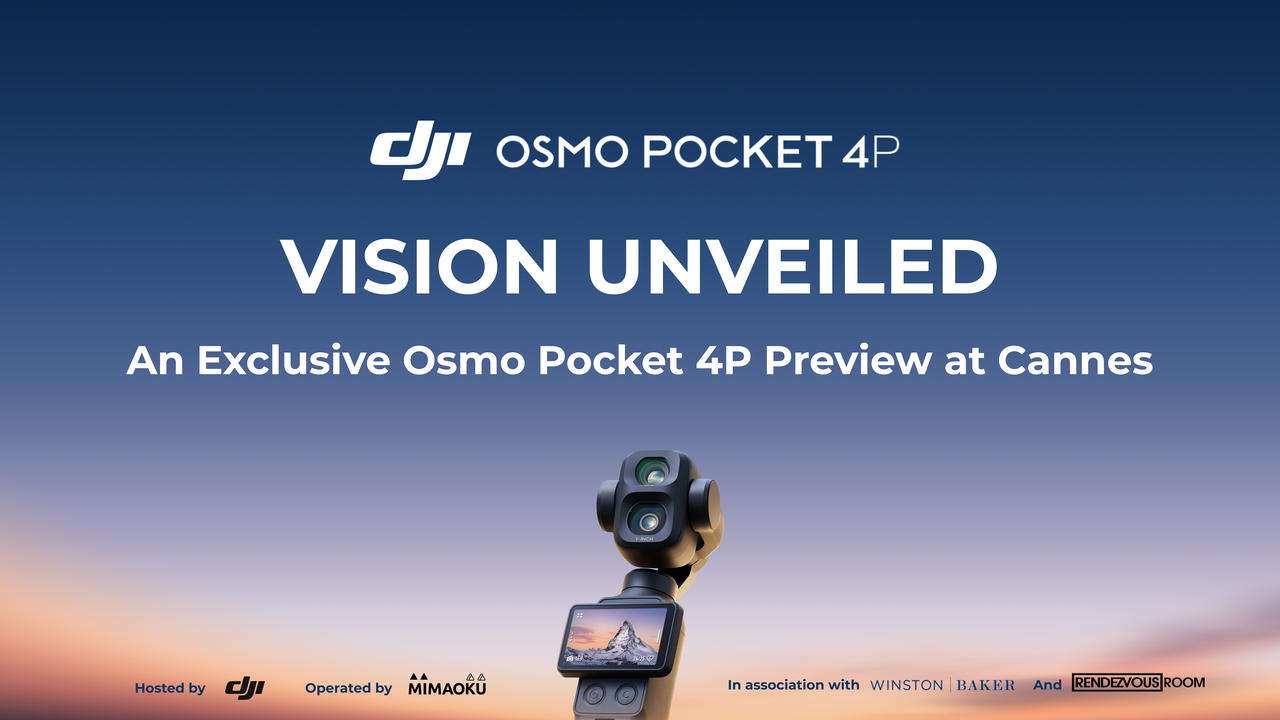
Quick Verdict: DJI revealed the DJI Osmo Pocket 4P at the Cannes Film Festival on May 14, 2026, framing it as a cinema-grade dual-camera pocket gimbal with 10-bit D-Log2 color and a 1-inch primary sensor. Price, release date, and full specs are still unconfirmed. Because DJI sits on the FCC Covered List as of December 22, 2025, the 4P will not ship through US retail at launch. If you want a pocket gimbal today, the Osmo Pocket 3 remains the practical buy.
Last updated: May 2026 | 9 min read
In This Review
- DJI Osmo Pocket 4P Overview: Cannes Reveal at a Glance
- Key Specs at a Glance (Confirmed vs Leaked)
- Cannes Is the Pitch: Why the Venue Is the Real Story
- 10-bit D-Log2 and the Cinema Color Workflow Argument
- Dual Camera, ActiveTrack 7.0, and the Hardware Leaks
- DJI Osmo Pocket 4P vs Pocket 3: Wait or Buy Now?
- The US Availability Problem: FCC Covered List Explained
- Pros and Cons
- Final Verdict
- Frequently Asked Questions
DJI Osmo Pocket 4P Overview: Cannes Reveal at a Glance
DJI did not pick Cannes by accident. On May 14, 2026, day three of the 79th Cannes Film Festival, DJI pulled the curtain off the new dual-camera DJI Osmo Pocket 4P (originally rumored as the DJI Pocket 4 Pro in leak reports) at one of the most loaded venues in global filmmaking. I have shot with the Pocket line since the original launched in 2018, and no prior generation in this series has been introduced with this much cinema-tier theater behind it.
DJI confirmed two things in writing. First, the camera exists. Second, it carries a next-generation imaging system with 10-bit D-Log2 color performance for professional grading workflows. Beyond those points, DJI’s release reads more like a positioning statement than a spec sheet. There are no confirmed resolutions, no frame rates, no aperture range, no battery capacity, no physical measurements, and no release date.
Pricing will follow “at a later date,” in DJI’s own words. By way of reference, the standard DJI Osmo Pocket 4 launched in April 2026 at €499 for the Standard Combo and €619 for the Creator Combo, so most analysts expect the 4P to land above those numbers. The closest fully available product right now is the DJI Osmo Pocket 3, which still sells through Amazon with its 1-inch sensor, 4K/120 capture, and 3-axis mechanical gimbal. For US shooters in particular, the Pocket 3 is the only Pocket-series body with a clear retail path in 2026.
Key Specs at a Glance (Confirmed vs Leaked)

Here is how the Pocket 4P shapes up based on the official Cannes release and credible pre-launch reporting from DroneXL, Android Authority, and Gizmochina. Items marked “Confirmed by DJI” come directly from the May 14, 2026 press release. Anything marked “Leaked” should be treated as expected, not guaranteed.
| Specification | Details |
|---|---|
| Camera arrangement | Dual-camera (Confirmed by DJI). Leaked: 1-inch main + 1/1.5-inch telephoto. |
| Color profile | 10-bit D-Log2 (Confirmed by DJI) |
| Dynamic range | “Cinematic-level” (Confirmed by DJI, no number given). Standard Pocket 4 hits 14 stops. |
| Optical zoom | Leaked: 3x optical via second lens, hybrid range beyond |
| Aperture | Leaked: variable, between F1.7 and F2.8 |
| Subject tracking | Leaked: ActiveTrack 7.0 (same as standard Pocket 4) |
| Display | Leaked: 2.5-inch rotating OLED, 1,000 nits |
| Battery | Leaked: roughly 2,000 mAh (Pocket 4 ships with 1,545 mAh) |
| Price | Announced later. Standard Pocket 4 starts at €499 / £445. |
| Release date | Announced later |
| US availability | Blocked at launch (FCC Covered List as of December 22, 2025) |
Featured on Amazon
Shop the DJI Osmo Pocket 3 While You Wait for the 4P
The Pocket 3 is the only Pocket-series body with a clear US retail path right now. Same 1-inch sensor, 4K/120 video, 3-axis gimbal, ships today.
Cannes Is the Pitch: Why the Venue Is the Real Story

The festival runs May 12 through 23 this year with 22 films competing for the Palme d’Or under jury president Park Chan-wook. By staging the reveal during day three, DJI tied the Pocket 4P to the most prestigious cinema platform on the global calendar. The wording in the release commits to the same repositioning: “a bold evolution of the Pocket series from a creator tool into a cinematic imaging device capable of professional-grade storytelling.”
For perspective, earlier Pocket generations were sold to vloggers and YouTube creators. Specifically, the Pocket 3 launch in October 2023 leaned on hybrid action and vlogging language, not cinema rigging. This time, DJI is pitching documentary filmmakers and visual storytellers. From my chair, the venue choice signals a clear product-tier split. The standard Pocket 4 keeps the creator-camera lane. Cinema sits one tier up with the 4P.
Notably, DJI also leaned on its Ronin pedigree to support the cinema framing. The Academy of Motion Picture Arts and Sciences gave the Ronin 2 team a Scientific and Technical Award on April 29, 2025, and the Television Academy honored the series with an Engineering Emmy in October 2024. Both awards attached to professional Ronin stabilizers used on Mank, Nomadland, The Whale, and Tár. Whether a pocket body inherits the same cinema DNA simply because it carries DJI branding is the question hardware testing will answer.
10-bit D-Log2 and the Cinema Color Workflow Argument
The single most concrete claim in the Pocket 4P release is the move to 10-bit D-Log2. For anyone who has color graded footage in DaVinci Resolve or Premiere, D-Log2 is meaningful. It is the same log curve family DJI uses on its higher-end products, and it captures more highlight and shadow information than the standard D-Log profile.
For comparison, the recently released DJI Osmo Pocket 4 ships with 10-bit D-Log, which is already a significant upgrade over the Pocket 3’s profile. D-Log2 pushes the curve further. In practice, you get a flatter image straight out of camera, which means more headroom for grading skin tones, mixed lighting interiors, and tricky highlight rolloff during golden hour. Documentary shooters in particular tend to live in those exact conditions.
However, log capture is only as good as the workflow you build around it. If you are publishing to social platforms in standard Rec. 709, you might not see the upside compared to a normal profile. On the other hand, if you are intercutting Pocket 4P footage with a Sony FX3 or a Canon C70 on a documentary shoot, matching color grades becomes much easier when both cameras give you 10-bit log files.
Dual Camera, ActiveTrack 7.0, and the Hardware Leaks

DJI confirmed a dual-camera arrangement and stopped there. Pre-launch reporting from DroneXL and Android Authority filled in the rest. According to those leaks, the primary camera uses a 1-inch sensor while the secondary uses a 1/1.5-inch sensor with a roughly 70mm equivalent telephoto lens. The combination would deliver 3x optical zoom natively.
For me, the second lens is the most interesting hardware decision. Specifically, every prior Pocket relied on digital zoom, which softened the image past about 2x. A real telephoto lens on a stabilized gimbal would address one of my biggest frustrations with the Pocket 3 during travel shoots. When I shoot wildlife or street scenes, the inability to get closer without losing detail has been the line where I reach for a mirrorless body instead.
The leaked variable aperture between F1.7 and F2.8 is the upgrade I am most curious about. On the Pocket 3, I have screwed ND filters onto a stabilized gimbal at the start of every bright midday shoot, often losing 30 seconds of framing time per location while my hands fight the housing. A built-in iris between F1.7 and F2.8 collapses that workflow into a settings toggle. ActiveTrack 7.0, also leaked from the standard Pocket 4, would add multi-subject locking on top, which matters when you are filming a moving subject against a busy background.
For the rest of the leaked hardware, expect a 2.5-inch rotating OLED at 1,000 nits and a battery in the 2,000 mAh range. Both upgrade meaningfully over the Pocket 4 for longer-format shooters.
Featured on Amazon
Pocket 3 Creator Combo: Mic, Battery Handle, ND Filters
Add the wireless transmitter, extended battery, and ND set to a Pocket 3 and you cover the workflow gaps pushing me to look at the 4P in the first place.
DJI Osmo Pocket 4P vs Pocket 3: Wait or Buy Now?
If you came here to figure out whether to hold off for the Pocket 4P, here is my read. The Pocket 3 is a known quantity. It ships today through Amazon with a 1-inch sensor, 4K/120 video, and a 3-axis mechanical gimbal. As a result, it remains the most capable stabilized pocket video tool with a clear US retail path right now. Our full DJI Osmo Pocket 3 review walks through the strengths in more detail.
The Pocket 4P promises real upgrades on paper: optical zoom from the second lens, D-Log2 for color grading, a brighter screen, and a larger battery. Conversely, the 4P also brings real unknowns. We do not have a confirmed price, a confirmed release date, or a confirmed feature list. For US shooters specifically, the 4P is blocked at launch through official channels because of the FCC Covered List action covered in our Pocket 4 US availability explainer.
My advice: if you have a paid shoot in the next 60 days and you need pocket gimbal coverage, buy the Pocket 3. If the 4P later ships at a reasonable price through a workable channel, sell the Pocket 3 on the used market or keep it as a B-camera. For personal travel buyers who do not need the camera until late 2026, hold off and watch DJI’s spec drop before committing.
The US Availability Problem: FCC Covered List Explained
The piece of the Pocket 4P story DJI did not address in the press release is also the most important one for US buyers. On December 22, 2025, the FCC added DJI to its Covered List. The 4P’s FCC certification under ID 2ANDR PP041 was filed the same day. Timing here matters: because DJI now sits on the Covered List, its FCC authorization for new consumer hardware is treated as pending rather than approved.
The DJI Osmo Pocket 4 release date arrived globally on April 16, 2026, yet the standard Pocket 4 has not entered American retail for the same reason. Similarly, the DJI Power 1000 Mini, launched in April, also sits in US limbo. Today’s 4P release referenced “DJI’s official channels and authorized retail partners” without naming markets.
For PhotographyTalk readers in the US, this means three practical things. First, do not expect Pocket 4P units at B&H, Adorama, or Amazon Prime through official DJI channels at launch. Second, gray-market import is technically possible but voids your warranty. Third, the Pocket 3 carries valid pre-Covered-List FCC authorization, which is why it still ships freely. As a result, the Pocket 3 is the practical default for US buyers across the entire current DJI Pocket lineup.
Pros and Cons
Pros
- Confirmed dual-camera setup with leaked 3x optical zoom from a secondary lens, addressing the biggest Pocket 3 weakness
- 10-bit D-Log2 color for professional grading workflows, a step beyond D-Log on the Pocket 4
- Cannes-tier positioning gives the device clear cinema lineage support from DJI’s award-winning Ronin team
- Leaked 2.5-inch 1,000-nit rotating OLED improves on the Pocket 4’s 2.0-inch display
- Leaked 2,000 mAh battery, roughly 30% larger than the Pocket 4’s 1,545 mAh cell
- Likely ActiveTrack 7.0 with multi-subject locking and obstruction recovery
- Variable F1.7 to F2.8 aperture would give exposure control without bolting on ND filters
Cons
- No confirmed price, release date, or full spec sheet from DJI on May 14, 2026
- Blocked from US retail at launch because of FCC Covered List action filed December 22, 2025
- Premium positioning likely pushes price above the standard Pocket 4’s €499 starting point
- Two-stage launch structure delays review units, so independent testing is weeks or months out
- Cinema-tier marketing claims will face skeptical hands-on testing once units reach reviewers
- The standard Pocket 4 already covers most creator use cases at a lower price for international buyers
Final Verdict
The DJI Osmo Pocket 4P aims at independent filmmakers, documentary shooters, and solo creators who need pocket portability without giving up cinema-grade color and stabilization. Its biggest strength is the second lens. Real optical zoom on a gimbaled body removes one of the few legitimate complaints about the Pocket 3, and D-Log2 brings the color science in line with DJI’s higher-end products. For someone like me who shoots travel and editorial work, those two changes alone make the 4P a more flexible tool than anything in the Pocket form factor before it.
The trade-offs matter. You are buying into an announcement, not a product, until DJI confirms pricing, the release date, and the full spec sheet. For US shooters, the FCC Covered List action blocks the official retail path entirely at launch. International buyers will pay a premium over the standard Pocket 4.
For value, my best guess: the 4P will land between €700 and €900 for the Standard Combo. The math behind this estimate is simple. Going from Pocket 3 to Pocket 4 added roughly €100 at the Standard Combo tier, and the Pocket 4 to 4P jump adds a second sensor, a brighter screen, a larger battery, and D-Log2. A €200 to €400 premium over the Pocket 4’s €499 is consistent with how DJI prices Pro tiers. Treat this as speculation, not fact. At this price band, the 4P competes with entry-level mirrorless bodies and the Insta360 Luna Ultra.
My recommendation: if you want stabilized pocket video right now, buy the Osmo Pocket 3. It ships through Amazon today and remains the strongest available option for US shooters. For a wider look at how the Pocket 4 series stacks up, see our Pocket 4 leaks and specs roundup and the earlier Pocket 4P dual-camera confirmation coverage.
Featured on Amazon
Ready to Shoot Pocket Video Today?
The DJI Osmo Pocket 3 is the practical pick while the 4P remains a press release. 1-inch sensor, 4K/120, 3-axis stabilization, in stock and shipping through Amazon Prime.
Frequently Asked Questions
When is the Pocket 4P release date?
DJI has not confirmed one. The Cannes press release dated May 14, 2026 says only pricing and configurations will be announced “at a later date.” Compared to the DJI Osmo Pocket 4 release date in April 2026, the 4P timeline remains open. A follow-up spec drop within four to eight weeks is plausible based on prior DJI launches.
How much will the DJI Pocket 4P cost?
Pricing has not been announced. For reference, the standard Osmo Pocket 4 starts at €499 for the Standard Combo and €619 for the Creator Combo. Given the cinema-tier positioning, my expectation is a Standard Combo price between €700 and €900.
Will the DJI Osmo Pocket 4P be sold in the US?
Not at launch through official DJI channels. On December 22, 2025, the FCC added DJI to its Covered List on the same day the 4P’s FCC certification was filed. The standard Pocket 4, also caught by this Covered List action, has not entered US official retail. DJI has not announced a US workaround for either body.
What is the difference between the standard Pocket 4 and the Pocket 4P?
The Pocket 4 uses a single 1-inch sensor with 4K/240 video and 10-bit D-Log. By contrast, the 4P (sometimes called the DJI Pocket 4 Pro in early reporting) adds a second camera leaked as a 1/1.5-inch telephoto, steps up to 10-bit D-Log2, and aims at the cinema tier. Both bodies are expected to share ActiveTrack 7.0 and the rotating OLED interface.
Is the Pocket 4P worth waiting for?
For international buyers who grade footage and need optical zoom, the answer is probably yes once pricing is announced. US buyers should plan differently because the 4P will not ship through official US channels at launch. The Osmo Pocket 3 remains the only Pocket-series body with a clear US retail path in 2026.
Does the DJI Pocket 4P support 10-bit D-Log2?
Yes. DJI confirmed 10-bit D-Log2 color in the Cannes press release on May 14, 2026. This is a step up from the 10-bit D-Log profile on the standard Pocket 4 and aligns the Pocket line with DJI’s higher-end imaging products.

