


Quick Facts:
- Topic: The viral tiger selfie and the safe alternative
- The incident: A US tourist posed with a tiger at Tiger World Thailand in 2026
- The price: More than $200 for the shoulder pose
- The human risk: 379 selfie-related deaths logged worldwide from 2008 to 2021
- The animal cost: Cubs declawed and pulled from their mothers within weeks
- The safe version: A green screen composite or an AI prompt
- Cost of the safe version: Free to a few dollars
- Best for: Travelers and creators who want the shot without the harm
8 min read
In This Article
A Tiger Selfie, a Viral Video, and a Bad Trade
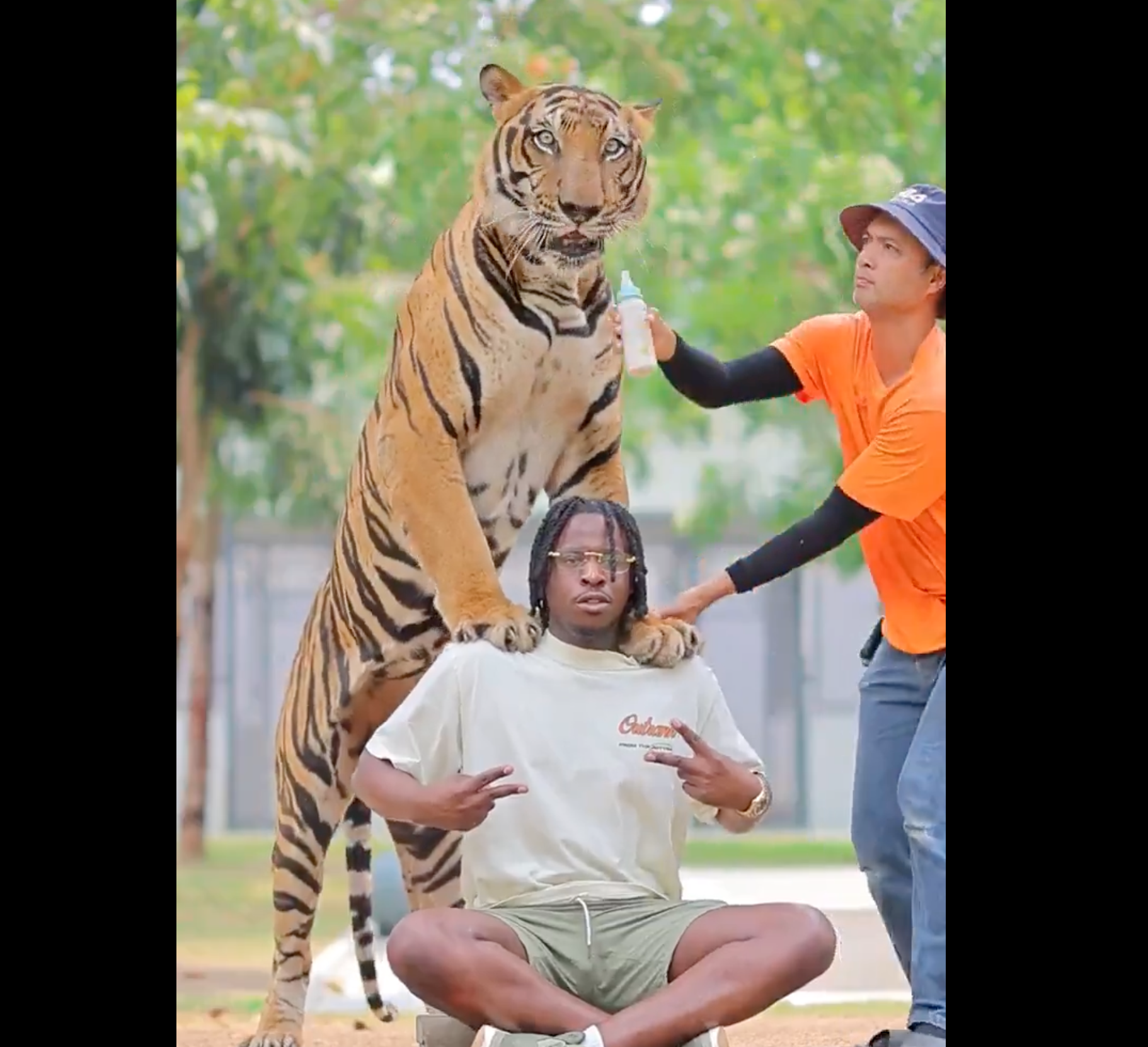
A tiger selfie from Thailand has pulled close to five million views on X, and the footage is hard to watch. An American tourist sits cross-legged on a brick while a full-grown tiger sets its paws on his shoulders. Still, he looks terrified. Meanwhile, zookeepers hover at the edge of the frame, ready with a milk bottle the moment the animal shifts its head. PetaPixel first reported the clip, and it shows the behind-the-scenes side of a paid souvenir photo.
The shoot happened at Tiger World Thailand, a venue about 60 miles from Bangkok. According to the park’s own website, a session like his costs more than $200. The same page also recommends the shoulder pose only for physically strong visitors. Other poses exist, yet the shoulder shot stays the popular pick.
Watch the clip below. The tourist’s face tells the whole story.
Tayland’a giden ABD’li turist, kaplanlarla çekildiği fotoğrafın kamera arkasını paylaştı. pic.twitter.com/DAOyYILU1T
Bulvar Medya (@Bulvarpress) May 20, 2026
The behind-the-scenes clip, posted by Bulvar Medya on X.
Here is the irony. While reading the original report, I kept thinking about our recent coverage of AI images, and about green screens. You want a keepsake photo with a tiger. A green screen or an AI prompt hands you the photo in minutes. No cage, no $200 fee, and no animal in distress. So the real question is short. Why climb in with the tiger at all?
Tiger Selfie Risks at a Glance
Before the AI argument, the numbers deserve a look. Each figure below comes from a primary source, cited later in this article.
| Data Point | Detail |
|---|---|
| Source incident | American tourist, Tiger World Thailand, 2026 |
| Cost of the shoulder pose | More than $200 |
| Selfie-related deaths, 2008 to 2021 | 379 worldwide, across 292 incidents |
| Leading cause of selfie deaths | Falls from height, 49.9% of cases |
| Average age of a victim | 24.4 years |
| Tiger Temple raid finding | 40 dead cubs in a freezer; 147 tigers seized |
| AI image generation time | A few seconds to under a minute |
| Risk of the safe version | None |
Read the bottom row twice. Notably, the AI version carries no risk at all.
The Photos People Die Taking
The tiger selfie sits inside a wider problem. For instance, a 2025 video showed a tourist mauled by a tiger in Thailand during a paid photo session. World Animal Protection flagged the incident. Moreover, people die taking ordinary selfies, far from any predator.
A 2022 study in the Journal of Travel Medicine counted 379 selfie deaths worldwide between 2008 and 2021. Researchers also logged 292 separate incidents. Notably, the toll runs higher than shark-bite deaths across the same years. Specifically, falls from height caused about half of those selfie deaths.
The pattern is consistent. For example, most victims were young, with an average age of 24.4 years. India, the United States, and Russia also recorded the most cases. Finally, the sequence repeats: a person steps past a barrier, turns toward a drop, and frames a shot.
The Cliffs and Waterfalls Behind the Numbers
For instance, the Grand Canyon shows it plainly. Park Service records include repeated cases of visitors falling to their deaths while photographing the rim. In 2019, a man fell roughly 1,000 feet at Eagle Point near the Skywalk while taking photos. A separate fall killed a 59-year-old woman who stepped off the edge while taking photos.
Similarly, waterfalls carry the same danger. In 2021, Hong Kong influencer Sofia Cheung fell to her death while posing for a photo at the edge of a waterfall. During April 2024, two visitors slipped over the Linn of Tummel falls in Scotland while taking pictures. Because wet rock offers no grip, one step backward ends a life.
A cliff-edge selfie sits at the far end of a list of common travel photography mistakes. The fix, however, is not complex. First, keep your feet on stable ground, and use a zoom lens to cover the distance.
What a Tiger Selfie Costs the Tiger
The human risk is only half the story, and the animal pays the rest. Specifically, the Environmental Investigation Agency, an international NGO, advises tourists to avoid any venue offering photos or contact with tigers. Moreover, its researchers say conservation claims behind such venues rarely hold up.
Tiger tourism depends on a steady supply of cubs. Operators separate cubs from their mothers within weeks of birth, then hand-raise them for tourist photos. As a result, early handling makes the animal calm enough for a stranger’s lap.
Operators also declaw many captive cubs. The procedure amputates part of each toe to stop the animal from scratching a paying customer. In addition, World Animal Protection investigators have documented tigers held in small, barren cages. By contrast, a wild tiger covers 10 to 20 miles in a single night.
The history here is grim. For example, in 2016 Thai authorities raided the Tiger Temple and found 40 dead cubs in a freezer. Then officers removed 147 tigers from the site. Still, by 2019 the BBC reported more than half of the rescued animals had died.
So the souvenir photo is not harmless. Instead, the payment flows straight into this supply chain. Behind the smiling photo sits a cub pulled from its mother and an adult worn down by the photo line.
Green Screen It, or Let AI Do It
Think about the last theme park photo you bought. Nobody made you wrestle the dinosaur. You stood in front of a green screen, smiled, and an editor dropped the dinosaur in behind you. Zoos and aquariums, likewise, run the same setup with sharks, gorillas, and big cats. And nobody climbs into the enclosure.
You get the exact same result for a tiger photo. Snap a picture of yourself in the pose you want, against any plain wall or a cheap green sheet. Then drop in a tiger, a shot taken safely from outside the fence, or a licensed stock image. A phone app or free editing software blends the two. If you have ever followed a guide on cutting an object out in Photoshop, you already have the skill. The result looks like you stood next to the tiger, because the framing says so.
Let AI Generate the Whole Thing
AI skips the editing step entirely. An AI image generator builds a photorealistic tiger portrait from a line of text. You type a description, wait 30 to 45 seconds, and a finished frame appears. No flight to Thailand, no fee, and no cage.
Speed is the headline. For example, ChatGPT’s built-in image tool returns a result in well under a minute. Likewise, Midjourney delivers a four-image grid within seconds of a prompt. Some models, such as FLUX, render a frame in under five seconds. A free or low-cost account covers most casual use.
The prompt itself stays short. Here is one example for any major AI image generator:

Adjust the details to taste. For instance, swap the big cat for a snow leopard, or shift the light toward golden hour. The tool answers in seconds, every time. You hold full control, and nothing alive is harmed.
One honest caveat applies to both routes. A green screen composite and an AI image are illustrations, not records of a real moment. For a keepsake or a social post, they work fine. However, passing either one off as a real photograph breaks trust, so label it for what it is.
The Real Tiger Photo vs. the Safe One
Set the two paths side by side. A real tiger selfie costs a flight, a $200 fee, and a few minutes of genuine fear. It also funds an industry built on declawed cubs, and it carries a real mauling risk. The green screen or AI version costs a few dollars and a few minutes. Nobody gets hurt.
So which should you pick? For a photo to post, print, or frame on a shelf, the safe version wins on every count. It is faster, cheaper, and kinder. The staged tiger selfie wins nothing. It runs slower and pricier than a green screen, and it puts your body inside a predator’s reach.
Final Verdict
The viral clip from Tiger World Thailand works as a warning, not a travel tip. After all, a tiger selfie puts a wild predator inches from your throat for a souvenir. The tourist in the video looked terrified because the fear was real.
Step back, and the choice gets clear. A green screen composite or an AI prompt hands you the keepsake in minutes. Either route costs a few dollars, and it beats paying an industry to traumatize a cub.
The math is simple. Specifically, an AI route takes 30 to 45 seconds, costs almost nothing, and harms no one. In contrast, the tiger route needs a long flight, $200, real fear, and a share of the cruelty. Finally, no photograph is worth a fall or a mauling.
Before your next trip, study a few solid travel photography tips. Decide what kind of photographer you want to be. Green screen the shot, or generate it with AI, and label it honestly. Either way, leave the tiger alone.
Frequently Asked Questions
How many people die taking selfies each year?
Counts shift by year, but the scale stays steady. A 2022 study in the Journal of Travel Medicine logged 379 such deaths worldwide between 2008 and 2021. The yearly average sits near 29. Specifically, falls from height drove about half of the total.
Is it illegal to take a tiger selfie?
It depends on the country. In Thailand, venues sell tiger photo sessions openly, so the act is legal there. However, other regions restrict it, and New York banned public contact with big cats at fairs and shows in 2014. Legal or not, the photo still funds tiger tourism built on captive breeding.
How realistic is an AI-generated tiger photo?
Modern tools produce convincing results. A current AI tool renders fur, light, and depth well enough to pass a quick glance. Look closely, though, and small errors show up in paws, whiskers, or background detail. Still, for a social post the quality is more than enough.
Why are tiger selfies bad for the animals?
The photo industry runs on captive breeding. Operators pull cubs from their mothers within weeks, hand-raise them for handling, and often declaw them. Moreover, the Environmental Investigation Agency reports the conservation claims behind these venues rarely hold up. As a result, tiger tourism rewards the practice every time a tourist pays.
What is the safest way to get a tiger photo?
Two options work well. First, photograph yourself in the pose, then composite a tiger behind you with a green screen. Second, generate the whole image with an AI tool. Both deliver the keepsake without fear and without funding cruelty, and both cost almost nothing.

