


Quick Facts:
- Subject: Muybridge’s 1878 galloping-horse study
- Photographer: Eadweard Muybridge (1830 to 1904)
- Commissioned by: Leland Stanford
- Date and place: June 1878, Palo Alto, California
- Method: 12 cameras triggered by tripwires along a track
- Question settled: Whether a galloping horse lifts all four hooves at once
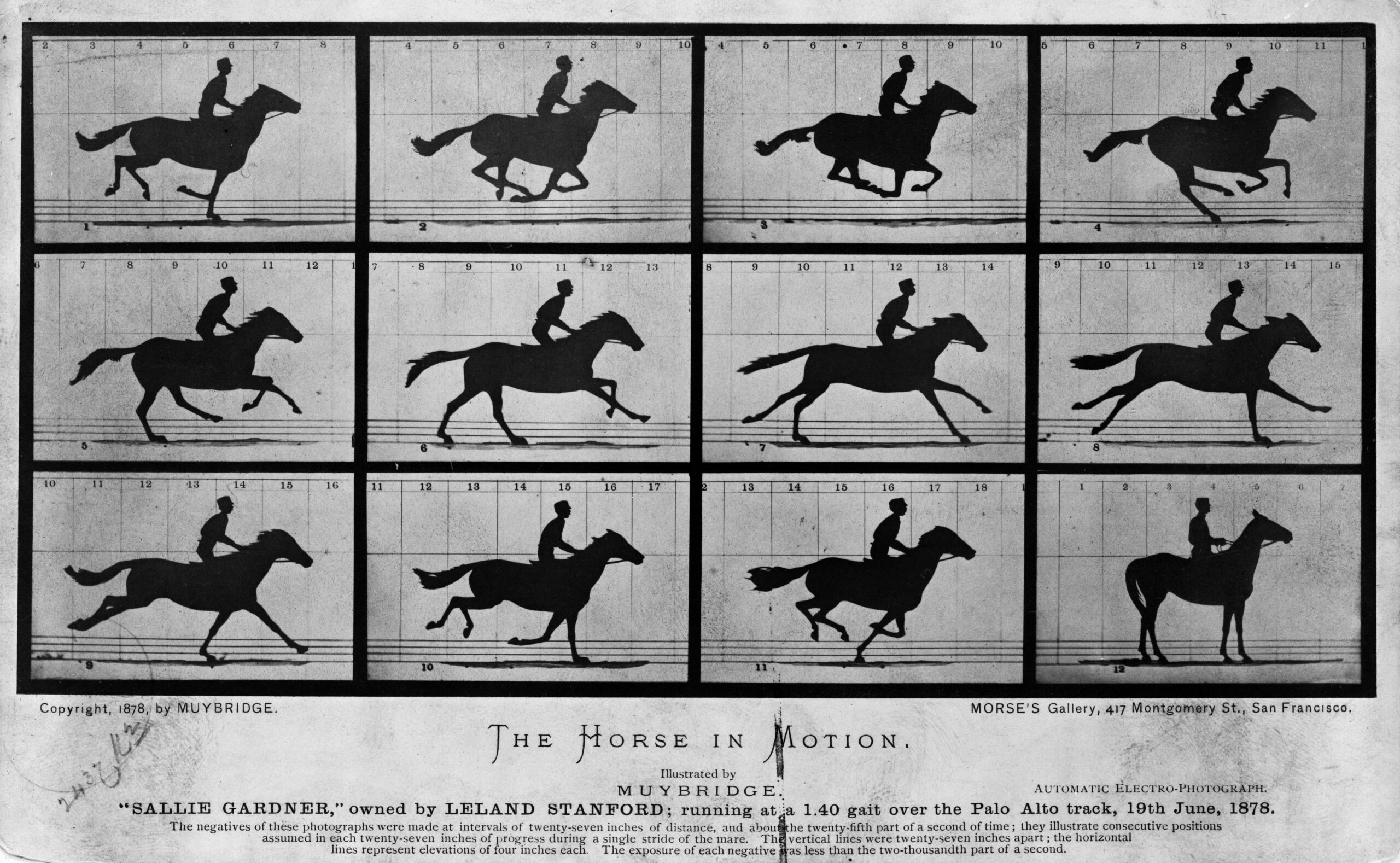
- Famous frame: “Sallie Gardner,” shot June 19, 1878
- Why it matters: A direct ancestor of the motion picture
11 min read
In This Article
- The Horse in Motion: An Overview
- Key Facts at a Glance
- What the Photographs Show
- Who Was Eadweard Muybridge?
- How Muybridge Built the 12-Camera Rig
- The $25,000 Bet: Myth and Fact
- The Murder Trial and the Acquittal
- The Credit Dispute With Leland Stanford
- How The Horse in Motion Led to Cinema
- Frequently Asked Questions
The Horse in Motion: An Overview
The Horse in Motion is a set of photographs from 1878, and they settled a question artists had argued over for centuries. When a horse gallops, does it ever lift all four hooves off the ground at once? Eadweard Muybridge answered it with a row of 12 cameras on a California racetrack. His sequence froze a galloping mare frame by frame, and the result changed both science and art.
If you have ever used a fast shutter speed to freeze a bird or an athlete, you are working in a tradition Muybridge started. He also proved a camera records motion the human eye misses. The photographs carry a darker story too: a murder trial, a bitter credit dispute, and a famous bet most people get wrong. This article covers all of it.
Photography in the 1870s was slow and mostly still. The full history of photography timeline runs from hours-long exposures to the split-second captures Muybridge needed. His galloping-horse study marks the birth of motion photography, the moment the camera learned to freeze fast movement. It pointed straight toward the motion picture.
Key Facts at a Glance
Here are the essentials of The Horse in Motion before the full story.
| Detail | Information |
|---|---|
| Work | The Horse in Motion (also “Sallie Gardner at a Gallop”) |
| Photographer | Eadweard Muybridge (1830 to 1904) |
| Commissioned by | Leland Stanford, railroad magnate and former California governor |
| Date and place | June 1878, Palo Alto, California |
| Method | A battery of 12 cameras fired by tripwires across the track |
| Famous frame | “Sallie Gardner,” running, shot June 19, 1878 |
| Format | Cabinet cards and projected lantern sequences |
| Question settled | Whether all four hooves leave the ground in a gallop |
| Now held by | The Library of Congress and other public collections |
Go deeper
The Full Muybridge Story
The Inventor and the Tycoon by Edward Ball tells the true story of the murder, the money, and the birth of moving pictures.
What the Photographs Show
The Horse in Motion is a sequence, not a single picture. Each card holds a row of frames, and each frame catches the horse a fraction of a second apart. Read left to right, the frames show one full stride broken into stages. The most famous card follows the mare Sallie Gardner at a gallop.
The frames settled the old question. A galloping horse does lift all four hooves off the ground, though not in the pose painters had used for centuries. For generations, artists drew the airborne horse with its legs stretched fully to the front and back. Instead, Muybridge showed the truth: the hooves leave the ground only when the legs fold together beneath the body. Photographers and scientists call this phase the unsupported transit.
Seen in a row, the frames almost move. The horse rises, gathers, extends, and lands across a dozen exposures. Muybridge later printed sequences like these onto glass discs and spun them in front of a light. As a result, the still photographs became, in effect, a short film. Today, the original cabinet cards survive in the Library of Congress and other public collections.
Why the Photographs Stunned Artists
The study embarrassed a lot of fine art. Painters and sculptors had drawn running horses wrong for hundreds of years, and the camera proved it in an afternoon. Some artists welcomed the correction. Others complained the true motion looked stiff and wrong to the eye. The debate over honest motion still runs through sports and wildlife photography, where photographers control shutter speed to freeze motion.
News of the correction also spread well beyond photography. The French painter Ernest Meissonier, famous for his battle scenes, studied Muybridge’s frames and reworked how he painted horses. Edgar Degas used the sequences for his own studies of movement. Still, some critics defended the old stretched-leg pose, arguing it felt faster on canvas. From then on, the camera, not the eye, set the standard for accurate motion.
Who Was Eadweard Muybridge?

Eadweard Muybridge was born Edward James Muggeridge in 1830, in Kingston upon Thames, England. He changed his name more than once. Eventually he settled on Eadweard, an old Anglo-Saxon spelling, and Muybridge to match. At 20 he sailed to the United States and worked as a bookseller.
In 1860, a stagecoach crash in Texas nearly killed him. He suffered a serious head injury and spent years recovering in England. During the recovery, he took up photography and learned the wet-plate collodion process. People who knew him said he returned to America in 1867 a changed man, restless and sharp-tempered.
From Landscapes to Motion Work
First, Muybridge made his name with landscapes. His large photographs of Yosemite Valley sold well, and he became one of the best-known photographers in the American West. By the 1870s, he had the skill and the reputation Leland Stanford needed for a hard technical job.
Muybridge also worked at the leading edge of photography. He photographed the Modoc War, the Pacific coast lighthouses, and San Francisco in huge panoramas. He also held British patents for several photographic inventions, including a sky shade and a clockwork shutter. By 1872, when Stanford approached him, Muybridge was both an artist and an inventor, the rare photographer ready for an experiment no one had solved.
The next years handed Muybridge two hard problems at once. His work in motion photography for Stanford began in 1872, and it demanded years of invention. A personal crisis would interrupt it, yet the technical challenge came first: how to stop a galloping horse on a photographic plate.
How Muybridge Built the 12-Camera Rig
Stopping a galloping horse on film in 1878 was brutally hard. Wet-plate emulsions were slow, and a horse at full speed crosses a lot of ground in a heartbeat. Because of this, Muybridge needed both an extremely short exposure and a way to fire many cameras in sequence.
His answer was a battery of 12 cameras set in a row beside the Palo Alto track. Each camera fired a fast mechanical shutter, the same principle behind how shutter speed freezes action in any camera today. Muybridge stretched threads across the track, and the running horse broke them one after another. Every broken thread tripped an electric circuit and fired the next camera.
Exposures Faster Than the Eye
The exposures had to be staggeringly short. Muybridge drove the shutter speed down to a tiny fraction of a second, fast enough to catch a hoof in mid-air without blur. Period accounts put the quickest 1878 exposures near one-thousandth of a second. The speed was extraordinary, since ordinary photographs of the day still needed several seconds of light.
Muybridge also built a long white backdrop behind the track, so each horse stood out as a sharp silhouette. In addition, he marked the ground with numbered lines to measure the stride. For the running mare Sallie Gardner, the rig produced a clean sequence of one full gallop.
The 1878 success did not come fast. Muybridge and Stanford had worked on the problem since 1872, with crude early results. Better shutters, the electric triggers, and the white backdrop together made the difference. In the end, the rig was less a single camera and more a small machine for sampling time.
The $25,000 Bet: Myth and Fact
Almost every retelling of The Horse in Motion includes a bet. The popular version says Leland Stanford wagered 25,000 dollars on whether a galloping horse goes fully airborne, then hired Muybridge to settle it. It is a great story. Still, the evidence for it is thin.
Historians who have searched the record find no proof of a wager. The photography historian Phillip Prodger, among others, has noted no primary account from the period mentions a 25,000 dollar bet. Stanford was a wealthy horseman with a real scientific interest in how his trotters moved. He did not need a bet to fund the work.
The wager makes sense as a story, because it hands the project a clean motive and a dramatic stake. Real life, however, was messier. Stanford bred and raced trotting horses on a large scale, and sharper knowledge of equine movement carried real commercial value for him. The science, not a barroom bet, paid for the cameras.
The myth also obscures something real. Stanford treated the project as private scientific research and personally covered its considerable cost across six years of work. He wanted reliable knowledge of equine movement, not a headline. The lasting irony is plain: a careful study is still remembered for a wager the record does not support.
The Murder Trial and the Acquittal
In 1874, Muybridge learned his wife Flora was involved with another man, Major Harry Larkyns. The discovery broke him. He traveled to where Larkyns was staying, confronted him, and shot him dead. Afterward, Muybridge made no attempt to deny it.
His murder trial opened in 1875. The defense argued insanity, tied to the head injury from the 1860 stagecoach crash. The jury, however, reached a different verdict. They rejected the insanity argument and instead called the killing justifiable, given the circumstances. Muybridge walked free.
The acquittal stunned even Muybridge’s own defense lawyer, who had pinned his case on the insanity argument. Still, public opinion in 1875 largely sided with Muybridge, treating the killing as the act of a wronged husband. He soon left the country, taking a photography commission in Central America. Flora died in July 1875, only months after the trial, while he was still abroad.
The scandal also stalled the horse project. Stanford had paid for Muybridge’s defense, and the motion work halted through the trial and the long absence. Only after Muybridge returned did the work regain momentum. Three more years of refinement led to the 1878 breakthrough.
For history readers
Read the Whole Saga
National Book Award winner Edward Ball traces Muybridge from a murder trial to the invention of motion pictures.
The Credit Dispute With Leland Stanford
The partnership ended badly. In 1882, Stanford published a book called The Horse in Motion, written by his friend Dr. J. D. B. Stillman. The book used Muybridge’s photographs as the basis for its illustrations. Yet it gave Muybridge almost none of the credit.
The slight cost Muybridge dearly. He had hoped the work would bring him scientific standing, and instead the book handed much of the credit to Stanford. As a result, reviewers treated Stanford as the mind behind the study. Muybridge sued, arguing the photographs and the method were his. A court dismissed the case.
The fight was about more than pride. In the 1880s, scientific reputation decided who received grants, lecture invitations, and a place in the record. Stillman’s book, backed by Stanford’s wealth, threatened to write Muybridge out of his own achievement. He spent years afterward lecturing and publishing under his own name to set the story straight.
History has since corrected the record. Museums, archives, and historians now name Muybridge as the photographer and inventor behind the sequence. Stanford funded the work and pushed for it, yet the photographs and the rig were Muybridge’s. The dispute remains a lasting lesson about who owns a famous image.
How The Horse in Motion Led to Cinema
The Horse in Motion did more than settle a question about hooves. It proved a series of still photographs, played in order, recreates movement. Muybridge saw the potential at once.
Around 1879, Muybridge built the zoopraxiscope. The device printed his sequences onto a glass disc and projected them as the disc spun. An audience then saw a horse trot across a screen years before celluloid film existed. The zoopraxiscope is one of the clearest ancestors of the movie projector.
Muybridge took the zoopraxiscope on the road. He lectured across the United States and Europe, projecting his moving sequences for paying audiences and scientific societies. In Paris, he met the physiologist Étienne-Jules Marey, whose own motion experiments pushed the technology further. Each demonstration made the same point to the public: still photographs, shown fast in sequence, recreate movement.
Muybridge’s Legacy in Film and Beyond
Muybridge kept working. At the University of Pennsylvania in the 1880s, he produced over 100,000 photographs of animals and people in motion. His work fed straight into the experiments of Thomas Edison and the Lumière brothers. Within two decades, the motion picture was a working medium.
The line runs forward to your own camera. Every time you raise the shutter speed to catch a sprinter or a diving hawk, you repeat Muybridge’s basic move. The burst mode in your camera is a pocket-sized version of his 12-camera rig. In short, the skill of freezing motion in modern photography is his direct inheritance.
Before you go
Take the Story Home
The Inventor and the Tycoon is the gripping account of how a galloping horse helped launch cinema.
Frequently Asked Questions
Who was Eadweard Muybridge?
Eadweard Muybridge was an English-born photographer, born in 1830, who worked mostly in the American West. First, he earned fame for landscape photographs of Yosemite. Later, his motion studies of horses and other animals made him a founding figure of motion photography.
Why did Leland Stanford commission The Horse in Motion?
Leland Stanford was a railroad magnate, a former California governor, and a serious horseman. He wanted to understand how his trotting horses moved, partly to train and breed them better. Therefore, he hired Muybridge for the technical skill the project demanded.
How many cameras did Muybridge use to photograph the horse?
Muybridge used a battery of 12 cameras for the famous 1878 series at Palo Alto. The running horse broke threads stretched across the track, and each broken thread fired the next camera. His later projects used larger arrays.
Does a galloping horse lift all four hooves off the ground?
Yes. The photographs proved a galloping horse does go briefly airborne. All four hooves leave the ground only when the legs are folded under the body, not when they are stretched out front and back.
Was there a $25,000 bet between Stanford and Muybridge?
Probably not. The famous 25,000 dollar wager appears in many retellings, but historians find no primary evidence for it. Instead, Stanford funded the work out of genuine interest in equine motion.
Is The Horse in Motion the first motion picture?
Not exactly. It is a set of still photographs, not a film. Still, Muybridge soon projected sequences like it with his zoopraxiscope, which makes the work a direct ancestor of cinema.
As an Amazon Associate, PhotographyTalk earns from qualifying purchases.

