


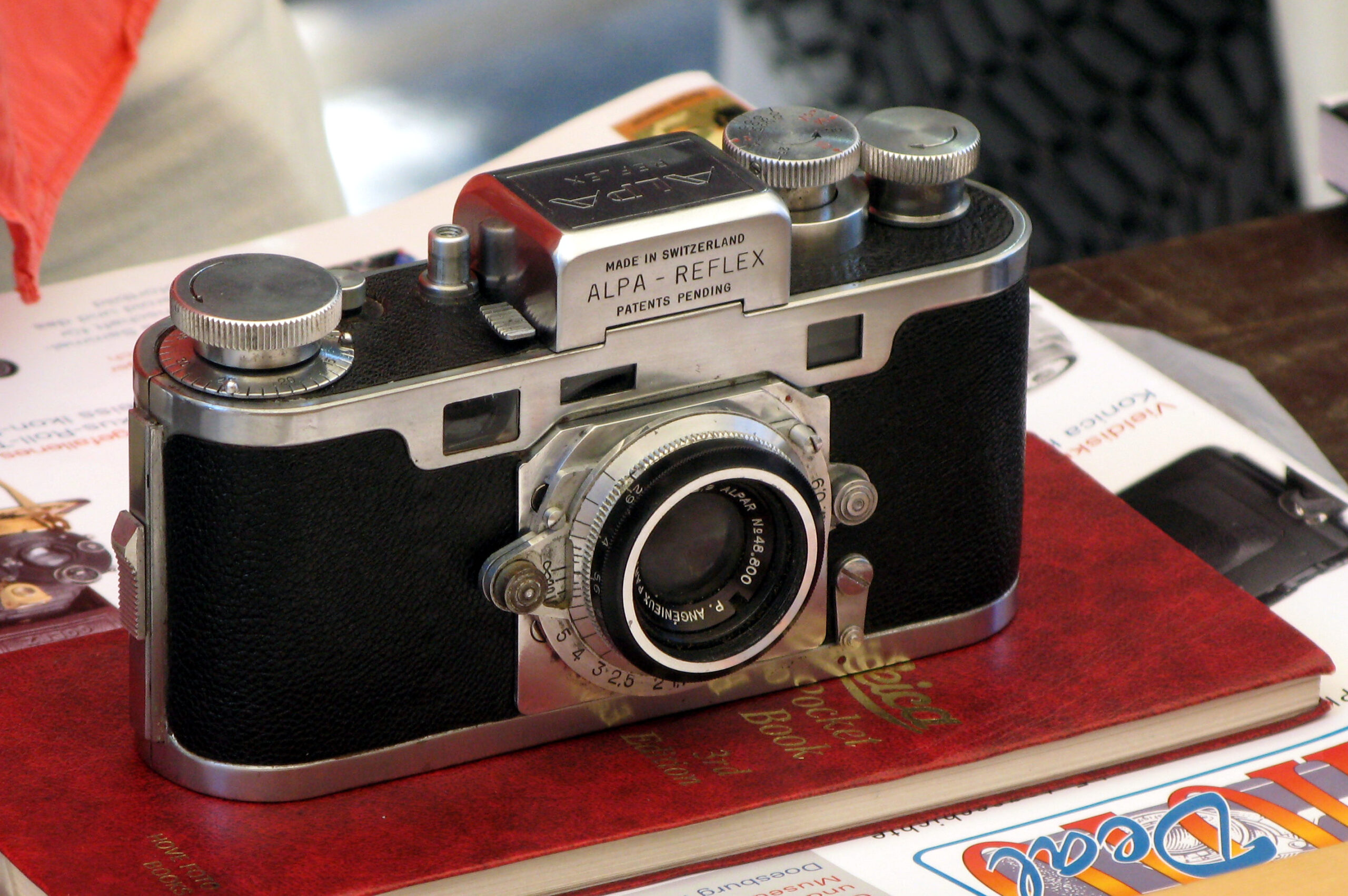
Quick Facts:
- Product: Alpa Reflex Model I
- Introduced: 1944, at the Swiss Industries Fair in Basel
- Type: 35mm SLR with a coupled rangefinder
- Designer: Jacques Bolsey, creator of the original Bolex cine camera
- Maker: Pignons S.A., a Swiss precision and watch firm
- Lenses: Collapsible Angenieux 50mm, later Kern-Switar optics
- Production: Only 571 units built
- Best for: Collectors of rare Swiss cameras and early SLRs
5 min read
In This Article
Alpa Reflex Overview: A Rare Swiss SLR Worth Knowing
The Alpa Reflex is one of the rarest and most inventive 35mm cameras the Swiss ever built. Introduced in 1944, the Model I paired a single-lens reflex viewfinder with a coupled rangefinder in the same body, a combination almost no other camera offered. Because only 571 units left the workshop, most photographers have never seen one in person.
This was a precision instrument first and a consumer product second. A Swiss firm better known for watch parts built it to exacting tolerances, and a brilliant émigré engineer designed it. For collectors of early SLRs and unusual Swiss cameras, few bodies carry this much history in so few surviving examples.
If you study rare gear, this Swiss SLR rewards a closer look. It sits at the crossroads of two camera types, two countries, and one extraordinary career. Among the strangest cameras ever made, this Swiss oddity earns its place on engineering and scarcity alone.
Specs at a Glance
| Specification | Details |
|---|---|
| Model | Alpa Reflex Model I |
| Introduced | 1944 |
| Format | 35mm film |
| Viewfinder | Waist-level reflex plus coupled rangefinder |
| Designer | Jacques Bolsey (Yakov Bogopolsky) |
| Manufacturer | Pignons S.A., Ballaigues, Switzerland |
| Standard lens | Collapsible Angenieux 50mm |
| Production | 571 units |
Why Only 571 Alpa Reflex Cameras Were Made
Production reached only 571 units, a tiny figure even by collector standards. Several forces kept the number low. The camera launched in 1944, while the Second World War still disrupted supply chains and export markets across Europe.
Pignons was also a precision workshop rather than a mass manufacturer. Each body demanded careful hand assembly, so output stayed slow and costs ran high. The Model I therefore served a narrow market of professionals and well-funded enthusiasts.
Today the survivors trade as prized collector pieces. Values depend heavily on condition, matching lenses, and working rangefinder coupling, much like the rest of the vintage film camera values driving the current market. For a body this scarce, a clean, functional example commands a strong premium.
Jacques Bolsey and the Bolex Connection
The mind behind the camera makes the story even better. Born Yakov Bogopolsky in Kyiv, Bolsey trained as an engineer and moved to Switzerland in his youth. Before still cameras, he created the original Bolex, the foundation of one of the most famous cine-camera lines ever made.
Bolsey sold his cine assets to Paillard, which continued the cine line, and then turned to still photography. Working with Pignons, he developed the SLR design later sold under the Alpa name. So the same engineer shaped both a legendary film camera and this rare Swiss SLR.
History then intervened. Bolsey left for the United States in 1939, yet Pignons pressed on with his design through the war years. Because of this persistence, the camera finally reached the public in 1944, carrying ideas from one of the era’s sharpest camera minds.
A Rangefinder and a Reflex Finder in One Body
The defining feature of this camera is its twin viewing system. Most cameras give you either a reflex finder or a rangefinder, yet this one offered both. A waist-level reflex finder let you compose and focus through the lens, while a separate coupled rangefinder sat on the body for fast eye-level focusing.
This dual approach made the camera unusually flexible for 1944. For careful studio or close work, you used the reflex finder and saw exactly what the lens saw. When speed mattered, the rangefinder gave a bright, direct view and rapid focus confirmation.
Few cameras have combined these two systems so directly. The reflex finder gave parallax-free, through-the-lens framing, while the coupled rangefinder locked focus fast for handheld work. This practical pairing is part of why the body still fascinates collectors and historians of 35mm photography history today.
Swiss Precision: Pignons and Kern-Switar Lenses
Pignons S.A. built the camera with the same discipline a watchmaker brings to a movement. Based in Ballaigues, the firm specialized in tiny precision parts, so tight tolerances and fine finishing came naturally. This craftsmanship gave the camera its reputation for quality.
The early Model I usually shipped with a collapsible Angenieux 50mm lens. Later Alpa cameras paired with Kern-Switar optics from another Swiss maker, lenses now regarded as some of the finest of their era. Collectors prize these later Kern-Switar Alpa bodies especially highly.
Subsequent Alpa models also moved to a 45-degree prism finder, which let photographers view a corrected, eye-level image. The Model I therefore marks the starting point of a respected Swiss camera line running for decades.
Where the Alpa Reflex Sits in Early SLR History
The Alpa Reflex was not the first 35mm SLR, yet it ranks among the earliest. The German Kine Exakta reached the market in 1936 and usually takes the title of first 35mm SLR. Even so, the Swiss camera arrived when single-lens reflex design was still young and rare.
What set the Swiss camera apart was its dual-finder approach and its watchmaker build quality. While the Exakta leaned on a waist-level finder alone, the Alpa added the coupled rangefinder for flexibility. For collectors mapping the genre, both bodies belong on any list of the best cameras of all time.
So the Model I matters less as a sales success and more as an inventive early step. It shows how one engineer and one precise workshop pushed the SLR forward when the format was barely a decade old.
Final Verdict
The Model I is a collector’s camera through and through. Its rarity, its dual viewing system, and its link to a legendary cine-camera designer give it a story few cameras will match. For anyone who values early SLR history, it is a genuine landmark.
In practical use, the realistic answer is different. With only 571 made, surviving bodies are scarce, costly, and too valuable to treat as everyday tools. So most people will admire the Model I rather than load film into one.
Still, the camera rewards study. It captures a moment when Swiss precision, wartime constraint, and one engineer’s vision met in a single rare body. If the lineage draws you toward shooting a classic instead, our guide to the best 35mm film cameras points to far more accessible options.
Frequently Asked Questions
What is the Alpa Reflex Model I?
The Alpa Reflex Model I is a rare Swiss 35mm SLR introduced in 1944. It paired a waist-level reflex finder with a coupled rangefinder, and only 571 units were built.
Who designed the Alpa Reflex?
Jacques Bolsey, born Yakov Bogopolsky, designed the camera. He also created the original Bolex cine camera before working with Pignons on the Alpa SLR.
How many were made?
Records put production at only 571 units. This small number, combined with its unusual dual finder, makes the Model I one of the most collectible early Swiss cameras.
Was the Alpa Reflex the first 35mm SLR?
No. The German Kine Exakta of 1936 usually holds the title. Among the earliest 35mm SLRs, though, the Model I stood out for adding a coupled rangefinder.
Who built Alpa cameras?
Pignons S.A., a precision firm in Ballaigues, Switzerland, manufactured Alpa cameras. The company brought watchmaking-grade tolerances to camera production.
What lenses did it use?
The Model I shipped with a collapsible Angenieux 50mm lens. Later Alpa cameras used prized Kern-Switar optics, which collectors regard as some of the best lenses of the period.

