


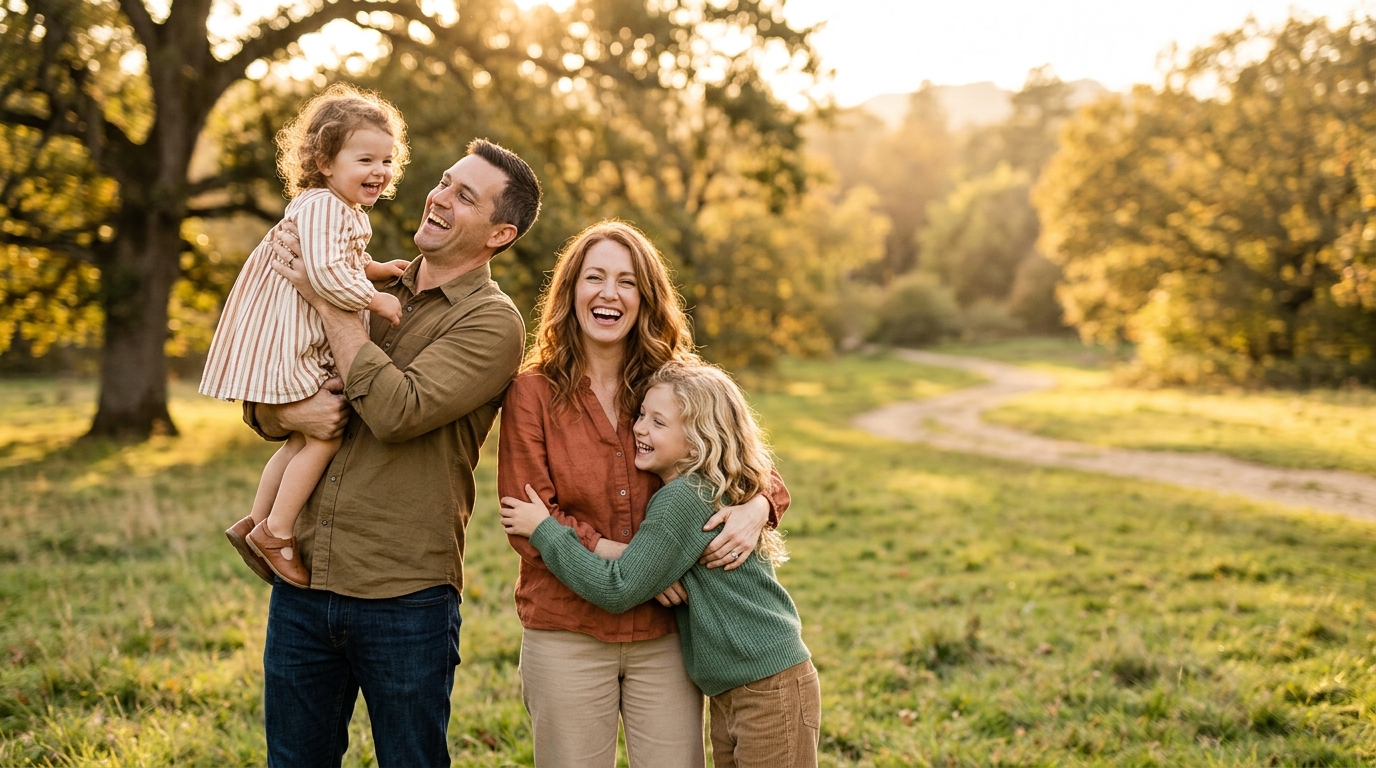
Quick Facts:
- Genre: Family photography
- Best light: Golden hour or open shade, never harsh midday sun
- Group settings: f/5.6 to f/8, ISO 200 to 800, shutter 1/200s or faster
- Lens: A 35mm or 50mm for groups, an 85mm for individual portraits
- Focus: Continuous autofocus for moving kids
- Approach: A mix of relaxed poses and candid moments
- Skill level: Beginner to advanced
- Best for: Sessions with parents, kids, and extended family
10 min read
In This Guide
- What It Takes to Get Natural Photos
- Family Photography Settings at a Glance
- Gear and Lens
- Camera Settings for Family Portraits
- Light and Time of Day
- Posing vs. Candid
- Locations and Backgrounds
- What to Wear for Family Photos
- Working With Kids
- Directing the Group
- Editing Family Photos
- Common Mistakes
- Printing and Displaying Your Photos
- Final Verdict
- Frequently Asked Questions
Family Photography: What It Takes to Get Natural Photos
Family photography sounds simple until you have five people, two toddlers, and fifteen minutes of good light. The best results rarely come from stiff, forced poses. They come from real connection: a shared laugh, a parent lifting a child, a quiet moment between siblings. Your job is to set the scene, then catch those moments as they happen.
The genre blends a few skills. You need the technical control to keep a group sharp, the people skills to relax your subjects, and the timing to press the shutter at the right second. None of it requires expensive gear, though, since light and rapport matter far more than the camera body.
This guide covers the gear, the settings, the light, and the posing behind relaxed family photos. You will also learn how to work with restless kids, direct a group, edit for consistent color, and turn a favorite frame into wall art. Whether you shoot your own family or a client, the same fundamentals of portrait photography apply.
Family Photography Settings at a Glance
Here is a quick reference to start from. Treat these as a baseline, then adjust for the group size, the light, and the look you want.
| Scenario | Starting Settings |
|---|---|
| Whole group sharp | f/5.6 to f/8, ISO 200 to 800, 1/200s or faster |
| Two or three people | f/2.8 to f/4 for soft background separation |
| Single portrait | f/1.8 to f/2.8, 85mm lens |
| Active kids | Shutter 1/500s, continuous autofocus, burst |
| Lens | 35mm or 50mm for groups, 85mm for portraits |
| Light | Golden hour, open shade, or window light |
| File format | RAW |
Print your family photos
Family Photos Belong on the Wall
Pictorem prints your favorite family shots on gallery canvas, framed prints, metal, or acrylic, in custom sizes with free US and Canada shipping.
Gear and Lens for Family Photography

You need less gear than you might think. Any camera with manual control and reliable autofocus handles a family session, so the lens matters more than the body. A 35mm or 50mm lens fits a whole group with a little environment, which makes either one the most useful choice. For tighter individual portraits, an 85mm flatters faces and softens the background.
A fast aperture helps in low light and separates your subjects from a busy scene. A prime lens at f/1.8 gathers plenty of light, while a 24-70mm zoom trades a little speed for flexibility across a moving group. Bring a spare battery and a couple of memory cards, since a lively session fills a card fast. For help matching focal length to the scene, our guide on understanding camera lenses breaks it down. A lens hood tames flare in backlit scenes, and a simple reflector bounces soft natural light back into shaded faces.
Camera Settings for Family Portraits
Group sharpness is the first priority. When several people stand at slightly different distances, a wide aperture leaves someone soft, so set f/5.6 to f/8 to keep the whole row in focus. For a single subject or a close pair, open up to f/2.8 for a gentle, blurred background. Our primer on controlling depth of field shows how aperture shapes the look.
Movement is the second priority. Kids rarely hold still, so keep the shutter at 1/200 second or faster, and push to 1/500 when they run. Set continuous autofocus with a wide focus area, and fire short bursts to catch the peak expression. Raise ISO as needed to protect the shutter speed, since a little noise beats a blurry face. Shoot RAW for full control over color later. Back-button focus helps here, since it separates focus from the shutter and keeps a moving child sharp between frames.
Light and Time of Day
Soft, natural light flatters families more than anything else. Golden hour, the window after sunrise and before sunset, wraps everyone in warm, gentle light with no harsh shadows. Overcast days work well too, since clouds spread even light across every face. Avoid harsh midday sun, which casts hard shadows and makes people squint.
Open shade is your friend when the sun is high. Move the family under a tree, a porch, or the shaded side of a building, and the light turns soft and even. Indoors, place them near a large window and turn off the overhead bulbs, since mixed light muddies skin tones. Backlight adds a lovely rim glow when you expose for the faces. A sheer white curtain over a bright window turns hard sun into soft, even natural light for indoor portraits.
Posing vs. Candid

The strongest family photos mix structure with spontaneity. Start with a loose base pose to organize the group, then prompt an action to bring it to life. Ask everyone to walk toward you, tickle the youngest, or share a secret, and real smiles replace stiff ones. These unposed beats give a gallery its heart. Between prompts, keep shooting, since the settle right after a laugh often holds the best expression.
Connection reads better than any formal pose. Have people touch, lean in, or look at each other rather than lining up like a team photo. Vary the head heights so the group forms a pleasing shape instead of a flat row. A stool or a low wall gives you an easy way to stack heights when the group is large. For more on relaxing your subjects, see our tips on how to capture authentic expressions, which apply directly to a family.
Locations and Backgrounds
A clean, meaningful location does half the work. A cluttered park bench or a busy street pulls the eye away from the family, so scout for simple backgrounds with room to move. Parks, beaches, tree-lined paths, and open fields all give a group space and soft color.
Home is an underrated choice. A lifestyle session in the living room or backyard captures a family in its own world, with familiar comforts to relax everyone. Pick a spot with good window light and tidy the frame before you shoot. For a deeper look at matching place to mood, our guide to choosing a portrait location helps you plan.
What to Wear for Family Photos
Clothing shapes a family portrait more than most people expect. The goal is to coordinate, not match, so pick a simple palette of two or three colors and let everyone pull from it. Matching outfits look dated, while a coordinated mix feels relaxed and current. Soft, mid-tone colors keep the focus on faces.
Texture and layers add depth without shouting. A knit sweater, a denim jacket, or a light scarf gives an outfit shape in a photo, where a flat solid falls dull. Avoid large logos, neon shades, and busy patterns, since they pull the eye away from expressions. One patterned piece per group is plenty.
Dress for the place and the season. Earth tones suit a park or a beach, while richer colors work well indoors in fall and winter. Comfortable shoes keep kids happy, and a spare outfit saves a session after a spill. Lay everything out the night before to avoid a rushed morning.
Working With Kids
Kids set the pace of a family session, so plan around them. Get down to their eye level, since shooting from above shrinks them and loses the connection. Keep the session short, because attention fades fast, and shoot the group early while everyone is fresh.
Turn direction into a game. Ask kids to jump, spin, whisper a joke, or run to a parent, and the energy turns real. Bribes of a snack or a sticker work when patience runs thin, and a silly noise often earns a genuine laugh. For a full set of age-specific tricks, our tips for photographing kids go deeper on the topic. Give the kids a job, like holding a prop or leading the walk, and their focus turns from the camera to the task.
Directing the Group

A group needs a clear, calm leader, so speak with simple directions and a friendly tone. Stagger heights to build a natural triangle, and fill the gaps so no one floats alone at the edge. Confirm every face is visible and no one hides behind another shoulder. Count down out loud before the burst so everyone knows the moment to look and smile.
Groups blink, so shoot more than you think you need. Fire a short burst of each arrangement, since one frame in the set almost always has everyone with open eyes and a real smile. Watch the edges for a stray hand or a distracting background element. A quick scan before each burst saves hours of cleanup later. Ask the family to hold the smile for a beat after the joke, since the second laugh often looks more relaxed than the first.
Editing Family Photos
Good editing keeps a family gallery natural and consistent. Start by setting an accurate white balance, then match the color and exposure across the set so the images feel like one session. Keep skin tones warm and true rather than pushing heavy filters, which date fast. Build a simple preset from your best frame and apply it across the set, so the whole gallery shares one consistent look.
Retouch with a light hand. Remove a stray hair or a temporary blemish, but leave the freckles, laugh lines, and features making each person themselves. Cull hard first, keeping only the frames with the best light and expression, since a tight edit of strong images beats a bloated gallery. Export at full resolution when you plan to print.
Common Family Photography Mistakes
A few habits hold back otherwise sweet frames. The most common is harsh midday sun, which creates hard shadows and squinting. Move the family into open shade or wait for softer natural light instead. A close second is too wide an aperture on a group, which leaves the back row soft. Stop down to f/5.6 or f/8 so everyone stays sharp.
Shooting kids from standing height is another miss, since it looks down on them and breaks the connection. Crouch to their level for a warmer, truer frame. Over-posing hurts too, because stiff, matching lines drain the life from a group. Prompt movement, then let real moments surface between the setups.
Finally, do not skip the cull and edit. Blinks, stray hands, and mixed color slip through when you rush, so scan each frame and keep only the best. A careful pass protects the natural feel behind good family photography.
Printing and Displaying Your Photos

A family photo earns its value on the wall, not on a phone. A printed portrait becomes part of the home, a daily reminder of the people in it, and it lasts far longer than a file on a drive. The medium you choose sets the mood, so match it to your image and your space.
Canvas suits family portraits especially well, since its soft, matte surface reads warm and timeless in a living room or hallway. A framed print adds a classic, finished look, while metal and acrylic give a modern, glossy pop for a bold color image. Pictorem prints all of these, and its gallery canvas uses a heavyweight fine-art fabric built to hold its color for decades. Framed prints suit a gallery wall of smaller family photos, while a single large canvas makes a bold centerpiece.
Plan the size for the space. A large canvas anchors a wall above a sofa, while a cluster of smaller frames tells a story down a hallway. Pictorem even lets you upload a photo and preview the print on your own wall at any size, which removes the guesswork before you order. A framed family portrait also makes a lasting keepsake gift for grandparents.
Final Verdict
Strong family photography rewards connection more than gear. Set soft light, keep the group sharp, and prompt real interaction, and an ordinary afternoon turns into portraits a family keeps for years. Start with the settings and light, then focus your energy on the people in front of the lens.
Patience and timing carry the day. Work fast while the kids are fresh, shoot plenty of frames of each group, and watch for the small, honest moments between the posed shots. Those in-between frames often become the favorites.
Once you capture a portrait the whole family loves, give it a place in the home. A printed family portrait on canvas or in a frame turns a single session into lasting wall art. Plan your light, pick a simple location, and shoot both relaxed poses and candid play.
Ready to print?
Turn Your Best Family Portrait Into Wall Art
Order gallery-wrapped canvas, framed prints, or HD metal from Pictorem, and preview your print on your own wall before you buy.
Frequently Asked Questions
What camera settings are best for family photography?
For a whole group, use f/5.6 to f/8 so everyone stays sharp, with ISO 200 to 800 and a shutter of 1/200 second or faster. For one or two people, open to f/2.8 for a soft background. Use continuous autofocus for kids, and shoot RAW.
What lens is best for family portraits?
A 35mm or 50mm lens fits a whole group with some surroundings, which makes it the most versatile choice. An 85mm flatters individual faces and blurs the background. A 24-70mm zoom covers both ends when you need to move fast between group and single shots.
How do you pose a family for photos?
Start with a loose base arrangement, then prompt an action like a group hug or a walk toward the camera. Stagger head heights, have people touch or lean in, and aim for connection over a stiff line. Prompted action produces the most natural expressions.
What should a family wear for photos?
Choose coordinated, not matching, outfits in a simple palette of two or three colors. Avoid loud logos and busy patterns, which pull focus from faces. Soft, mid-tone colors and layers photograph well and keep the eye on the family rather than the clothes.
How do you photograph kids who will not sit still?
Work with the energy instead of against it. Raise the shutter to 1/500 second, use continuous autofocus, and turn directions into a game. Keep the session short and shoot the group early. Our tips for photographing kids cover more age-specific tricks.

