


Quick Facts:
- Product: I’m Back Roll APS-C digital film cartridge.
- Sensor: Sony IMX571 APS-C CMOS, 26.1MP.
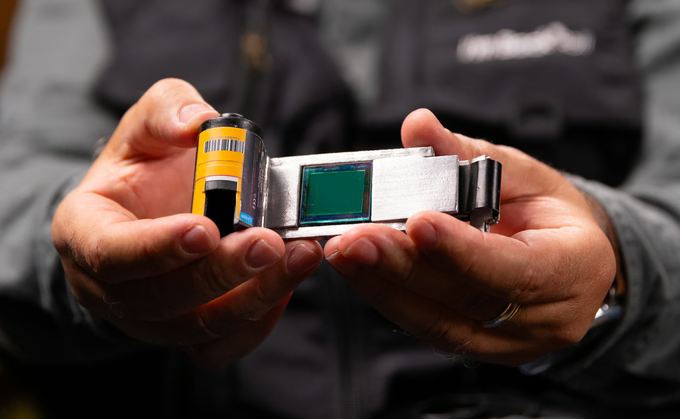
- Cartridge size: 75 x 35 x 7 mm, no external screen.
- Storage: 64GB, 128GB, or 256GB internal.
- Files: RAW, JPEG, and 4K video. ISO 100 to 6400.
- Connectivity: Wi-Fi and Bluetooth, smartphone app pairing.
- Kickstarter price: CHF 359 super early bird. CHF 439 standard 64GB tier.
- Delivery target: December 2027 per campaign FAQ.
- Best for: Film SLR owners who want digital capture without giving up their old body.
9 min read
In This Article
I’m Back Roll APS-C Overview
Film photography never died. However, the gap between shooting a 1970s SLR and seeing a usable digital file has stayed wide for forty years. Swiss startup I’m Back GmbH, the team behind the I’m Back Film module, has now closed the gap. Their newest product, the I’m Back Roll APS-C, has raised $1,049,283 from 1,721 backers on Kickstarter, sitting 2,338 percent above its $44,878 goal. The Kickstarter campaign closes Friday, May 15, with less than two days left for backers.
The pitch is exactly what film shooters have been asking about since digital arrived. Specifically, the cartridge drops a Sony IMX571 APS-C sensor where your film used to sit. After installation, your Canon AE-1, Pentax K1000, or Nikon FM keeps everything else it already has. The optical viewfinder, the mechanical shutter, and your favorite manual lens all remain in play.
For PhotographyTalk readers who shoot film, this matters because the product respects the original camera body. Instead of replacing your gear, the I’m Back Roll leans on the parts your SLR already does well. Consequently, the result is a hybrid built to keep the analog feel. The cartridge delivers 26.1-megapixel RAW files at the end of the session.
One author on our team owns a Canon AE-1 from the mid-1970s. A roll of Portra 400 plus processing and a flat scan runs roughly $30 per 36 frames. Over a year of casual shooting, the math gets ugly fast. The I’m Back Roll is the most ambitious digital back for film camera bodies the company has announced. Moreover, when a small Swiss team beats its Kickstarter goal by more than twenty times in a single campaign, the industry pays attention.

Key Specs at a Glance
Every spec below comes from the official Kickstarter campaign page and the I’m Back product documentation.
| Specification | Details |
|---|---|
| Sensor | Sony IMX571 APS-C CMOS, 26.1MP |
| Cartridge dimensions | 75 x 35 x 7 mm |
| Storage options | 64GB, 128GB, or 256GB internal (no SD card) |
| File formats | RAW, JPEG, 4K video |
| ISO range | 100 to 6400 |
| Connectivity | Wi-Fi, Bluetooth, smartphone app sync |
| Battery | Custom internal battery (one spare included via stretch goal) |
| Display | None on cartridge; optional add-on viewfinder |
| Trigger | External remote control puck or dedicated sync button |
| Warranty | 3 years (unlocked via $800k stretch goal) |
| Kickstarter pledge | From CHF 359 (super early bird) to CHF 798 (256GB) |
| Estimated delivery | August to December 2027 |
Need a Donor Body First
Find a Vintage 35mm SLR on MPB
The I’m Back Roll needs a film SLR to live in. MPB grades every used body. Every order ships with a six-month warranty.
How the I’m Back Roll Works

The hardware reads like science fiction until you see it apart. Inside the 75 x 35 x 7 mm cartridge sits a Sony IMX571 APS-C sensor. Around it sit internal flash memory, Wi-Fi and Bluetooth radios, plus a custom battery. The shape mimics a 35mm film canister. As a result, the cartridge slides into the film chamber on most SLRs without modification.
Installing the I’m Back Roll takes five steps per the campaign FAQ. First, you remove the pressure plate from the film door. Next, you insert the cartridge into the chamber. Then you mount the remote control puck or sync button to the camera body. Next, you close the back door. Finally, you start shooting.
The remote puck handles the timing problem. Because your SLR uses a mechanical shutter, the digital sensor needs a signal telling it when to expose. Therefore, the puck either bolts onto a hot shoe or uses a dedicated sync button. Whichever method you pick, the sensor fires the instant the host shutter opens.
Image transfer happens over Wi-Fi and Bluetooth to a smartphone app. While shooting, the wireless radios stay quiet to preserve battery. Later at home, you pair the cartridge to your phone. Then the images move across as RAW and JPEG files. Additionally, the device records 4K video, though video on a manual SLR is its own conversation.
From I’m Back Film to the Roll APS-C
The original I’m Back Film launched as the company’s calling card. It used a 20-megapixel sensor in a bulkier external module. The I’m Back Film shipped to photographers worldwide and proved the concept worked. However, early reviewers noted the bulk and the fiddly external bracket.
The Roll APS-C addresses both criticisms head-on. For one, the sensor jumps from 20MP to 26.1MP. Additionally, the form factor shrinks to a true film-canister shape living inside the camera body. Moreover, the new model adds Wi-Fi, Bluetooth, and a smartphone app, plus internal storage up to 256GB. The I’m Back Film required a converter tool to turn proprietary files into DNG. Similarly, the Roll likely uses the same workflow per the company’s published documentation.
One detail underscores how far the team has come. I’m Back GmbH was founded in 2018 by Samuel Mello Medeiros and Filippo Nishino in Lugano, Switzerland. The company won the Cinema5D Photokina award and placed second in the Boldbrain Startup competition the same year. Since then, I’m Back has shipped multiple iterations. Those include the I’m Back Film module, the I’m Back MF medium format back, and the Yashica-branded MiMi micro-mirrorless. The Roll APS-C is the cleanest expression of the digital back for film camera concept yet.
Compatible Film Cameras
Compatibility is broader than most digital back products. The Kickstarter campaign lists Canon AE-1, A-1, AT-1, F-1, and EOS-series film bodies. Nikon support spans the F, F2, F3, F4, F5, F6, FM, FM2, FE, FE2, F70, F80, F90, and F100. Pentax compatibility includes the K1000, LX, ME Super, and Spotmatic. Olympus shooters get the OM-1 through OM-4. Meanwhile, Minolta X-700 and X-500 owners qualify too.
Leica, Contax, and Yashica film bodies also work. Specifically, Leica M-series and R-series cameras, Contax 139 and RTS, plus Yashica FX bodies appear on the compatibility list. The full extended list from the predecessor I’m Back Film names more than 250 models. Those include Konica Autoreflex, Ricoh KR, Praktica BX, Zenit E and TTL, and several Voigtländer Bessaflex bodies.
Four cameras need a 3D-printed back door instead of the standard install. Those four are the Alpa Reflex 6, Alpa Reflex 7, Contax II, and the original Nikon F. Owners of those bodies pay extra for the printed door. Additionally, they lose the drop-in convenience the other 250 models enjoy.
If you are shopping for a donor body, check our list of best 35mm film cameras for a curated set of vintage SLRs. Each option pairs well with the Roll cartridge. Additionally, review what to check on a used camera before you commit. After all, forty-year-old foam seals and shutter timing affect image quality.
Shooting Experience: One Roll, No Screen
The company tagline reads “One Roll, No Screen, Pure Shooting,” and the experience matches. There is no rear LCD. There is no chimping between frames. Once you load the cartridge, you shoot through a full session blind. Specifically, you see no images until later, exactly as you would with a roll of Portra 400.
Why no screen? The design choice is intentional. According to the campaign page, the team built the device for photographers who miss the slow pace of analog work. Specifically, the absence of a screen forces you to compose carefully. After composing, you trust the meter, and you move on. Moreover, battery life stays workable because the radios and any display drain are eliminated during the shoot.
An optional add-on viewfinder is mentioned in the campaign materials, though pricing for the accessory has not been published. The host camera’s optical viewfinder remains your primary framing tool. Although the APS-C sensor crops the image inside the larger 35mm frame, your viewfinder still shows the full 35mm coverage. Consequently, you frame loose and crop in post, or you mentally subtract the edges as you shoot.
After the session, Wi-Fi and Bluetooth bring the files into a smartphone app. The app name has not been published for the Roll APS-C specifically. However, the company runs a unified “app imback” platform documented on their site. The transfer flow mirrors how Fujifilm and Sony handle wireless image dumps. As a result, the learning curve should stay flat for photographers used to phone-paired workflows.
Save on a Donor Camera
Used Canon AE-1 Bodies on MPB
Skip eBay risk. MPB inspects every used Canon AE-1, grades cosmetic and mechanical condition, and backs every body with a six-month warranty and a 14-day return window.
I’m Back Roll vs. Native APS-C Mirrorless
The honest comparison stings if you only weigh specs. A current Fujifilm X-T5 used on MPB gives you 40 megapixels, 7-stop in-body stabilization, autofocus, and a screen. The price lands in a similar range as the I’m Back Roll 256GB tier. Therefore, on pure imaging output per dollar, native mirrorless wins every measurable category.
However, the comparison misses why anyone backs the I’m Back Roll. The device is not competing on autofocus or image stabilization. Instead, it sells a shooting experience. The deliberate, manual, screenless workflow pulls film shooters back to their old gear. The X-T5 weighs 557 grams. A Canon AE-1 with the I’m Back Roll inside weighs roughly the same as the AE-1 alone, around 590 grams.
For readers who already own a working SLR and a small kit of manual lenses, the math changes. Moreover, those manual lenses already paid for themselves over decades. Adding the I’m Back Roll digital film cartridge gives the existing kit a second life as a digital tool. Additionally, the cartridge moves between bodies, so one purchase covers your AE-1, your Pentax K1000, and your Olympus OM-1.
For readers who do not yet own a film camera, the X-T5 route makes more sense most days. Browse our roundup of the best mirrorless cameras for beginners if you are starting from zero and want digital convenience.
Pros and Cons
Pros
- 26.1MP Sony IMX571 sensor delivers genuine APS-C image quality.
- Fits more than 250 named film SLR models without modification.
- True film-canister form factor, only 75 x 35 x 7 mm.
- RAW, JPEG, and 4K video output with ISO 100 to 6400.
- Wi-Fi and Bluetooth wireless transfer via smartphone app.
- Three-year warranty unlocked through Kickstarter stretch goal.
- One spare battery included for every backer.
- Internal storage up to 256GB on the top tier.
Cons
- No external screen means zero in-the-field image review.
- External remote puck adds a piece of gear to manage.
- APS-C crop changes the field of view of every lens.
- Estimated delivery target sits at December 2027.
- No microSD slot, only fixed internal storage.
- Battery life is intentionally limited per the campaign page.
Final Verdict
The I’m Back Roll APS-C is the most thoughtful digital film cartridge anyone has announced. For PhotographyTalk readers who keep a Canon AE-1 or a Pentax K1000 on the shelf, the proposition is hard to argue with. The cartridge gives the old body a 26.1-megapixel digital second act without changing how the camera feels in the hand.
The trade-offs are honest and well-documented. There is no rear screen, the APS-C sensor crops your favorite lenses, and you wait until late 2027 for delivery. Backers also bet on a small Swiss company hitting an ambitious production deadline. However, the team’s track record with the I’m Back Film makes the bet less speculative than most Kickstarter pledges.
Value depends on what you already own. If your shelf already holds a working film SLR and a roll of manual lenses, the CHF 359 to CHF 439 entry price pays back fast. Specifically, it offsets the cost of film, processing, and scanning over a year of shooting. Conversely, if you are starting fresh, a modern Fujifilm or Sony APS-C mirrorless body delivers more capability per dollar. For comparison context on hybrid film-feel digital products, see our coverage of the Rewindpix digital film compact. Notably, it raised $900,000 on a similar premise.
Our recommendation is straightforward. Film shooters already invested in a 35mm SLR system should back the I’m Back Roll while early-bird pricing lasts. Photographers who want digital capture without the analog body should buy used through MPB instead.
Ready to Build the Kit
Find Your Donor Film SLR on MPB Today
The Roll fits over 250 SLR bodies. Source one through MPB, with grading, warranty, and free shipping included.
Frequently Asked Questions
Will the I’m Back Roll turn a film camera into a digital one?
Yes. The I’m Back Roll cartridge slides into the film chamber of most 35mm SLRs, replacing the film roll. Once installed, the camera captures 26.1-megapixel digital files through its existing lens and shutter. The original body is not modified. Consequently, you preserve the option to shoot film again later.
What sensor does the I’m Back Roll APS-C use?
The cartridge uses a Sony IMX571 APS-C CMOS sensor at 26.1 megapixels. According to the company, the same sensor family is used in astronomy cameras where image quality matters most. The ISO range runs from 100 to 6400. Additionally, the device outputs RAW, JPEG, and 4K video files.
Which film cameras are compatible with the I’m Back Roll?
More than 250 named 35mm SLR models work, including the Canon AE-1, Pentax K1000, Olympus OM-1, Nikon FM, Minolta X-700, and Leica M-series. Four bodies need a 3D-printed back door for installation. Those four include the Alpa Reflex 6, Alpa Reflex 7, Contax II, and the original Nikon F. The official I’m Back compatibility list on imback.eu carries the full set.
How much does the I’m Back Roll cost on Kickstarter?
Pledges start at CHF 359 for the super early bird 64GB tier. Prices run up to CHF 798 for the 256GB version. The Creator Twin Pack with two cartridges, two remotes, and two spare batteries costs CHF 959. Post-Kickstarter retail pricing has not been announced.
Is the I’m Back Roll better than shooting real film?
Neither option is better outright. Shooting real 35mm film delivers a unique look from grain, color science, and chemistry. By contrast, the I’m Back Roll APS-C delivers digital files with no per-shot cost, instant transfer through Wi-Fi, and modern post-processing flexibility. Many photographers will shoot both. Specifically, they switch between the digital module and an actual film roll based on the project.
When will the I’m Back Roll APS-C ship?
Most reward tiers list an estimated delivery of August 2027. Meanwhile, the campaign FAQ targets December 2027 as the firm deadline. Kickstarter delivery timelines slip often, so plan on late 2027 or early 2028 as a realistic window. Backers receive updates from the I’m Back team as production milestones land.

