


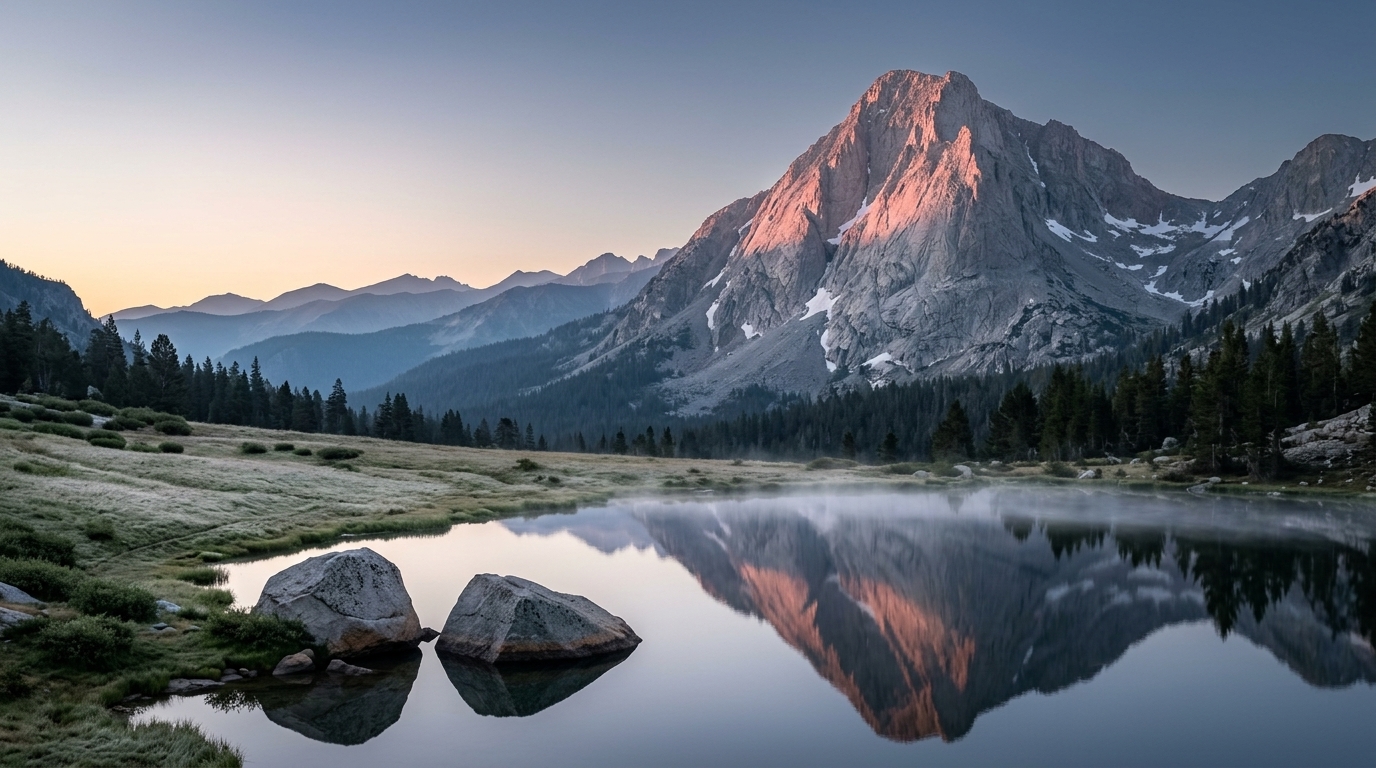
Quick Verdict: Great mountain photography is a planning problem first and a camera-settings problem second. Show up for first light and plant a stable tripod. Shoot f/8 to f/11 at base ISO, use a polarizer to cut haze, and build the frame around a strong foreground. The peaks do the rest once those four pieces fall into place.
8 min read
In This Article
- Overview
- Quick Facts
- The Best Light for Mountain Photography
- Camera Settings That Work in the Mountains
- Best Lenses for Mountain Photography
- Composition Rules for Mountain Photos
- Working With Mountain Weather
- Why a Tripod Belongs on Every Mountain Shoot
- Cutting Haze With a Polarizing Filter
- My Field Take From Two Decades of Mountain Work
- Final Thoughts
- Frequently Asked Questions
Overview
Right out of the gate, mountain photography looks easy on Instagram and humbles you in person. The peak sits right there. The light is doing the work. The camera still hands you a flat, hazy frame with a blown-out sky and a muddy foreground. In short, closing that gap is what this guide is built around.
For starters, mountain landscape photography is a discipline of small choices. Where you stand. When you arrive. What you put in front of the peak. Which lens you reach for. What the polarizer does to the cloud sitting above the ridge. Get those choices right and the camera settings almost handle themselves. Get them wrong and no amount of editing rescues the file.
Specifically, this guide covers the nine moves I lean on most. Light timing, camera settings, lens choices, composition rules, weather strategy, and the two pieces of gear I refuse to drive to a trailhead without. Practical numbers and the reasoning behind each rule. Plus a few warnings earned the slow way over twenty years of standing in front of peaks.
Quick Facts
| Detail | Value |
|---|---|
| Best Light | Alpenglow at sunrise/sunset, then golden hour, then blue hour |
| Aperture | f/8 to f/11 for sharpness across the scene |
| ISO | Base ISO (typically 100; ISO 64 on Nikon Z 7, Z 7 II, Z 8, and Z 9) |
| Shutter Speed | Tripod-led, whatever exposure needs (often 1/30s to 2s) |
| Focus | Hyperfocal or manual focus 1/3 into the frame |
| Metering | Matrix or evaluative, then check histogram for clipping |
| Recommended Lenses | 16-35mm wide for sweeping vistas, 70-200mm for compression |
| Must-Have Filter | Circular polarizer to cut haze and deepen sky |
| Tripod | Carbon fiber for the trail, 4kg+ payload, low-angle capable |
| Shooting Format | RAW (14-bit), for highlight and shadow recovery |
| Pre-Trip Apps | PhotoPills, Windy, Mountain Forecast, Gaia GPS |
The Best Light for Mountain Photography

To begin, mountains have three windows worth chasing. First, alpenglow is the strongest of the three. The sun is still below the horizon. The valley is dark. The top third of the peak picks up a band of pink that nothing else in nature produces. Anyone who has stood by an alpine lake watching the high peaks go pink knows the feeling, and knows it lasts about as long as one song on the radio.
Notably, alpenglow is typically a 10 to 20 minute window on a good morning and closer to seven minutes on a fast one, depending on latitude, terrain, and atmospheric conditions. If you arrive as it starts, you are already late. The working plan is to be on the tripod 45 minutes before official sunrise and metering 30 minutes before. Our take on golden hour photography covers the wider light window in detail. The same planning logic applies here, except mountain photography rewards earlier arrival and longer patience.
By contrast, midday is the file you keep deleting. Sun directly overhead, no shadow shape on the rock face, haze sitting in every valley. Treat 10 a.m. to 4 p.m. as travel and scouting time. Eat lunch, hike to the next vantage, scout angles for tomorrow. The only midday work worth keeping is black and white, where the harsh contrast finally has a job to do.
Camera Settings That Work in the Mountains

In practice, camera settings for mountain photography are simpler than the internet makes them sound. Start at f/8, ISO 100, and let shutter speed do the work. With a tripod planted, the file looks the same whether the meter lands on 1/30s or two full seconds.
So here is the four-step setup that works on almost every mountain scene. Switch to manual mode. Set f/8 to f/11. Drop ISO to base, which is 100 on most bodies and 64 on the Nikon Z 7, Z 7 II, Z 8, and Z 9. Dial shutter speed until the histogram sits just inside the right edge. If the highlight blink fires on sky or snow, drop exposure by a third of a stop until it stops.
Next, lock focus manually using live view at maximum zoom. Pick a point one-third into the frame from the bottom. Then tweak focus until that point snaps crisp. Hyperfocal distance gets you in the ballpark. Live view confirmation is faster and far more reliable on a high-resolution sensor.
Best Lenses for Mountain Photography
On the gear side, the best lens for mountain photography is the one that solves the scene in front of you. A two-lens kit of a 16-35mm wide and a 70-200mm short telephoto handles roughly 80% of mountain work. The wide fits a full ridge plus a foreground tarn in one frame. The telephoto compresses layered ridges and isolates a single peak from a sea of others.
For day one, pack the wide and the short telephoto. A 24-70mm or 24-105mm standard zoom rides in the bag for the in-between work but rarely comes out on a peak shoot. Our deep dive on the best lens for landscape photography covers specific picks across Canon, Nikon, and Sony mounts. It also walks through the trade-offs of zoom versus prime.
In reality, sharpness matters less than people think. Any modern lens stopped down to f/8 is excellent across the frame. Weather sealing and weight matter more on a mountain shoot. A weather-sealed body and lens combo lets you keep shooting through wind-driven snow without panicking. A lighter kit lets you reach the location that looks like the location. The f/4 versions of pro zooms cut weight by 30% to 40% and rarely cost a stop you needed.
Composition Rules for Mountain Photos
For starters, three things carry almost every mountain frame worth keeping. A foreground anchor, layered depth from front to back, and one clear focal point. Drop any of the three and the peak shrinks. Big peaks will look like a backdrop on a sound stage if you stand in the wrong parking lot.
For instance, a foreground rock the size of a car, a stretch of lupine in early July, a tarn still holding ice in June, or a ridgeline two valleys closer than the main peak all add scale. Our take on the role of foreground in landscape photography walks through that move. A deliberate foreground turns a flat snapshot into a frame with depth.
Beyond that, leading lines do the rest of the work. A trail switchback, a glacial moraine, the curve of a creek, or the staggered line of subalpine fir all point the eye uphill. Our piece on leading lines in landscape photography shows the technique in action across multiple scenes.
Of note, layered depth is the most underused tool in mountain photography. Haze and distance separate ridges into bands of tone. Pull out the 70-200, stack four ranks of ridgeline in the frame, and in the first hour after sunrise the front ridge glows warm while the back ridges recede in cooler blue. The Smokies do this almost on command. So do the Cascades on a humid August morning.
Working With Mountain Weather
Mountain weather is the assignment, not the obstacle. Bluebird days produce postcards your aunt will compliment and nobody else will stop scrolling for. Storm light, drifting fog, breaking clouds, and the moment a squall clears off a summit produce the portfolio frames.
In practice, build the trip around weather windows, not calendar days. Mountain-Forecast.com gives summit-specific forecasts that surface storm timing better than general weather apps. Windy.com layers wind speed, cloud height, and precipitation in one view. Watch for cloud bases sitting around peak height. That is the recipe for mist among the ridges and rays cutting through the gaps.
When fog rolls in, do not pack up. Our guide on how to photograph fog and mist for moody landscape photos covers exposure compensation and composition for low-contrast conditions. Mountain photography in fog hides distractions, simplifies the frame, and adds mood that clear days never deliver.
On top of that, the hour after a storm passes is usually the best light of the day. Sun beams punch through trailing clouds, light a single peak, and leave the rest of the frame moody. Our coverage on photographing light rays in landscape photography applies almost word for word to mountain work.
Why a Tripod Belongs on Every Mountain Shoot
In effect, mountain photography lives at the edges of usable light. Shutter speeds of half a second to two seconds at base ISO are common during alpenglow and blue hour. As a result, a tripod is the only way to keep base ISO and avoid blur in those windows.
Importantly, the tripod you carry is the only tripod that helps you. A 2.4kg studio rig at home gets left at home before the trailhead. A 1.3kg carbon-fiber travel tripod clips to the pack and goes on every hike. The Peak Design Travel Tripod in carbon fiber folds to a packed length around 39cm, extends to roughly 152cm, and supports a 9kg payload. The footprint earns its place in the pack.
Featured Gear on Amazon
Need a Tripod That Earns Its Place on the Trail?
The Peak Design Travel Tripod in carbon fiber folds to a packable size, extends to roughly 60 inches, supports a 20-pound payload, and clips onto a hiking pack without snagging. It is the tripod I take to peaks I am not sure I will reach.
Cutting Haze With a Polarizing Filter

By contrast, atmospheric haze is the silent killer of mountain photography. The peak looks crisp to your eye and washes out in the file. The cause is scattered light off airborne moisture and dust. A circular polarizer rotates to filter that scattered light. In effect, the result is a deeper sky, cleaner snow, and visible texture on distant ridges the unfiltered shot loses.
In effect, the polarizer lives on the front of my lens whenever I shoot mountains above 6,000 feet. The Hoya HD3 HRT polarizer is the one I have run for years. It transmits noticeably more light than older multi-coated polarizers, which means a smaller shutter-speed penalty. The hardened coating also wipes clean after a snow squall without streaking.
From there, rotate the front ring slowly while watching live view. The sky deepens, specular highlights on wet rock settle, and texture on distant ridges sharpens like someone wiped a window. Back off the rotation if the sky shows a dark gradient across one side. That happens when the sun sits at roughly 90 degrees off your shooting axis. The effect is brutal on anything wider than 24mm equivalent.
Featured Gear on Amazon
Stop Fighting Atmospheric Haze in Post
A circular polarizer is the one filter I refuse to shoot mountains without. The Hoya HD3 HRT pulls glare off rocks, deepens sky tones, and rescues distant ridges that always wash out without it.
My Field Take From Two Decades of Mountain Work
For context, twenty-plus years of shooting landscape, and the mountains are still the places I drive ten hours for. The Tetons in October when the cottonwoods go yellow. The North Cascades the second week of August. The Sierra east side any month the high passes are open. Three lessons from years of those trips have done more for my mountain work than any tutorial I have ever read.
For context, the first lesson is that the best mountain frames live two miles from where the car is parked. Drive-up overlooks are saturated, shot flat by hundreds of phones every weekend, and almost never sit at the angle your subject deserves. A 45-minute hike to a quieter vantage almost always finds something the parking lot did not have.
Moreover, the second lesson is that bad weather is not a reason to cancel. The ugliest-looking forecast on Mountain-Forecast.com is the one I drive toward, not away from. A storm clearing over a peak is the image people stop scrolling for. Bluebird forecasts produce postcards nobody saves.
To be clear, the third lesson is the hardest one to actually believe. The peak is not the subject. The light hitting the peak, the foreground that makes the peak feel huge, and the small piece of weather that gives the scene mood is the subject. Move the camera until those three pieces stack up. If they never do, hike out and come back tomorrow.
Final Thoughts
To wrap up, mountain photography rewards the photographer who plans, shows up early, and trusts the foundation more than the gear. Pick a forecast window. Bring the tripod that fits on your pack. Run base ISO at f/8. Keep a polarizer on whenever the sky has texture. Find a foreground worth standing in front of.
From there, pair those habits with a body and lens combo that fits your hiking style and the rest sorts itself out. Our piece on the best cameras for landscape photography in 2025 covers the bodies that hold up to trail use and produce files that earn the wall space.
Finally, the long game is the only game with mountains. Return trips beat one-shot visits. The peak that handed you a flat file in June often delivers a portfolio frame in October. For the seasonal angle, our guide to shooting landscapes in winter weather covers gear protection and exposure tactics that translate straight to alpine work.
Frequently Asked Questions
What camera settings are best for mountain photography?
In practice, the standard setup for mountain photography is f/8 to f/11 at base ISO. Base ISO is 100 on most bodies and 64 on the Nikon Z 7, Z 7 II, Z 8, and Z 9. Shutter speed is driven by the meter on a tripod. Manual focus one-third into the frame keeps both foreground and background sharp. Shoot RAW for highlight and shadow recovery in post.
What is the best lens for mountain photography?
For wide compositions, a 16-35mm wide-angle covers sweeping vistas with strong foregrounds. A 70-200mm short telephoto compresses layered ridges and isolates a single peak from a sea of others. A two-lens kit of wide plus short telephoto handles roughly 80% of mountain work. A 24-70mm or 24-105mm standard zoom fills the gap when you want a single lens for general shooting.
When is the best time of day for mountain photography?
For the best light, alpenglow at sunrise or sunset wins. High peaks catch warm color for roughly 10 to 20 minutes, depending on latitude, terrain, and conditions. Golden hour follows for an additional 30 to 60 minutes. Blue hour after sunset produces cool, even light ideal for snow texture and sky gradient. Avoid midday for hero shots and use it for scouting and hiking.
Do you need a polarizer for mountain photography?
Yes. In particular, a circular polarizer cuts atmospheric haze that otherwise washes out distant ridges. It deepens sky tone and pulls glare off wet rocks and snow. The Hoya HD3 HRT line is the workhorse choice. Rotate the front ring slowly while watching live view. Back off if the sky shows an unnatural dark gradient.
How do you avoid atmospheric haze in mountain photos?
For most shots, three moves do most of the work. Shoot in the cool hours of the day when air is denser and clearer. Use a circular polarizer to cut scattered light. Shoot RAW so the haze you cannot avoid in-camera responds to a dehaze slider in Lightroom or Capture One. Storms also scrub haze out of the air, so the hours right after rain are some of the best.
What tripod is best for mountain hiking?
In short, a carbon-fiber travel tripod between 1.1 and 1.5kg is the sweet spot. It folds compact and supports a 4 to 9kg payload. The Peak Design Travel Tripod, Gitzo Traveler, and Really Right Stuff TFC-14 are top picks photographers tend to keep across many bodies. The tripod you carry is the only tripod that helps you on the trail.
Sources: Field notes from twenty years of landscape work across the Tetons, Sierra Nevada, and North Cascades. Peak Design Travel Tripod specifications from Peak Design. Hoya HD3 HRT product information from Hoya Filter USA.

