


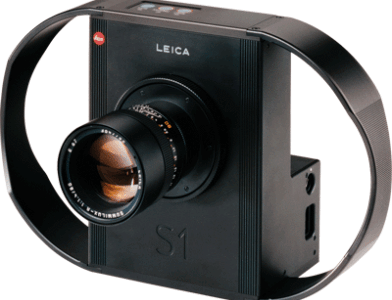
Quick Facts:
- Product: Leica S1 (1996); upgraded Leica S1 Pro followed in 1998
- Released: Shown 1996, marketed from late 1997
- Type: Studio scanner camera, the first Leica digital camera
- Sensor: 36x36mm square CCD, triple-linear scanning
- Resolution: 26.4 megapixels, 5140 x 5140 pixels (Leica now cites the camera at up to 75 megapixels)
- Lens mount: User-swappable, including Leica R and M, Nikon F, and Canon FD
- Production: Reportedly about 1,500 built, with far fewer sold
- Best for: Collectors and Leica history enthusiasts
6 min read
In This Article
Leica S1 Overview: The Forgotten First Leica Digital Camera
The Leica S1 is the camera most people forget when they talk about Leica going digital. Shown at Photokina in 1996, it was the first Leica digital camera, arriving a decade before the Leica M8 made headlines. Yet almost no one has handled one, because it was rare, costly, and aimed squarely at studios rather than street photographers.
This was not a rangefinder you slung over your shoulder. Instead, the S1 was a stationary scanner camera built for reproduction work, museums, and high-end commercial studios. It sat on a stand, stared at a static subject, and scanned the scene line by line. For this reason, it stayed invisible to the wider photography world even as it set a resolution record.
If you collect Leica gear or follow camera history, the S1 matters because it fills a gap. People wonder why the modern Leica S line starts at the S2. An S1 came first, in 1996, and then quietly disappeared. Among the strangest cameras ever made, this one earns its place on engineering alone.
Leica S1 Specs at a Glance
| Specification | Details |
|---|---|
| Model | Leica S1 (later Leica S1 Pro variant) |
| Announced | Photokina 1996; sold from late 1997 |
| Type | Studio scanning camera |
| Sensor | 36x36mm triple-linear CCD |
| Resolution | 26.4 megapixels, 5140 x 5140 (Leica now cites up to 75 megapixels) |
| Color depth | 48-bit RGB, files around 150MB |
| Base ISO | 50 |
| Lens mount | User-swappable (Leica R/M, Nikon F, Canon FD, and more) |
| Production | Reportedly about 1,500 units |
Why the Leica S1 Was a Scanner Camera
The Leica S1 captured an image the way a flatbed scanner reads a document. A linear sensor moved across the focal plane and recorded the picture one column at a time. Each high-resolution scan therefore took minutes rather than an instant.
This slow process ruled out anything in motion. People, sports, and wildlife were impossible to capture. Instead, the camera served studio and reproduction work, where the subject stayed perfectly still and the lighting held constant. Artwork, archival documents, and product photography fit the S1 perfectly.
In use, the camera tethered directly to a desktop computer, Mac or PC, and delivered each scan straight to the screen through dedicated software. The photographer then reviewed a finished file within a few minutes. For a 1996 workflow, this direct path from sensor to large-format file ran well ahead of its time, and it traces a clear line through the wider history of digital photography.
The 36x36mm Square Sensor
At the heart of the S1 sits an unusual 36x36mm square sensor. Most cameras use a rectangle, yet Leica chose a square so the camera matched the wider field of square and medium format compositions. The sensor measured the same 36mm across as a full-frame 35mm frame, so standard full-frame lenses covered it without trouble.
Resolution reached 26.4 megapixels, or 5140 by 5140 pixels. Leica today cites the camera at up to 75 megapixels, a figure reflecting how its triple-linear sensor counts individual color samples rather than final pixels. Either way, the output was extraordinary for 1996, when most digital cameras delivered fewer than two megapixels.
The sensor used a triple-linear CCD, recording true red, green, and blue at every point, so the files needed no color interpolation. Each 48-bit image held around 150MB of data. The camera also ran at a low base ISO of 50, which suited its controlled studio role. This square, scanning approach put it among cameras built around an unusual sensor design rather than a conventional one.
How Rare the S1 Is
Few photographers have seen an S1 in person, and the production numbers explain why. Reports put the total at about 1,500 units, with far fewer sold to working studios. Its high price and narrow purpose kept demand small from the start.
Timing worked against it too. The S1 launched as digital photography was barely beginning, so the market for a five-figure scanning camera stayed tiny. Meanwhile, faster single-shot digital backs soon arrived and made the slow scanning method look dated for most jobs.
Today the S1 trades as a collector’s curiosity rather than a working tool. Surviving units rarely appear for sale, and when one does, it draws interest mainly from Leica historians. For a brand famous for the best cameras of all time, the S1 is a genuine outlier in both design and scarcity.
Leica S1 vs. the Later Leica S System
The naming confuses people, and for good reason. Leica released the S2 in 2008 and the S3 years later, yet skipped any obvious mention of the original S1 Pro. Because the two share a letter but nothing else, many assume the S line began with the S2.
In practice, the two cameras share almost nothing. The 1996 S1 was a tethered studio scanner with a square CCD and minute-long captures. By contrast, the modern Leica S-System uses a handheld medium format body with a rectangular sensor, fast single-shot capture, and autofocus.
So the S1 is better understood as a separate experiment than as a direct ancestor. It proved Leica would chase high-resolution digital imaging early, even when the technology forced hard compromises. The later S-System then delivered this ambition in a practical, portable form.
Final Verdict
The S1 is a fascinating footnote deserving a fuller chapter in digital camera history. As Leica’s first digital camera, it showed the company chasing resolution and color accuracy years before rivals reached the same level. For collectors and Leica historians, this pioneering role is its real value.
Most other photographers face a simpler reality. You would never shoot daily work with a minute-long scanning camera, and surviving units are too scarce and costly to treat as tools. So the S1 belongs on a shelf or in a display case, not in a working kit bag.
Still, the camera rewards anyone who studies how digital imaging grew up. Its 26.4-megapixel square sensor and tethered studio workflow mapped out ideas later cameras refined. Set against Leica’s storied rangefinders, the S1 stands as proof the brand experimented boldly, a pattern still visible in Leica’s current direction.
Frequently Asked Questions
What was Leica’s first digital camera?
The S1 was the first Leica digital camera. Leica showed it at Photokina in 1996 and marketed it from late 1997. It served as a studio scanner camera rather than a handheld model.
How many megapixels was the S1?
The S1 captured 26.4 megapixels, or 5140 by 5140 pixels, from its square sensor. Leica now cites the camera at up to 75 megapixels, a figure linked to its scanning method. Either number was huge for 1996.
Why did the S1 take so long to capture an image?
The S1 worked as a scanning camera, reading the scene line by line instead of all at once. Because of this, a single high-resolution capture took minutes. This approach suited still subjects but ruled out any motion.
How rare is the S1?
Reports put production at about 1,500 units, with far fewer sold to studios. Its high price and narrow studio purpose kept numbers low. Today the S1 is a sought-after collector’s piece.
Is the Leica S1 related to the Leica S2 and S3?
They share a name but little else. The 1996 S1 Pro was a tethered scanning camera, while the modern Leica S-System uses a handheld medium format body with autofocus. Most people treat the S1 as a separate experiment.
What is an S1 worth today?
The S1 launched as a five-figure professional system. Today it sells as a collector’s item, so condition, completeness, and working tethered hardware drive the price. Values vary widely because so few change hands, and serious Leica collectors are the main buyers.

