


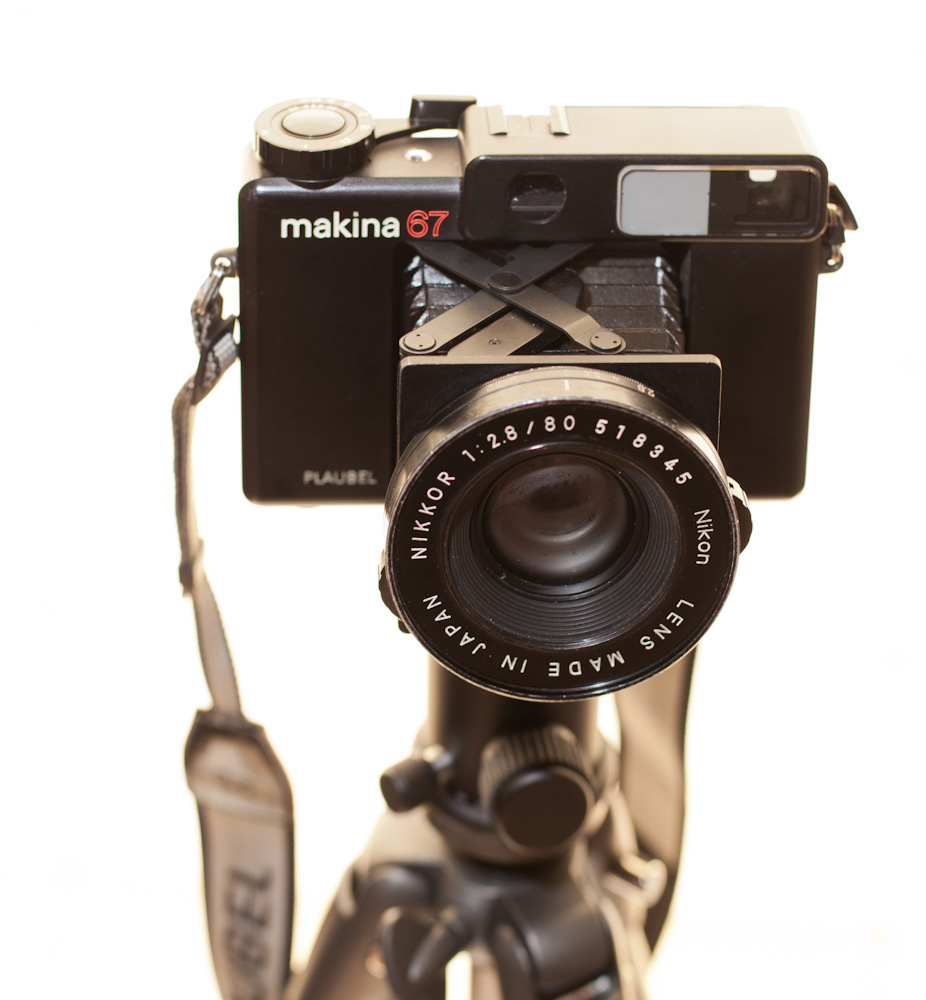
Quick Facts:
- Product: Plaubel Makina W67
- Released: 1981
- Type: Folding 6×7 medium format rangefinder
- Lens: Fixed 55mm f/4.5 Wide-Nikkor, about 28mm equivalent
- Film: 120 roll film, 6×7 frames
- Design: Collapsible bellows folds the camera flat
- Production: Reportedly about 3,500 units
- Best for: Collectors and medium format landscape shooters
5 min read
In This Article
Plaubel Makina W67 Overview: A Rare Wide-Angle Medium Format Gem
The Plaubel Makina W67 packs a big 6×7 negative into a body you fold flat and tuck into a small bag. Released in 1981, it is the wide-angle member of the Makina family, built around a fixed 55mm f/4.5 Wide-Nikkor lens. Because only about 3,500 left the factory, it remains one of the harder medium format rangefinders to find today.
This camera solves a real problem for travelers and landscape shooters. Medium format usually means bulk, yet the folding bellows lets this body shrink dramatically between shots. So you get large-negative quality in a package closer to a 35mm rangefinder than a typical 6×7 system.
If you love rare and clever gear, the W67 rewards attention. It blends a cult lens, an unusual folding design, and genuine scarcity into one collectible body. Among the strangest cameras ever made, this folding Plaubel earns its spot on engineering and rarity alike.
Specs at a Glance
| Specification | Details |
|---|---|
| Model | Plaubel Makina W67 |
| Released | 1981 |
| Format | 6×7 on 120 roll film |
| Lens | Fixed 55mm f/4.5 Wide-Nikkor |
| Equivalent | About 28mm in 35mm terms |
| Focusing | Coupled rangefinder |
| Body design | Collapsible bellows, folds flat |
| Production | Reportedly about 3,500 units |
Why Only 3,500 Plaubel Makina W67 Cameras Were Made
The wide-angle W67 was always a niche product. While the standard Makina 67 sold more than 15,000 units, the wide version reached only about 3,500. A fixed 28mm-equivalent lens simply appeals to fewer buyers than a normal focal length, so demand stayed modest from the start.
Price and purpose narrowed the audience further. Specifically, this was a specialist tool for landscape, architecture, and environmental work, not a general-purpose camera. As a result, fewer photographers reached for it, and the factory built far fewer bodies.
Scarcity now drives strong collector interest. Clean, working examples with sharp rangefinder coupling command high prices, in line with the broader surge in vintage film camera values. For a wide medium format body this capable, the W67 sits near the top of many want lists.
The Folding 6×7 Design
The signature trick of the Makina is its folding bellows. When you finish shooting, the lens collapses back toward the body, and the camera flattens into a slim rectangle. As a result, this design shrinks a 6×7 camera to a size you carry comfortably all day.
In practice, the payoff is portability without a format compromise. A 6×7 negative gives you far more detail and tonal smoothness than 35mm, yet most 6×7 cameras are heavy bricks. The W67 keeps the big negative while folding down close to the footprint of a large 35mm rangefinder.
There is a trade-off, of course. Bellows demand care, since a pinhole or a knock will let light leak in or push the lens out of alignment. Even so, a well-kept example still delivers the rare mix of big-negative quality and true travel portability.
The Cult Wide-Nikkor 55mm Lens
The heart of the W67 is its fixed 55mm f/4.5 Wide-Nikkor lens. On the 6×7 format, 55mm gives roughly the field of view of a 28mm wide-angle on a 35mm camera. Notably, Nikon designed the optics, and collectors regard this lens as one of the sharpest ever fitted to a medium format body.
Its rendering explains much of the camera’s reputation. The Wide-Nikkor resolves fine detail across the frame and holds contrast even into the corners, which matters greatly on a large negative. For landscape and architecture, this edge-to-edge sharpness is exactly what the work demands.
The fixed-lens approach carries a clear limit. You cannot swap focal lengths, so the W67 commits you to a wide view for every frame. Photographers who want this perspective, however, gain a compact, optimized package no zoom will match.
Who Built the Makina
The Makina name is German, but the modern cameras came from Japan. The Doi Group, a Japanese distributor, acquired the long-dormant Plaubel brand in 1975 and revived the Makina line, launching the standard 67 in 1979 and the wide W67 in 1981. Nikon designed the lenses, Copal built the leaf shutter, and Mamiya later took over W67 production, so the camera blends German heritage with Japanese precision.
This provenance feeds the collector appeal today. Because the run stayed small and the engineering pedigree ran deep, both the standard and wide versions now rank among the most desirable folding rangefinders ever made, a status reflected across the wider film camera history.
Plaubel Makina W67 Versus the Standard Makina 67
The core difference between the two is the lens. A standard Plaubel Makina 67 carries an 80mm f/2.8 Nikkor, a normal focal length on 6×7, whereas the W67 swaps in the 55mm f/4.5 Wide-Nikkor for a wide view. Everything else, from the folding body to the rangefinder, stays largely similar.
This single change shifts who each model suits. Specifically, the 80mm version handles portraits and general shooting with a brighter f/2.8 aperture, so it appeals to a wider audience. By contrast, the wide W67 targets landscape and architecture, which is part of why so few were built.
Against rivals, both Makinas hold their own. A Mamiya 7 offers interchangeable lenses, yet it cannot fold flat, and it lands on most lists of the best cameras of all time for similar reasons. For a fixed wide lens in a folding body, the W67 stands almost alone.
Final Verdict
The W67 is a specialist’s dream and a collector’s prize. Its folding 6×7 body, its cult Wide-Nikkor lens, and its scarcity give it a character few cameras match. For landscape and travel shooters who love a wide view, it is close to ideal.
The trade-offs are real, though. A fixed wide lens, a modest f/4.5 aperture, and delicate bellows make it a focused tool rather than an all-rounder. Surviving units are also scarce and pricey, so buyers must inspect condition carefully before committing.
Still, the W67 rewards the photographer who wants its exact strengths. Nothing else folds a sharp wide 6×7 into a pocketable shape. If you would rather start with something more common and affordable, our guide to the best film cameras points to easier entry points.
Frequently Asked Questions
What is the Plaubel Makina W67?
The W67 is a folding 6×7 medium format rangefinder from 1981. It uses a fixed 55mm f/4.5 Wide-Nikkor lens, and only about 3,500 units were built.
What is the difference between the Makina 67 and the W67?
The lens. A standard Plaubel Makina 67 has an 80mm f/2.8 Nikkor, while the W67 carries a wider 55mm f/4.5 Wide-Nikkor. Only the wide model is truly scarce.
How many were made?
Reports put production at about 3,500 units, against more than 15,000 of the standard Plaubel Makina 67. This gap helps explain why the W67 commands premium prices today.
What film does it use?
The W67 shoots 120 roll film in the 6×7 format. Each roll yields ten large negatives, which deliver far more detail than a 35mm frame.
Is the Wide-Nikkor lens as good as collectors claim?
Collectors and shooters widely praise the 55mm Wide-Nikkor for its sharpness and even contrast. Many consider it one of the finest wide lenses ever fitted to a medium format rangefinder.
Who manufactured the Plaubel Makina W67?
Plaubel was a German brand revived under Japanese ownership. Nikon supplied the lens and Copal handled key mechanical parts, so the W67 blends German heritage with Japanese engineering.

