


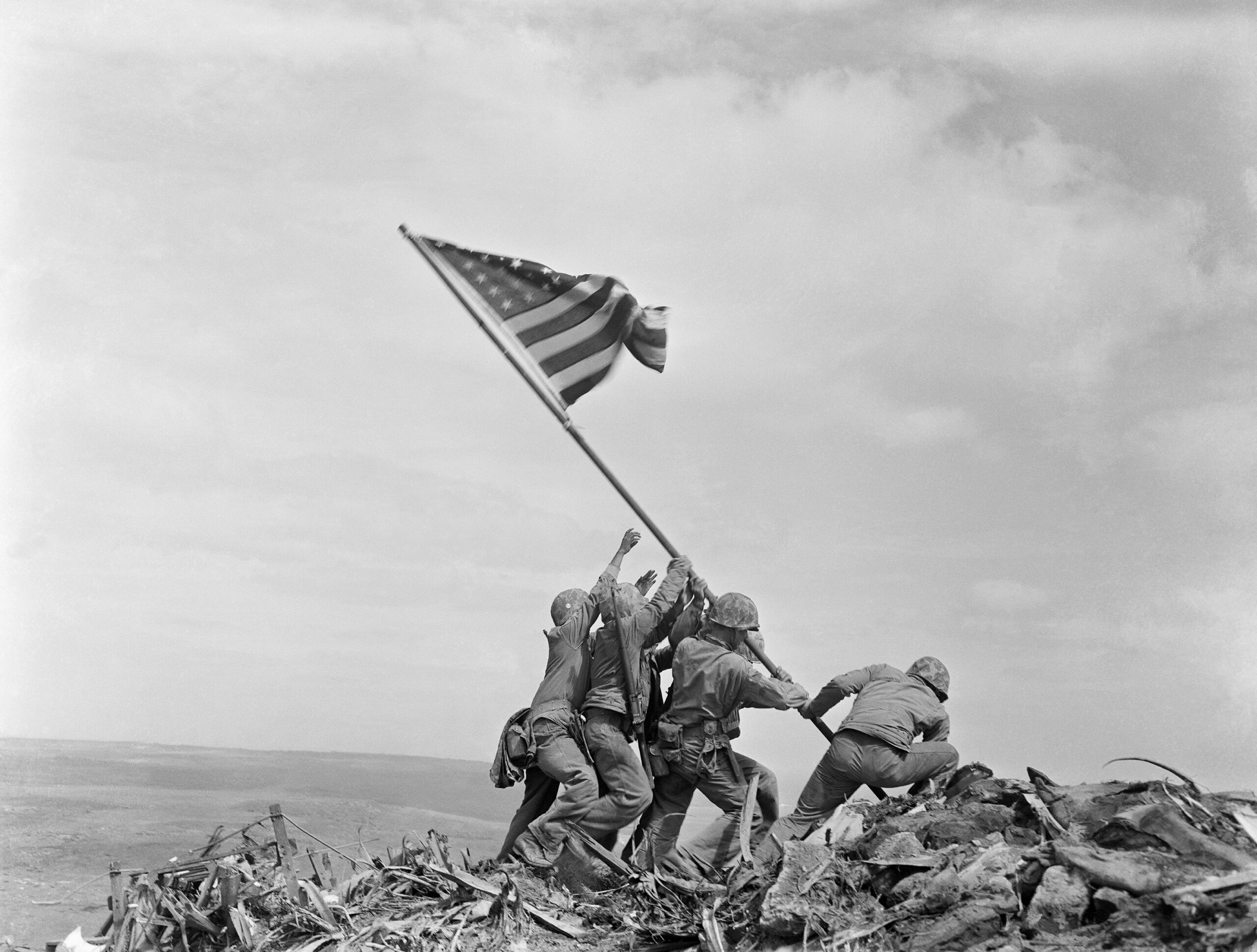
Quick Facts:
- Subject: Raising the Flag on Iwo Jima, by Joe Rosenthal
- Date taken: February 23, 1945
- Location: Mount Suribachi, Iwo Jima
- Camera: Speed Graphic press camera (4×5 sheet film)
- Exposure: 1/400 sec at f/8 to f/11, Agfa film
- Subjects: Six U.S. Marines raising the second flag
- Award: 1945 Pulitzer Prize for Photography
- Copyright status: Public domain in the United States
- Best for: Photographers studying war photography and composition
10 min read
In This Article
- The Photograph and Its True Story
- Key Facts at a Glance
- The Battle and the Six Marines Behind the Photograph
- Two Flag Raisings, One Iconic Frame
- Joe Rosenthal’s Speed Graphic and the Exposure Settings
- The Triangular Composition Behind a National Memorial
- The Staging Allegation and the Genaust Footage
- Misidentification and the 2016 and 2019 Corrections
- Legacy: Pulitzer, Posters, Stamps, and Film
- How Raising the Flag on Iwo Jima Compares to Other Iconic Frames
- Final Verdict: Why This Photograph Still Matters
- Frequently Asked Questions
Raising the Flag on Iwo Jima Overview: The Photograph and Its True Story
Raising the Flag on Iwo Jima sits at the center of American war photography. Joe Rosenthal of the Associated Press shot the image on February 23, 1945, atop Mount Suribachi, a 546-foot dormant volcanic cone at the southern tip of Iwo Jima. Within hours, the frame moved by radiophoto from Guam to U.S. newspapers. Readers saw six Marines pushing a steel pipe and a larger replacement flag upright on volcanic rock.
The photograph won the 1945 Pulitzer Prize for Photography. It became the only image to win the prize in the same year it was taken. Today the file lives in the public domain on Wikimedia Commons, freely reusable by photographers, historians, and educators around the world.
The image rewards close study on two levels. First, the historical record of Raising the Flag on Iwo Jima explains why six Marines were pushing a pipe and not the morning’s first flag. Second, the photographic decisions Rosenthal made in seconds, with a press camera on uneven volcanic rock, show what instinct under pressure looks like. The Joe Rosenthal Iwo Jima frame still circulates in classrooms, federal archives, and Marine Corps training materials.
Key Facts at a Glance
| Detail | Value |
|---|---|
| Photographer | Joe Rosenthal, Associated Press |
| Date | February 23, 1945 |
| Location | Mount Suribachi, Iwo Jima, Pacific Theater |
| Camera | Speed Graphic (4×5 press camera) |
| Shutter speed | 1/400 sec |
| Aperture | Between f/8 and f/11 |
| Film | Agfa |
| Image dimensions on Commons | 2,959 by 2,241 pixels, 2.3 MB |
| Award | 1945 Pulitzer Prize for Photography |
| License | Public domain in the United States, copyright not renewed |
The Battle and the Six Marines Behind the Photograph

The U.S. invaded Iwo Jima on February 19, 1945. Four days later, a patrol from Easy Company, 2nd Battalion, 28th Marines climbed Mount Suribachi to plant a flag at the summit. The battle for the island lasted until late March and cost nearly 7,000 American lives, with Japanese losses far higher. For the Marines pushing toward Suribachi’s crater, a flag visible from the beaches below carried real tactical weight. Every rifleman down on the sand saw the high ground had changed hands.
The six Marines in Rosenthal’s frame are now identified as Ira Hayes, Harold Schultz, Michael Strank, Franklin Sousley, Harold Keller, and Harlon Block. Three of the group (Strank, Block, and Sousley) were killed in action during the rest of the fighting on Iwo Jima. Hayes survived the war but struggled afterward with survivor’s guilt and alcoholism. He died in 1955 at age 32. His story later inspired Peter La Farge’s song “The Ballad of Ira Hayes,” recorded by Johnny Cash in 1964.
Two Flag Raisings, One Iconic Frame
A misconception persists because two American flags went up on Mount Suribachi on February 23, 1945. The first flag, raised earlier in the morning, was small. SSgt Louis R. Lowery, a Marine combat photographer for Leatherneck magazine, documented it. Officers on the beach below decided the small flag was hard to see from a distance, so they ordered a larger replacement.
Rosenthal arrived during the climb up. Lowery passed him on the way down and mentioned the summit was an excellent vantage point. By the time Rosenthal reached the top, a second team of Marines was preparing to plant the larger flag. He captured the moment they pushed the steel pipe upright. The first flag came down at almost the same instant the second went up, which is why some accounts conflate the two events.
Roger Fenton’s early Crimean War photograph faced a similar two-version problem nearly a century earlier. On Suribachi, however, the second raising was the only one Rosenthal documented, and his lone frame became Raising the Flag on Iwo Jima.
Joe Rosenthal’s Speed Graphic and the Exposure Settings
Rosenthal worked with a Speed Graphic, the standard press camera of the era. It used 4×5 sheet film, one frame at a time, loaded into individual holders. Reload speed mattered, because press photographers in combat zones often got one chance per scene. Contemporary records show Rosenthal set his shutter to 1/400 sec, with the aperture between f/8 and f/11, on Agfa film.
Before the flag went up, he placed the camera on the ground and stacked rocks to gain a slightly higher vantage. Specifically, he wanted a better angle on the planned group shot. As the Marines began pushing the pipe upright, he realized the moment was happening sooner than expected. He swung the camera up and pressed the shutter without using the viewfinder. The composition was, by his own account, partly luck and partly reflex.
For modern photographers, the lesson is practical. Pre-set your exposure for the light around you, then trust your hands when something happens faster than your eye. The instinct to bring the camera up and fire matters more than perfect framing in a moving scene.
The Triangular Composition Behind a National Memorial
Sculptor Felix de Weldon studied the Rosenthal frame and described its “classic triangular lines.” He compared the geometry to the ancient statues he had trained on. The line of bodies leans diagonally from lower right to upper left, with the pole and the Iwo Jima flag itself completing a strong triangle against the sky. Similarly, the angle of the pole echoes the angle of the Marines’ bent backs.
De Weldon used the photograph as the visual blueprint for the Marine Corps War Memorial in Arlington Ridge Park, dedicated in 1954. Construction began in 1951 and took three years. The bronze sculpture stands about 78 feet tall, with the figures alone reaching 32 feet. Few photographs in history have been translated so directly into a national monument.
For a deeper read on the decisive moment, see our notes on composition, emotion, and timing. The same triangular structure shows up in street and documentary work whenever bodies lean in shared effort, yet few frames carry the geometry as cleanly as Raising the Flag on Iwo Jima.
The Staging Allegation and the Genaust Footage

A misunderstanding caused a lasting belief the photograph was staged. After capturing the flag raising, Rosenthal asked the Marines of Easy Company to pose for a group shot beneath the raised flag. He later called this the “gung-ho” photo. Days afterward, back on Guam, a reporter asked him whether he had posed “the photograph.” Thinking the question referred to the group shot, Rosenthal replied “Sure.”
Time magazine’s radio program then aired a segment claiming Rosenthal had climbed Suribachi only after the flag was already up and had re-posed the Marines. A New York Times book reviewer suggested revoking his Pulitzer. The claim spread quickly and stuck for decades, even after retractions appeared.
Sgt. Bill Genaust ended the debate. Standing about three feet from Rosenthal during the second raising, Genaust shot motion-picture footage of the same event from nearly the same angle. The film confirms the second flag raising was unposed and matches the still frame Rosenthal captured. Genaust himself was killed in action nine days later and never saw his footage published.
Misidentification and the 2016 and 2019 Corrections
Identifying the marines raising the flag on iwo jima accurately took decades. Initially, Harlon Block was misidentified as Hank Hansen. The Marine Corps corrected the record in January 1947 after testimony from Ira Hayes. Afterward, two more corrections followed much later.
In June 2016, the Marine Corps announced Navy corpsman John Bradley had not been in the frame. The figure long believed to be Bradley was Marine Harold Schultz, identified through analysis of uniform details and a re-examination of Genaust’s footage. James Bradley, John Bradley’s son and author of the 2000 book Flags of Our Fathers, accepted the finding.
In October 2019, the Marine Corps issued a second correction. The Marine previously identified as Rene Gagnon was instead Harold Keller. The revisions show how even an image studied by millions held identification errors for more than 70 years. For modern photojournalists, the corrections argue for caption discipline and primary-source verification, especially in combat coverage.
Legacy: Pulitzer, Posters, Stamps, and Film
The reach of the Joe Rosenthal Iwo Jima image is hard to overstate. Rosenthal received the 1945 Pulitzer Prize for Photography within months. Notably, no other Pulitzer for photography has been awarded in the same year the photograph was taken. The U.S. Treasury used the frame for the Seventh War Loan drive in 1945, printing 3.5 million posters with the Iwo Jima flag as the centerpiece.
In July 1945, the United States Postal Service released a stamp showing the flag raising. A second commemorative stamp followed in 1995, as part of a 10-stamp series marking the 50th anniversary of World War II. In 2005, the U.S. Mint issued a commemorative silver dollar bearing the image to mark the 230th anniversary of the Marine Corps.
On screen, the photograph shaped popular memory through the 1949 film Sands of Iwo Jima, in which the three surviving flag raisers appeared at the end. James Bradley’s 2000 book became the basis for Clint Eastwood’s 2006 film Flags of Our Fathers. Dorothea Lange’s Migrant Mother followed a similar arc, becoming the defining image of an era through reproduction across books, films, and public memory.
How Raising the Flag on Iwo Jima Compares to Other Iconic Frames
Set against other photographs of the 20th century, Raising the Flag on Iwo Jima is unusual for the speed of its public reach. The frame moved from Suribachi to American breakfast tables in about 17.5 hours. By comparison, the Wright Brothers first flight photo from 1903 was barely shown publicly for several years. Eisenstaedt’s V-J Day in Times Square ran in Life magazine on August 27, 1945, with a longer editorial cycle.
What unites these images is the single-frame nature of their fame. Each one stands alone, without the context of a series or a sequence. Few of the marines raising the flag on iwo jima needed to be named for the picture to do its work, which is part of why captions stayed imprecise for so long.
Among war photographs specifically, Rosenthal’s image is one of the few captured by a stills photographer working alongside a motion-picture shooter at the same instant. The combination of still frame and Genaust’s film created an evidentiary record few war images of the era have.
Final Verdict: Why This Photograph Still Matters
For working photographers, Raising the Flag on Iwo Jima remains a reference point because of what Rosenthal did in seconds. Specifically, he pre-set his exposure for the light. Next, he chose a vantage on the volcanic rock. Then his hands responded faster than the viewfinder. The frame is sharp, the geometry is strong, and the moment is real. Beginners often hear “the camera doesn’t matter,” and this image is part of the proof. A press camera, plain film, and a fast shutter were enough.
For students of photo history, the image carries the weight of corrections. Three Marines were misidentified for years. Two of those corrections came after 2015. The story of who is in the frame kept changing long after the frame itself was famous, which is why fact-checking and primary sources still matter in photojournalism today.
For readers studying war photography as a body of work, the iwo jima flag raisers belong alongside Fenton’s Crimea, Capa’s D-Day landings, and Eddie Adams’s Saigon Execution. Each frame defines a war for the public. Each one carries questions about staging, intent, and the responsibilities of the photographer holding the camera.
Raising the Flag on Iwo Jima endures because the moment was real, the geometry holds, and the legacy keeps generating new conversations about truth in pictures. Few images reward repeated viewing the way this one does.
Frequently Asked Questions
Who took the photograph Raising the Flag on Iwo Jima?
Joe Rosenthal of the Associated Press took the photograph on February 23, 1945. He was 33 years old at the time. Rosenthal received the 1945 Pulitzer Prize for Photography for the image and worked as a press photographer until his retirement. He died in 2006.
Was the Iwo Jima flag raising photograph staged?
No, the photograph was not staged. The misconception began when Rosenthal answered a question about a separate “gung-ho” group shot taken minutes later. Motion-picture footage by Sgt. Bill Genaust, filmed from three feet away at nearly the same angle, confirms the second flag raising was unposed.
How many Marines raised the flag on Iwo Jima in Rosenthal’s photo?
Six Marines appear in the frame: Ira Hayes, Harold Schultz, Michael Strank, Franklin Sousley, Harold Keller, and Harlon Block. Three of the group (Strank, Block, and Sousley) were killed during the rest of the Battle of Iwo Jima.
Was there a first flag raising on Iwo Jima before the famous photo?
Yes. A smaller flag went up earlier in the morning, documented by SSgt Louis R. Lowery of Leatherneck magazine. Officers ordered a larger replacement so the flag would be visible from the beaches below, and Rosenthal photographed the second raising.
How many of the Iwo Jima flag raisers survived the war?
Three of the six Marines in the photograph survived the Battle of Iwo Jima: Ira Hayes, Harold Schultz, and Harold Keller. Hayes died in 1955 at age 32 after years of struggling with survivor’s guilt and alcoholism.
Is the Iwo Jima flag raising photo in the public domain?
Yes. Wikimedia Commons tags the file as public domain in the United States because it was published between 1931 and 1963 and the copyright was not renewed. Therefore, photographers and educators worldwide reuse the image freely.

