


Quick Facts:
- Subject: The Migrant Mother photograph
- Photographer: Dorothea Lange
- Date: March 1936
- Location: A pea-pickers’ camp near Nipomo, California
- Woman in the photo: Florence Owens Thompson, age 32
- Camera: A Graflex Series D large-format camera
- Held today by: The Library of Congress
- Why it matters: The defining photograph of the Great Depression
11 min read
In This Article
- Migrant Mother: An Overview
- Key Facts at a Glance
- The Photograph: A Face for the Great Depression
- Dorothea Lange and the Ten-Minute Encounter
- The Camera and Technique Behind Migrant Mother
- Florence Owens Thompson: The Woman in the Frame
- The Retouched Negative and the Missing Thumb
- How the FSA Turned One Negative Into an Icon
- Was Florence Thompson Exploited?
- The Legacy of the Migrant Mother Photograph
- Frequently Asked Questions
Migrant Mother: An Overview
In March 1936, Dorothea Lange spent about ten minutes at a roadside camp in California. Her stop produced the Migrant Mother photograph, now seen as the defining picture of the Great Depression. The woman in the frame was Florence Owens Thompson, a 32-year-old mother photographed with three of her children. For nearly a century, her worried expression has stood in for an entire era of American hardship.
The story runs from the roadside camp to the photograph’s place in history. It covers how Lange reached the camp, the camera and method behind the picture, and the life of the woman whose face carried it. The piece also weighs two debates the image still raises: the choice to alter the negative, and the question of whether Thompson met a fair outcome.
Photography in 1936 looked nothing like it does today. Lange worked with a large-format camera and sheet film, so every exposure cost time and money. Because she carried only a few sheets, each press of the shutter became a deliberate choice. Within those limits, she made one of the most reproduced photographs in history.
Key Facts at a Glance
Here are the essentials of the Migrant Mother photograph before the full story.
| Detail | Information |
|---|---|
| Subject | The Migrant Mother photograph, made in March 1936 |
| Photographer | Dorothea Lange, working for a federal relief agency |
| Woman in the photo | Florence Owens Thompson, age 32 |
| Location | A pea-pickers’ camp near Nipomo, California |
| Camera | Graflex Series D, a large-format camera using 4 by 5 inch film |
| The sequence | Lange recalled five exposures; six survive at the Library of Congress |
| Original caption | “Destitute pea pickers in California. A 32 year old mother of seven children.” |
| Holding archive | The Library of Congress, FSA photography collection |
| Why it matters | The defining photograph of the Great Depression |
The Photograph: A Face for the Great Depression

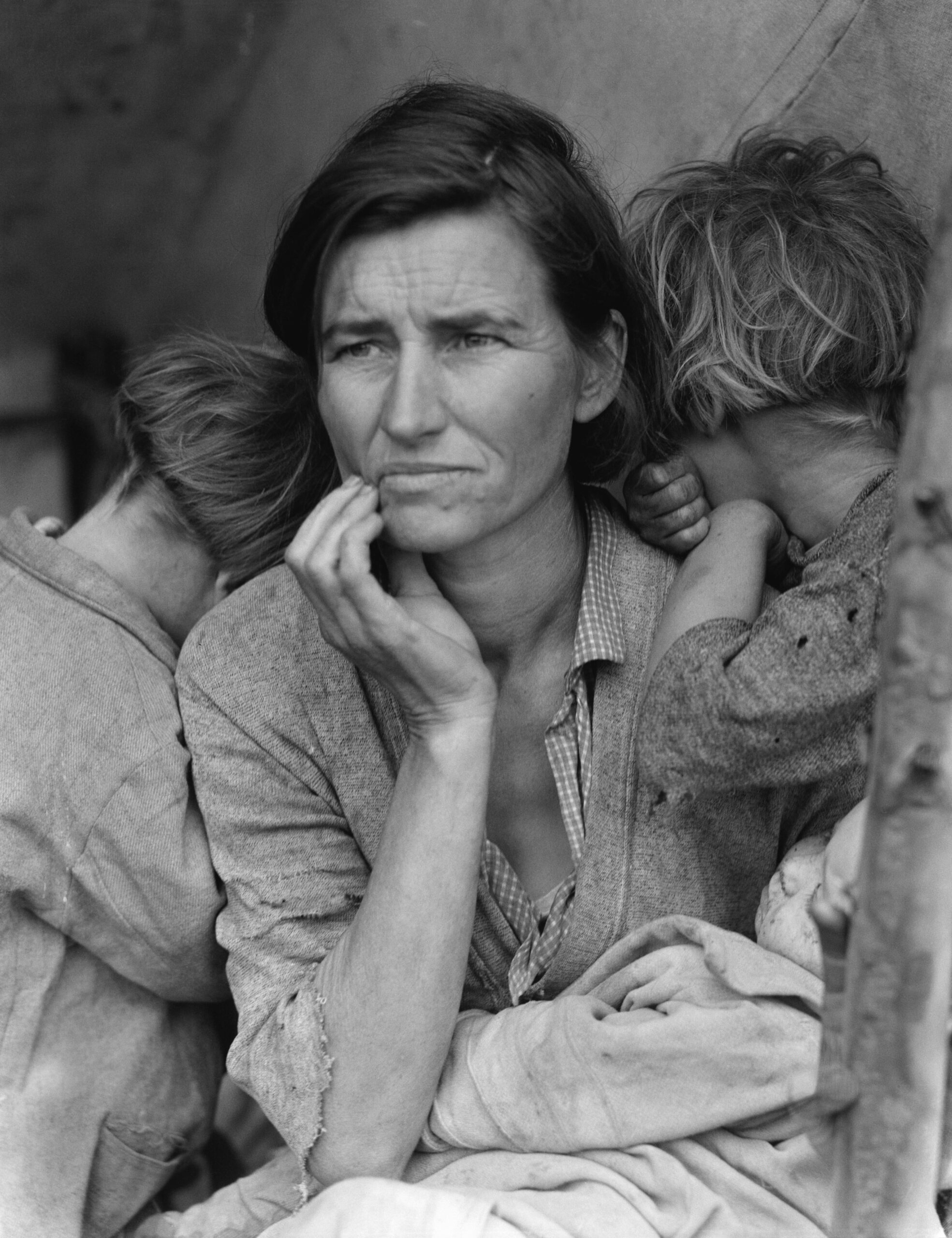
The Migrant Mother photograph holds a single woman at its center. Florence Owens Thompson sits in a canvas lean-to, an infant nestled in her lap. Two older children lean into her shoulders, their faces turned away from the lens. Her right hand rests against her cheek, while her eyes look past the camera at something the viewer never sees.
Lange built the frame with care. The mother forms the apex of a loose triangle, with the children sloping down on either side. Because the two children hide their faces, nothing competes with the woman’s expression. The worn tent, the loose strand of hair, the chapped hand: each element points back to her.
Reading the Composition
Photographers still study this picture for its structure. The triangular grouping echoes centuries of paintings of mothers and children, which lends the image a familiar, almost sacred weight. Lange also kept the background plain, so the eye finds nowhere else to travel. Notably, the woman’s gaze breaks a common rule of portrait work. She does not meet the lens, yet the averted look reads as worry rather than distance. The two older children, faces hidden, become quiet weight on her shoulders, while the sleeping infant anchors the lower frame.
Dorothea Lange and the Ten-Minute Encounter
Dorothea Lange did not plan to make an icon on the day she met Florence Thompson. She was driving home to Berkeley after a month of fieldwork, tired and ready to be done. A crude sign reading PEA-PICKERS CAMP slid past her windshield. Lange drove on for 20 miles before she turned the car around.
At the camp, Lange walked straight to Thompson, drawn, as she later put it, by a kind of magnet. She made her exposures fast and asked few questions. Lange never recorded the woman’s name. She learned only a handful of facts: the family had eaten frozen vegetables and birds the children caught, and Thompson had sold the tires off her car to buy food.
Lange’s Own Account of the Sequence
Years later, Lange described the meeting in print. She wrote of making five exposures, working closer and closer from the same direction. The woman, Lange recalled, seemed to grasp how the pictures might help her, and so she let the camera come near. Lange felt a rough equality in the moment. Still, the exchange was uneven: she drove away with the pictures, and Thompson received nothing for them.
The Camera and Technique Behind Migrant Mother

Lange worked the Nipomo sequence with a Graflex Series D, a large-format reflex camera. It exposed sheet film one 4 by 5 inch sheet at a time. The photographer loaded each sheet into a holder, framed the scene through a top viewfinder, and had no way to check the result until the film reached a darkroom.
Because the camera held so few frames, Lange had no room to shoot freely. Every sheet of film demanded a reason. As a result, she moved with intent, shifting her distance and angle between exposures rather than firing at random. This discipline shaped the final picture. For any photographer today, the lesson holds even with a full memory card: decide before you press the shutter.
Working the Subject, Frame by Frame
The sequence shows a photographer closing in. Lange’s first frames sit back to take in the lean-to, the children, and the camp around them. With each exposure, she stepped nearer. By the final frame, she had cropped the world down to one mother and her children. The wide views give context, while the close view delivers the feeling.
Black and white film also did part of the work. Stripped of color, the picture reduces to light, shadow, and the texture of a hard life. The approach links the image to a long line of photographers who convey emotion in black and white. Lange had trained first as a studio portrait photographer, and her years of reading faces show in every frame of the sequence.
Florence Owens Thompson: The Woman in the Frame
For 40 years, the public knew the Migrant Mother only as a symbol, not as a person. Her name was Florence Owens Thompson. Born in 1903 in Indian Territory in Oklahoma, she was a Cherokee woman who came west with her family during the hard farm years of the 1920s and 1930s.
By 1936, Thompson had already lived through more loss than most. Her first husband had died of tuberculosis years earlier. She supported her children through field labor, following the crops across California. By her own account, she had picked several hundred pounds of cotton in a single day as a field hand. On the day Lange found her, Thompson was 32 and stranded at a camp where the pea harvest had frozen in the ground.
Four Decades Without a Name
Lange’s notes never carried Thompson’s name, so the woman in the picture stayed anonymous for decades. The image ran in newspapers, textbooks, and on museum walls, while the person inside it lived quietly and unrecognized. Here the picture shares an odd fate with the first photo ever taken, an image lost to the public for years after it was made. Thompson watched her own face turn famous and earned nothing from it.
The wait ended in 1978. A reporter for the Modesto Bee tracked Thompson to a mobile home in Modesto, California. She finally spoke about the photograph, and her words were not warm. Thompson told the reporter she wished Lange had passed her by, since the image had brought fame but no relief.
The Retouched Negative and the Missing Thumb
Look closely at the lower-right corner of the early prints, and a thumb appears. It belonged to Florence Thompson, at the lower edge of the frame. The thumb sat in plain view in the original negative.
The retouching came later, and it came from Lange’s side. Some years after 1936, Lange had the thumb painted out of the negative, because she read it as a flaw in an otherwise clean frame. The decision did not sit well with everyone. Roy Stryker, who ran the FSA project, treated the documentary record as something a photographer should leave alone.
Two Ways to Read the Same Photograph
The edit still divides photographers. One side sees a clear breach. A documentary photograph claims to show the world as it is, so altering the negative, even slightly, chips at the picture’s promise of truth.
Others call the change minor. The thumb carried no meaning and added nothing, and removing it pulled no fact from the scene. By this reading, the edit tidied a corner without bending the record. Both views surface again whenever an editor alters a news image today.
How the FSA Turned One Negative Into an Icon
Lange was on the road for the Resettlement Administration, a New Deal agency. Its photography unit soon moved into the Farm Security Administration, and the full body of work is now known as the FSA collection, held today by the Library of Congress. Roy Stryker ran the project, and he sent photographers across the country to record rural poverty.
The picture moved fast once Lange reached San Francisco. She brought her prints to the San Francisco News and described the hunger she had seen at the camp. The paper printed the photographs within days. Soon after, the federal government rushed roughly 20,000 pounds of food aid toward Nipomo. A single photograph had pushed a government to act, and it did so within weeks of the shutter press.
What the Photograph Set in Motion
The aid came too late for Thompson herself. By the time the food reached Nipomo, she and her children had packed up and moved on to the next job. The relief reached the families still in the camp, yet the woman whose face had drawn the attention received none of it.
Stryker rated the picture the finest work of the whole project. He called it the photograph of the FSA. The agency placed the image everywhere, and editors reprinted it for years. Out of thousands of FSA negatives, this one frame became the face of the era, in large part because the government spread it so widely.
Was Florence Thompson Exploited?
The compensation question has followed the Migrant Mother photograph for decades. Florence Thompson posed for one of the most famous images ever made, and she never earned a dollar from it. Lange did not record her name, and the public knew her only as a symbol for 40 years. Whether all of this amounts to exploitation has no settled answer.
Two Sides of the Question
One reading is direct. Thompson gave her face and her hardship to a photographer, and she received nothing in return. She later said the image trapped her family in a single bad moment, a portrait of defeat she had never chosen. Her children recalled how the photograph embarrassed her for years. By this view, a photographer took a struggling woman’s likeness while she stayed poor and unnamed.
A second reading sets the picture in its public role. The photographs were federal government property, placed in the public domain, so no one held a copyright to sell. Lange drew a government salary and earned no royalties from the image. Any newspaper or publisher was free to reprint it without a fee. The picture also drew real help to migrant families, including the food aid rushed to Nipomo. By this view, the work served a public purpose, and no private gain came from Thompson’s hardship. Both readings carry weight, and the Migrant Mother photograph has never fully shed either one.
Thompson’s Final Years
Thompson’s feelings toward the picture softened in her last years. In 1983, she fell seriously ill, and her family faced bills they had no way to pay. They made a public appeal, and letters arrived from people who knew her only as the Migrant Mother.
Strangers sent roughly 35,000 dollars in donations. The money came too late to reshape her life, yet it showed the picture still moved people decades later. Florence Thompson died in 1983. Her grave marker names her as the Migrant Mother and calls her a legend of the strength of American motherhood.
The Legacy of the Migrant Mother Photograph
The Migrant Mother photograph outlived everyone in it. Its image has appeared on a United States postage stamp, in countless textbooks, and on gallery walls worldwide. It remains the first picture most people see in their minds at the words Great Depression.
Its reach also set a pattern for documentary photography. Photographers saw in Lange’s work how one careful portrait carries a public message farther than a page of statistics. Generations of photojournalists who followed built on her example.
A Template for Documentary Photography
Lange’s photograph still shapes how photographers approach hard subjects. It shows the value of patience, of working a scene, and of stepping closer when the wide frame says less. The picture also raises harder questions, about consent and about credit.
Lange’s picture sits beside other landmark photographs in the medium’s history. It belongs in the same conversation as aviation’s most famous photograph and Muybridge’s study of a galloping horse, two more images the public never forgot. To see where it fits in the wider story, the full history of photography timeline places these moments in order.
Ninety years on, the picture keeps its hold. Florence Thompson lived a long and difficult life beyond the ten minutes Lange spent with her. Yet the Migrant Mother photograph froze her at her lowest point, and the world chose to remember her there. The photograph asks every viewer to look past the symbol and recall the person inside the frame.
Frequently Asked Questions
When was the Migrant Mother photograph taken?
Dorothea Lange made the Migrant Mother photograph in March 1936. She shot it during a brief stop at a roadside pea-pickers’ camp, near the end of a long fieldwork trip across California.
Where was the Migrant Mother photograph taken?
Lange photographed Florence Thompson at a pea-pickers’ camp near Nipomo, California. The pea crop had frozen in the fields, so the workers had no pay and little food to show for the season.
Who was the woman in the Migrant Mother photograph?
The woman was Florence Owens Thompson, a 32-year-old mother and field worker of Cherokee descent. She stayed unidentified in public for about 40 years, until a newspaper reporter found her in 1978.
What camera did Lange use for Migrant Mother?
Lange used a Graflex Series D, a large-format reflex camera loaded with 4 by 5 inch sheet film. She made a short sequence of exposures, stepping closer to her subject with each frame.
Was the Migrant Mother photograph edited?
Yes. Some years after 1936, Lange had the thumb in the lower-right corner painted out of the negative. Roy Stryker, who led the FSA project, disliked the change, since the program’s documentary work was meant to stay unedited.
Why is the Migrant Mother photograph so famous?
The Migrant Mother photograph put a single human face on a national crisis. Federal agencies spread the image widely, and its mix of plain dignity and clear distress made it the lasting symbol of the Great Depression. It also stands as a defining work of American documentary photography.
Heads up: a few links here are affiliate links. If you buy through one, PhotographyTalk earns a small commission, no extra charge to you. Enough for a cup of coffee, and we appreciate it.

