


Quick Facts:
- Photograph: Roger Fenton’s 1855 Crimean photograph
- Date taken: April 23, 1855
- Photographer: Roger Fenton
- Location: A ravine outside Sevastopol, Crimea
- Process: Wet plate collodion on glass
- Equipment: Field camera, mobile darkroom in a “photographic van”
- Surviving versions: Two plates, cannonballs on the road and cannonballs off the road
- Holdings: Library of Congress, Royal Collection, Getty, Art Institute of Chicago, Musee d’Orsay
- Rights: Public domain (age)
- Best for: Readers exploring the Valley of the Shadow of Death and the roots of war photography
11 min read
In This Article
Valley of the Shadow of Death Overview: The First Iconic War Photograph
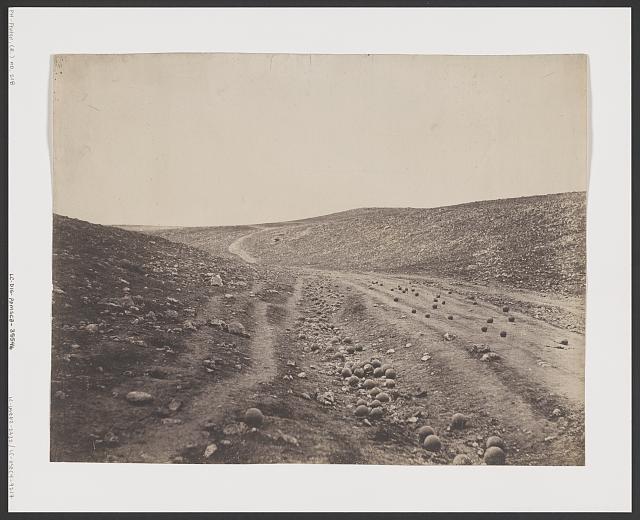
A battered track outside Sevastopol, lined and littered with spent iron, runs into the distance under a heavy sky. Roger Fenton exposed his Valley of the Shadow of Death there on April 23, 1855. Today, many photo historians, the Library of Congress among them, rank it as one of the first iconic war photographs. It also carries an enduring debate about whether Fenton arranged the cannonballs before tripping his shutter.
The full story runs from a Manchester print-seller’s commission to one of the most studied controversies in photography. First, you will read who took the photograph and where the valley sat. Then you will see how the wet plate process worked under fire, and why two versions still drive a debate. Above all, the photograph holds a clear spot on the history of photography timeline as the camera’s first sustained look at war.
The single-photo histories of Migrant Mother and Earthrise both rest on debates of their own. Fenton’s image, however, came first. Decades before Mathew Brady’s American Civil War work and a century before Robert Capa, the Crimean photograph was already showing the world what war looked like through a lens.
The Photograph at a Glance
Here are the core details of the photograph. The table below sets out the frame, the photographer, the process, and the holdings before the full story.
| Detail | Information |
|---|---|
| Title | The Valley of the Shadow of Death |
| Photographer | Roger Fenton |
| Date | April 23, 1855 |
| Location | A ravine outside Sevastopol, Crimea |
| Process | Wet plate collodion on glass |
| Field setup | Mobile darkroom in a converted wine merchant’s wagon, the “photographic van” |
| Commission | Thomas Agnew & Sons, Manchester print sellers |
| Surviving versions | Two plates: cannonballs on the road, cannonballs off the road |
| Holdings | Library of Congress, Royal Collection, Getty, Art Institute of Chicago, Musee d’Orsay |
| Copyright status | Public domain by age |
Inside the Valley of the Shadow of Death
The valley sat outside Sevastopol, on the road between the British camp and Balaclava harbor. Russian artillery on the high ground shelled it daily during the long siege. British soldiers moving supplies and the wounded crossed under fire, and the path filled up with spent cannonballs. They took to calling it after Psalm 23, where the speaker walks through “the valley of the shadow of death.” The name stuck on maps and in letters home.
Two valleys near Sevastopol carried similar names. The other, often confused with Fenton’s, was south of Balaclava, the gully Alfred Lord Tennyson made famous in “The Charge of the Light Brigade.” South Valley, as the British called it, hosted the cavalry charge in October 1854. Fenton photographed his image in a different ravine, six months later, on a different stretch of road.
The road in Fenton’s frame is a battered supply track running roughly east to west. Cannonballs lie in heaps along the road and in the ditches alongside. No soldiers stand in the picture. No bodies appear. Only the cannonballs and the empty path mark what happened there. Soldiers reported gathering and stacking the iron daily so they had room to move supplies, then the next bombardment refilled the road.
Roger Fenton: The Photographer Behind the Frame

Roger Fenton was born in 1819 in Lancashire, England. He trained first as a painter, then qualified as a barrister, and finally moved into photography in the early 1850s. By 1853, he had helped found the Photographic Society of London, the body later known as the Royal Photographic Society.
The Crimean War commission came from Thomas Agnew & Sons, a Manchester firm of print sellers. Agnew planned to sell engravings made from Fenton’s photographs to a British public reading bleak war coverage in the newspapers. Therefore the brief, in practice, leaned toward dignified scenes: officers, encampments, equipment, and the land itself. Dead bodies and wounded men were not on the program.
Fenton sailed for the Crimea in February 1855 and reached Balaclava in March. He photographed for roughly three months in the heat and dust. By late June, cholera in the camps and his own illness sent him home. He had exposed more than three hundred glass plates and produced an unmatched body of work from a 19th-century war.
After the Crimea, he kept working in landscape, architecture, royal portraiture, and orientalist still life. Then, in 1862, Fenton left photography and returned to law full time. He died in 1869, age 50, his career as a photographer barely a decade long. Even so, the Crimean work defined his career, and the field workflow behind it is the next part of the story.
How Fenton Made the Photograph in the Field
The process behind the photograph was wet plate collodion, the dominant photographic technique of the 1850s. A glass plate had to be coated, sensitized, exposed, and developed within roughly ten to fifteen minutes, before the chemistry dried on the plate. Out in the field, this schedule forced every photographer into a moving darkroom.
Fenton’s solution was the photographic van. He bought a converted wine merchant’s wagon, fitted it with a skylight, chemical racks, and water tanks, and drove it across Crimea with a team of horses. The van served as both a darkroom and a hot, cramped workshop. Soldiers learned to spot it and sometimes mistook it for an ammunition wagon. Russian artillery shelled the van more than once.
Wet Plate Under Fire
Crimean heat punished the workflow. By midday, plates dried before Fenton had time to expose them. As a result, much of his work happened early in the morning or late in the afternoon, when the chemistry held. The exposure itself took several seconds on a stable subject, longer in shade. So Fenton avoided action shots not by choice alone, but by physics.
Fenton’s frame sits well inside the medium’s limits. The road is empty. Nothing in the picture moves. Even light falls across the scene, and the cannonballs cast clean shadows pinning the time of day. For a wet plate photographer working with horses, glass, and chemistry under shellfire, the picture was the kind of subject the kit handled cleanly.
The Two Versions of the Valley of the Shadow of Death
Two distinct plates survive from the same view, taken within roughly an hour. In the first, the cannonballs lie in the ditches and slopes on either side of the road. The road itself runs largely clear. In the second, the cannonballs cover the road as well, in clusters running into the distance.
Both versions are real Fenton plates. The Library of Congress, the Royal Collection, the Getty, the Art Institute of Chicago, and the Musee d’Orsay hold prints from one version or the other. For decades, museums showed the cannonballs-on-the-road plate as the canonical image. Few viewers knew a second version existed.
The question of which plate came first, and what happened between them, drives the rest of the story. If the road version came first, the cannonballs in the ditches were tidied up afterward, which would be an odd choice. If the off-the-road version came first, the cannonballs on the road were placed there before the second exposure. This second reading, if correct, makes the photograph an early example of staging in war photography.
The story also has a deeper twist. Cannonballs were a precious commodity at the siege. Soldiers gathered them to recycle the iron or, in the case of Russian rounds, to fire them back. As a result, moving cannonballs onto a road, even for a photograph, would have meant taking them out of a working supply chain. Any answer about Fenton’s intent has to account for the iron’s value.
Errol Morris and the Susan Sontag Debate
Susan Sontag set the modern debate going in 2003. In her book “Regarding the Pain of Others,” she argued Fenton had placed the cannonballs on the road himself, building on earlier scholarship by the German art historian Ulrich Keller. Her short verdict was unflattering. Fenton, she wrote, had improved the image and lied about the war.
Four years later, filmmaker Errol Morris took up the question in a three-part series for The New York Times titled “Which Came First, the Chicken or the Egg?” He spent months on it. He flew to the Crimea. He photographed the road himself, talked with scholars and physicists, and ran shadow analyses on both plates. The series later grew into his 2011 book “Believing Is Seeing.”
From Sontag’s Claim to a Shadow Test
Morris’s central tool was the position of the sun. Shadows in both plates point in the same general direction, so the two exposures happened within a window of perhaps an hour. By matching the angle of light to specific stones and ruts, Morris worked out the order. He concluded the off-the-road version came first, and the cannonballs-on-the-road version followed.
If Morris is right, someone (Fenton, an assistant, or a soldier on hand) moved cannonballs onto the road between the two exposures. The change did not turn a peaceful path into a war zone; the path was already a war zone. It did, however, sharpen the picture’s drama and earn it a longer second look.
Not every scholar accepts Morris’s order. Some argue both orderings remain plausible, since the shadow shifts are small and the plates are not perfectly aligned. Even so, his case is the most careful one anyone has built. The debate now turns on small differences in shadow and stone, not on lazy assumption.
The argument also extends a thread the modern era keeps pulling on. Dorothea Lange’s Migrant Mother faced its own debate about exploitation and a retouched negative. The Apollo 8 Earthrise photo still gets published in a rotated orientation. Honesty in a single famous frame is a problem photography has carried since 1855.
Why the Photograph Still Matters
The Crimean War made photography a witness. Fenton’s images, including this one, reached British audiences as exhibition prints and as engravings in newspapers. Readers saw, for the first time in any number, what a far-off war looked like in a camera frame, even if no bodies appeared. From then on, the demand for war pictures only grew.
London responded fast to the work. In September 1855, for instance, Agnew opened a Fenton exhibition at the Society of Painters in Water Colours on Pall Mall East, with 312 prints on the walls. Among the visitors were Queen Victoria and Prince Albert. As a result, the Crimean War, fought thousands of miles from London, finally had a clean window into British drawing rooms.
From Fenton to the American Civil War
Within a decade, Mathew Brady, Alexander Gardner, and Timothy O’Sullivan were photographing the American Civil War, and the dead were in the frame. Their work, in turn, made later war photography possible. Fenton’s careful, almost landscape approach now reads as the first chapter of a long book.
The photograph also seeded an unfinished debate. Muybridge’s Horse in Motion proved the camera captures what the eye misses. Fenton’s frame proved the camera also chooses, frames, and arranges. Both lessons sit at the start of modern photography, beside the first photo ever taken.
Fenton’s plates live today on the websites of the institutions holding them. The Library of Congress entry, for example, sits at the Library of Congress catalog, fully public domain, free for any reader to download and study. Few historic photographs sit so cleanly inside open use.
Frequently Asked Questions
Where Was Fenton’s Valley?
The valley sat outside Sevastopol, on the road between the British camp and Balaclava harbor. It is not the same valley as Tennyson’s “Valley of Death” from “The Charge of the Light Brigade,” which was further south. Russian artillery shelled the road regularly, and British soldiers nicknamed it after Psalm 23.
Who Took the Photograph?
Roger Fenton, an English photographer and former barrister, took the photograph in April 1855. He traveled to the Crimea on commission from Thomas Agnew & Sons, a Manchester print seller. He worked from a mobile darkroom in a converted wine wagon and exposed more than three hundred plates during his three months in the field.
What Is the Valley of the Shadow of Death?
The Valley of the Shadow of Death is an 1855 photograph by Roger Fenton of a road covered with spent cannonballs in the Crimean War. The same phrase appears in Psalm 23, so search results often mix the photograph with religious content. This article is about the photograph and the road, not the Psalm.
Why Are There Two Versions?
Fenton exposed two plates of the same road within roughly an hour. In one, cannonballs sit only in the ditches alongside the road. In the other, cannonballs cover the road itself. Both plates have survived, and museums hold prints from each. The reason for the change is the heart of the staging debate.
Did Fenton Stage the Photograph?
The strongest available analysis, by filmmaker Errol Morris in 2007, argues yes, the cannonballs-on-the-road plate came second, and cannonballs were moved onto the road between exposures. Some scholars still disagree. Either way, the photograph belongs to the long history of editorial choice in documentary work.
Was This the First War Photograph?
Fenton was one of the first photographers to cover a war in depth, though not the absolute first to point a camera at conflict. Earlier daguerreotypes of the Mexican-American War (1846-1848) survive. What Fenton produced, however, was the first large, sustained, widely circulated body of war photography, and this photograph remains its most lasting image.

