


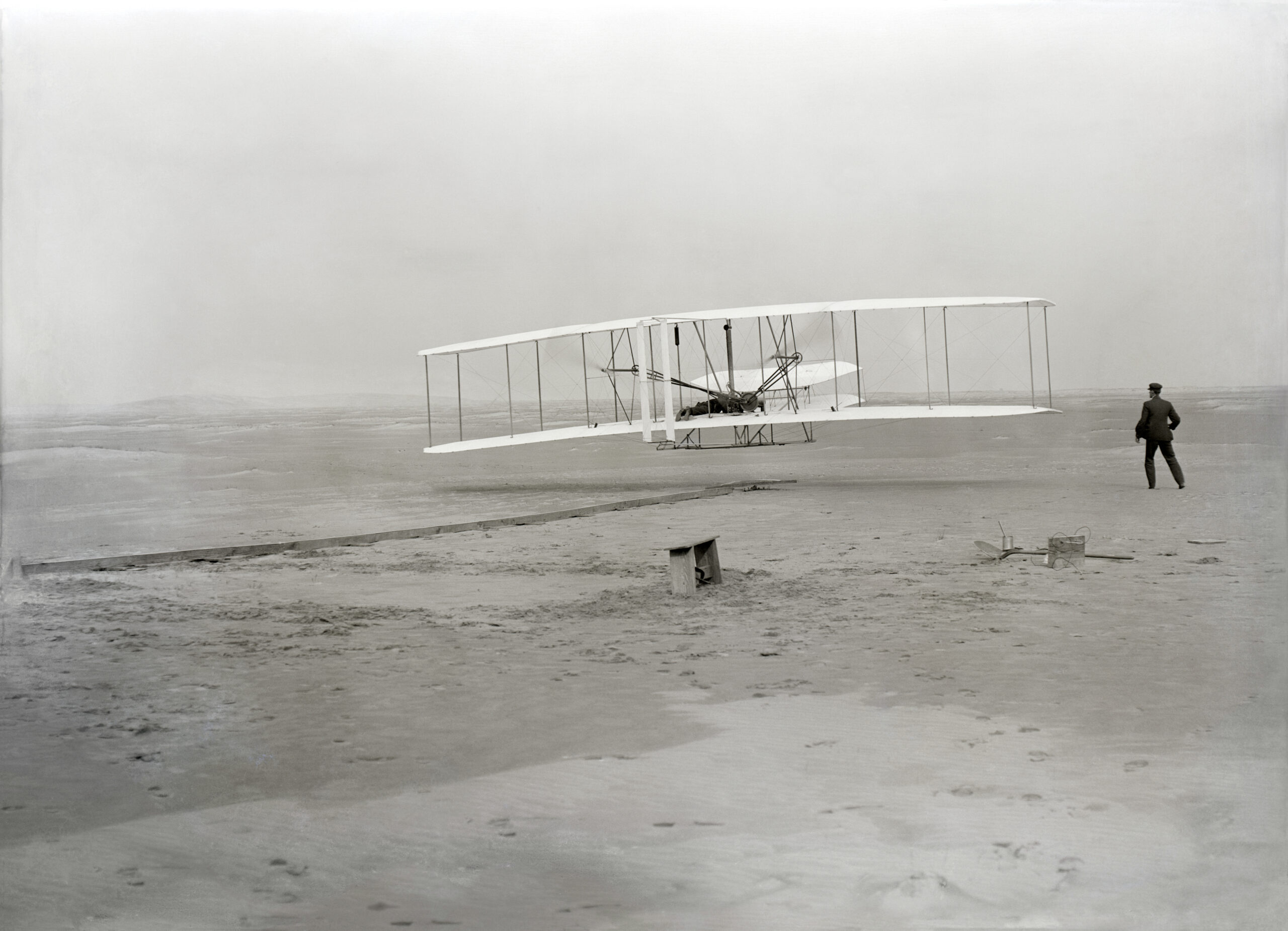
Quick Facts:
- Subject: The Wright brothers first flight photograph
- Date and time: December 17, 1903, around 10:35 a.m.
- Place: Kill Devil Hills, near Kitty Hawk, North Carolina
- Pilot in the photo: Orville Wright
- Photographer: John T. Daniels, a local lifesaver
- Camera: A Gundlach Korona V view camera on a stand
- First flight: 120 feet in 12 seconds
- Why it matters: The first photograph of powered, controlled flight
11 min read
A personal note before the history. Long before I trained as a pilot, I was a kid who read everything I found about the Wright brothers. This photograph of the first powered flight has stayed with me ever since. If aviation moves you at all, I think it will stay with you too.
In This Article
- The Wright Brothers First Flight: An Overview
- Key Facts at a Glance
- The Photograph: One Frame, One Chance
- John T. Daniels: The Man Who Took the Shot
- How the Shot Was Set Up
- The Four Flights of December 17, 1903
- Did the Wright Brothers Fly First?
- The Smithsonian Feud
- The Legacy of the Wright Brothers First Flight
- Frequently Asked Questions
The Wright Brothers First Flight: An Overview
The photograph of the Wright brothers first flight froze a single moment: a fragile biplane lifting off the sand, with Orville Wright lying flat at the controls. A local lifesaver named John T. Daniels pressed the shutter. He had never held a camera before. The image is now one of the most reproduced photographs in the world, and it remains the proof of powered flight, captured on a windy North Carolina morning.
If you have ever set up a camera for one important shot, you know the pressure Daniels faced. He had one frame, one chance, and a machine no one had ever photographed in the air. This article tells the whole story. It covers the photograph itself, the man who took it, the four flights of the day, and the long arguments over who flew first.
Photography in 1903 was slow, heavy, and unforgiving. A view camera held a single glass plate, and one missed exposure meant a lost moment forever. Against those limits, a first-time photographer still caught aviation’s defining instant on a single sheet of glass.
Key Facts at a Glance

Here are the essentials of the Wright brothers first flight photograph before the full story.
| Detail | Information |
|---|---|
| Subject | The first powered, controlled flight, December 17, 1903 |
| Photographer | John T. Daniels, Kill Devil Hills Life-Saving Station |
| Pilot in the image | Orville Wright |
| Location | Kill Devil Hills, near Kitty Hawk, North Carolina |
| Camera | Gundlach Korona V view camera, 5 by 7 inch glass plate |
| First flight | 120 feet in 12 seconds, around 10:35 a.m. |
| Longest flight of the day | 852 feet in 59 seconds, flown by Wilbur Wright |
| Aircraft | The Wright Flyer, a 12-horsepower biplane |
| Held today by | Library of Congress (negative); the Flyer at the Smithsonian |
The Photograph: One Frame, One Chance
The Wright brothers first flight photograph shows the Flyer a few feet off the ground. Orville lies prone on the lower wing, his hips set in the control cradle. Wilbur stands at the wingtip, having let go of the machine a moment earlier. The launch rail runs across the sand behind them, and the flat Carolina dunes stretch to the horizon.
The framing looks near perfect, and luck was only part of it. Orville had placed the camera with real care before the flight. He aimed it at the spot where he expected the Flyer to leave the rail. When the machine rose, it climbed straight into the frame Orville had already chosen, which is why the composition feels so deliberate.
Why the Photograph Endures
The camera held one 5 by 7 inch glass plate. There was no second exposure and no preview screen. Against the odds, the single negative survived, and the Library of Congress now keeps the Wright brothers’ original glass negatives. You will find the first-flight image there in fine detail, down to the texture of the sand.
Few photographs carry as much weight. The image fixed a 12-second event in permanent form, and it gave the public hard proof the first powered flight had happened. Without it, aviation’s defining moment would rest on eyewitness accounts alone. The photograph turned a fleeting claim into plain, lasting evidence.
On its own terms, the composition still works. The Flyer sits low and slightly left of center, riding a strong diagonal as it climbs off the launch rail. Wilbur, upright and small beside the wingtip, lends the scene a clear sense of human scale. Nothing pulls the eye away, since the open dunes behind the machine stay bare and quiet. A trained photographer would be proud of the framing, and a complete beginner captured it on his only attempt.
John T. Daniels: The Man Who Took the Shot
John T. Daniels was not a photographer. He was a surfman at the Kill Devil Hills Life-Saving Station, one of the men who watched the coast for shipwrecks and pulled sailors from the surf. The Wrights had befriended the station crew over several seasons, and the lifesavers often helped haul, hold, and launch the gliders.
On the morning of December 17, the Wrights asked Daniels to operate the camera. Orville showed him the rubber shutter bulb and told him exactly when to squeeze it. Daniels later admitted he was so caught up in the excitement of the moment, he was not sure he had pressed the bulb at all.
He had. The plate held a clean, sharp exposure of the first powered flight, the single most important instant in aviation history. It was also the only photograph John T. Daniels ever took. The photographers behind history-defining images are often trained masters, yet this one was a first-timer with steady nerves.
Daniels paid a price later the same day. After the fourth flight, a hard gust caught the parked Flyer and flipped it end over end across the sand. Daniels was caught between the wings and tumbled with the wreck, though he escaped serious injury. Daniels died on January 31, 1948, only one day after Orville Wright.
How the Shot Was Set Up
Behind the calm photograph sat hours of careful preparation. Orville used a Gundlach Korona V view camera, a wooden box built to hold a single sheet of glass. He set it on a sturdy stand near the launch rail, well before the engine was started, so nothing would need adjusting at the critical moment.
Orville did the hard part himself. He framed the shot, focused the lens, and chose the exact spot where the Flyer would cross. He fixed the camera in place for a locked, steady aim, the same logic behind mounting the camera on a tripod for any one-chance shot today.
All Daniels had to do was time the squeeze. Because Orville had pre-aimed and pre-focused the camera, a hard photograph became a single simple act. The skill sat in the setup, not the shutter press. For any photographer chasing one unrepeatable moment, the lesson still holds: prepare the frame first, so the moment only has to arrive.
A Process With No Second Try
The glass-plate process raised the stakes further. The medium had come a long way since the first photograph ever taken, yet it still left no room for a mistake. Each dry plate had to be loaded into a holder, exposed a single time, and developed later in a darkroom, with no way to check the result on the spot. A 5 by 7 inch plate also recorded fine detail, which is why the image still holds up at large print sizes today. After returning home to Dayton, the Wrights developed their plates with care. The first-flight negative came through the process intact, and it has survived for more than a century since.
The Four Flights of December 17, 1903
The Wrights made four flights on the morning of December 17. Orville flew first, at about 10:35 a.m. The Flyer traveled 120 feet and stayed up for 12 seconds. By a modern measure the hop was tiny. As the first powered, controlled flight by a piloted aircraft, it was everything.
The brothers then took turns. The second and third flights reached roughly 175 and 200 feet as the pilots learned the machine. Finally, Wilbur flew the fourth and longest run of the day: 852 feet in 59 seconds. Each flight pushed the Flyer a little further and held it a little steadier in the gusty air.
Kitty Hawk and the Witnesses to the Flight
The location was a deliberate choice. Years earlier, the Wrights had picked Kitty Hawk and the nearby Kill Devil Hills for steady wind, soft sand, and wide open space. Strong coastal wind gave the Flyer extra lift on takeoff. Yet the same wind ended the day, when a gust caught the parked machine and flipped it for good.
A small crowd watched the flights. On the cold morning of December 17, local witnesses gathered at the dunes, most of them from the Kill Devil Hills Life-Saving Station. They had also seen the failed first attempt three days earlier, on December 14, when Wilbur pushed the Flyer too steeply off the rail and stalled it into the sand. Between attempts, the brothers had repaired the minor damage and waited for better weather. The witnesses’ presence later mattered, because it gave the flights independent confirmation.
Did the Wright Brothers Fly First?
The Wrights were first in one precise sense. They made the first powered, controlled, sustained, heavier-than-air flight with a pilot aboard. Every word in the claim matters, because several rival claims hang on the words a challenger leaves out.
Gustave Whitehead, a German-born inventor in Connecticut, is the best-known challenger. His supporters say he flew in 1901, two years before Kitty Hawk. In 2013, Connecticut even passed a law recognizing Whitehead. However, aviation historians at the Smithsonian and elsewhere reject the claim, since no photograph or solid documentation supports a Whitehead flight.
Other names come up too. Brazil honors Alberto Santos-Dumont, whose 14-bis flew in Paris in 1906. New Zealand points to the farmer-inventor Richard Pearse. Each case turns on definitions: powered versus gliding, controlled versus brief, witnessed versus documented. The Wrights meet the strict standard, because they flew under power, under control, and on camera.
The Photograph as the Deciding Evidence
The photograph is part of why the Wrights’ claim holds up. Rival inventors left behind stories, sketches, and secondhand accounts, yet almost no hard images of a machine truly in the air. The Wrights, by contrast, flew in front of named witnesses and a working camera, and they kept detailed notebooks, letters, and logs. Strong evidence, not merely a strong story, settles the question of who flew first. For a photographer, it is a reminder of how much weight a single documented image carries.
The Smithsonian Feud
The Wrights also fought a long battle closer to home. For decades, the Smithsonian Institution credited its own former secretary, Samuel Langley, whose piloted Aerodrome had failed twice in 1903. The Smithsonian called the Aerodrome the first machine capable of powered flight, a claim pushing the Wrights to the side.
Orville Wright refused to accept the slight. In 1928, he sent the original 1903 Flyer to the Science Museum in London rather than hand it to the Smithsonian. As a result, the most important aircraft in American history sat in another country for 20 years, while the dispute dragged on.
The London Years and the Homecoming
The London exile lasted two full decades. From 1928, the original Flyer hung in the Science Museum in London, an ocean away from the country where it had first flown. British curators treated the aircraft with real care, yet the arrangement plainly stung American pride. World War II then pushed the Flyer into protected storage for safekeeping while bombs fell on the city. Only after the war did the long dispute finally begin moving toward a close.
The standoff finally ended. The Smithsonian withdrew its Langley claim, and Orville agreed to bring the Flyer home. He died in early 1948, months before the homecoming he had won. The aircraft went on display at the Smithsonian in December 1948, 45 years after the flight. Today it hangs in the National Air and Space Museum in Washington.
The Legacy of the Wright Brothers First Flight
The Wright brothers first flight changed the world in under a minute of total airtime. Within five years, the brothers were flying for more than an hour at a stretch. Within a single lifetime, aircraft crossed oceans, broke the sound barrier, and carried people to the Moon.
The photograph carried the proof. A 12-second event became a fixed, shareable fact, set permanently into the broader history of photography. Newspapers, museums, and textbooks have run the image ever since, and it still appears wherever the story of flight is told.
There is a lesson in it for any photographer. Daniels succeeded because the real work happened before the shutter ever moved. He framed nothing and focused nothing himself, yet he caught a flawless frame, because Orville had prepared the shot with patience and care.
The first flight belonged to the Wright brothers. The first flight photograph belonged, by pure chance, to a lifesaver with a borrowed camera and one job to do. Both have lasted well over a century. Both still repay a long, close look from anyone who loves aviation or the work behind a great photograph.
Frequently Asked Questions
When was the Wright brothers first flight?
The Wright brothers first flight took place on December 17, 1903, at around 10:35 a.m. Orville Wright piloted it. The flight lasted 12 seconds and covered 120 feet at Kill Devil Hills, near Kitty Hawk, North Carolina.
Who took the Wright brothers first flight photo?
John T. Daniels took the photograph. He was a surfman at the Kill Devil Hills Life-Saving Station and had never operated a camera before. Orville Wright set up and aimed the camera, and Daniels squeezed the shutter bulb at the right instant.
Where was the Wright brothers first flight?
The flight happened at Kill Devil Hills, a few miles from the town of Kitty Hawk, on the Outer Banks of North Carolina. The Wrights chose the spot for its steady wind, soft sand, and wide open space.
How long did the first flight last?
Orville’s first flight lasted 12 seconds and covered 120 feet. The brothers made four flights on December 17, 1903. The longest, flown by Wilbur, reached 852 feet and lasted 59 seconds.
Did the Wright brothers fly first?
By the standard definition, yes. They made the first powered, controlled, sustained flight with a pilot aboard. Rival claims for Gustave Whitehead and others lack the documentation and photographic proof the Wrights have.
Where is the original Wright Flyer now?
The 1903 Wright Flyer hangs in the National Air and Space Museum in Washington, D.C. It spent 20 years in London because of the feud with the Smithsonian, and it returned to the United States in 1948.
Heads up: a few links here are affiliate links. If you buy through one, PhotographyTalk earns a small commission, no extra charge to you. Enough for a cup of coffee, and we appreciate it.

