


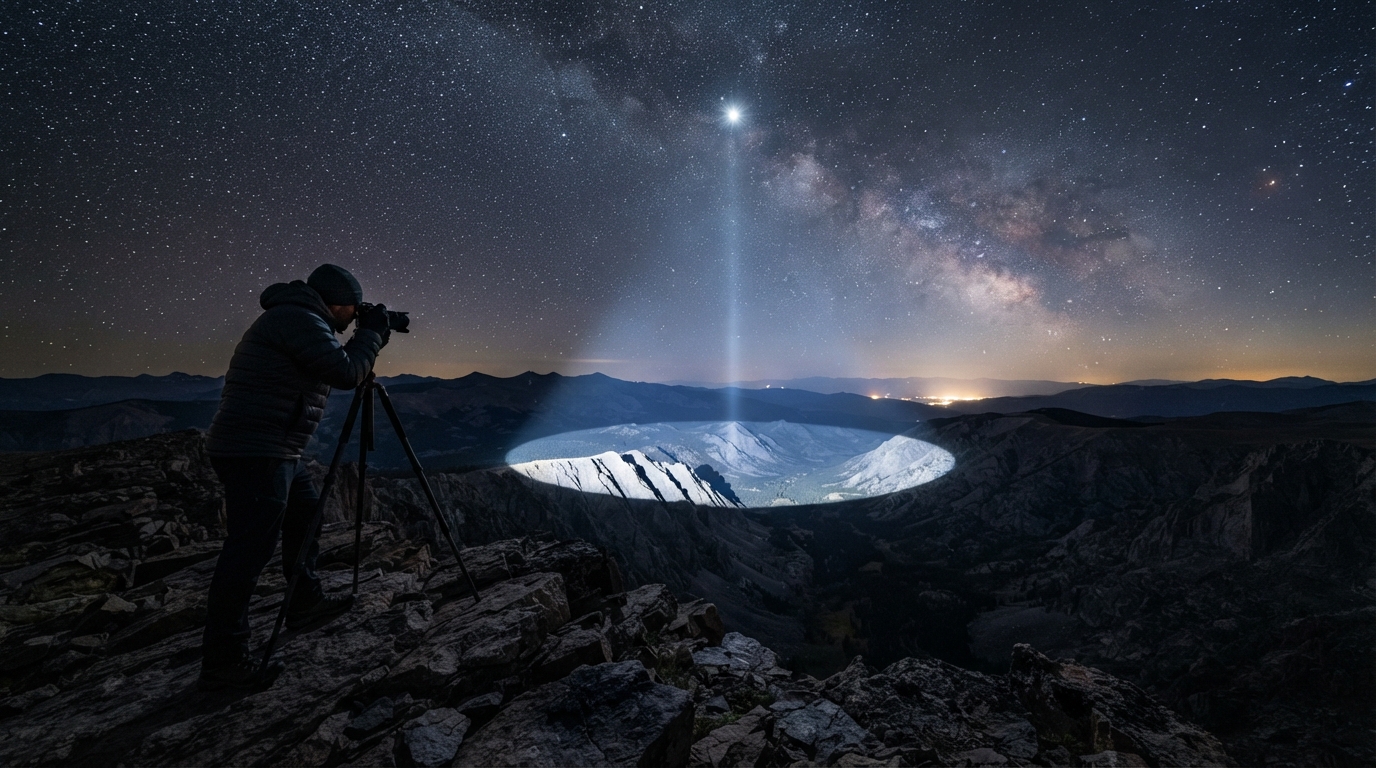
Quick Verdict: The FCC approved a satellite mirror from Reflect Orbital, a California startup. The company plans to beam sunlight to the ground at night for $5,000 an hour. No photographer pays those rates, so the real story runs deeper. For the first time, a company holds a permit to sell artificial daylight. Darkness itself is turning into a product. For night and landscape shooters who depend on genuine dark, the precedent matters more than the single mirror.
Last updated: July 2026 | 8 min read
In This Article
Overview
The FCC approved a satellite mirror from a California startup called Reflect Orbital. Overnight, the decision reshapes what darkness means for every photographer who shoots after sunset. Reflect Orbital plans to launch a single reflector named Eärendil-1 into low orbit. From there, it will bounce sunlight down to a chosen spot on the ground. For the first time, a private business holds a permit to sell artificial daylight by the hour. Your night sky now has a competitor with a price list.
Most coverage frames this story around astronomers and biologists, and their alarm is real. Yet the group with the most direct stake often gets overlooked. The night and landscape photographer depends on real darkness. Reflect Orbital wants to rent out light, while you rely on its absence. Below, you get how the satellite mirror works and who pays for it. You also learn what a sky-for-hire economy means for the images you make in the dark.
Quick Facts
| Detail | Value |
|---|---|
| Company | Reflect Orbital (California) |
| Satellite name | Eärendil-1 |
| Regulator | FCC (approved July 2026) |
| Orbit altitude | About 400 miles up |
| Mirror size | Square reflector nearly 60 feet wide |
| Lit area | Circular patch about 3 miles wide |
| Price | $5,000 per hour, 1,000-hour annual minimum (about $5M/year) |
| Likely buyers | Solar farms, emergency response |
| Long-term plan | 1,000 satellites up to 180 feet wide, as bright as 100 full Moons |
How the Satellite Mirror Works
Reflect Orbital keeps the hardware surprisingly small. The satellite mirror body measures about the size of a bedside table. It rides roughly 400 miles above the surface in low Earth orbit. Once in position, it unfurls a square reflector nearly 60 feet across. From there, the satellite mirror angles toward a booked location and reflects raw sunlight down through the atmosphere.
The beam lands as a circle of light about three miles wide. Inside the ring, the ground brightens to something close to a full Moon on a clear night. Ben Nowack, co-founder of Reflect Orbital, compares the effect to a second Moon on demand. A phone app handles the booking. A paying user picks a spot, sets a window, and waits for the light to arrive.
Physics sets hard limits here. The mirror only works while sunlight reaches it. So it performs best near dawn and dusk. At those hours, the ground sits in shadow while the reflector still catches the Sun. For now, a single unit tracks one target at a time. To light many places at once, Reflect Orbital needs many satellites, which points straight to its far larger ambition.
Why Darkness Now Has a Price Tag
Here is the shift worth sitting with. Until now, darkness was free and public. The Sun set, the sky went dark, and nobody owned the result. A satellite mirror breaks the arrangement, because it turns the night into a service you rent.
Reflect Orbital plans to charge $5,000 for one hour of one mirror. On top of the hourly rate, it asks customers to commit to 1,000 hours a year. In total, the math lands at roughly $5 million annually. No working photographer pays those rates, so you will never book personal daylight for a portrait shoot. Still, the point runs deeper. Once a company sells light on demand, darkness stops being a given and becomes a variable someone else controls.
Consider who benefits. Solar farms lose money the moment the Sun drops, so an extra hour of generation carries real value for them. Emergency crews might want light over a disaster zone. Both cases make commercial sense. Neither cares about the photographer on a ridge, waiting for the last glow to fade.
The natural night has always been your free studio. A satellite mirror introduces a landlord. Even if the beam never touches your frame, the precedent matters. Darkness is now a market, and markets tend to expand.
What Astronomers and Biologists Fear
The scientific pushback arrived fast and loud. Samantha Lawler, an astronomer at the University of Regina in Canada, put the worry plainly. “It’s terrifying to me that one country can change the night sky for everybody in the world,” she told reporters. “I need access to dark skies in order to do my research. If you’ve got giant mirrors shining down, then we’ve lost that.”
Her fear is not abstract. Astronomers already fight a rising tide of satellite trails and skyglow. A fleet of orbital mirrors would add a new and deliberate source of interference. One reflector is a nuisance. A thousand becomes a structural change to the sky itself.
Biologists raise a separate alarm. A group of researchers from Europe, the United States, Japan, and Canada warned about the ecological cost. “The proposed scale of orbital deployment would represent a significant alteration of the natural night-time light environment at a planetary scale,” they wrote.
Their concern centers on the light-dark cycle every living system depends on. Artificial night light disrupts circadian rhythms in humans and animals. It also interferes with animal migration and plant cycles. Even the ocean phytoplankton at the base of the food chain feel the shift. Change the timing of night, and the effects ripple outward through biology you rarely see.
What It Means for Night Photographers
Step back to your own work, and three practical concerns emerge. First, location risk. Reflect Orbital targets specific coordinates. So any spot near a paying solar farm or industrial site sits at risk of stray brightening. The interference might land during the exact golden window you planned around.
Second, the erosion of dark-sky sites. Serious astrophotography already sends you hunting for Bortle 1 and 2 skies far from city glow. Our own astrophotography light pollution forecast tracks how fast those locations shrink. A commercial mirror program adds intentional light on top of the accidental kind. Worse, it aims at the same rural darkness you drive hours to reach.
Third, planning uncertainty. Half the skill of night work is prediction. You study moon phase, weather, and the 500 rule to nail exposure before you leave home. A rentable light source you will not spot on any app throws a new variable into every shoot.
None of this ends night photography. The Moon has always added light, and photographers have long worked around it. Examples run from shooting the Milky Way for beginners to learning solid low-light technique. Still, a satellite mirror is a light you neither predict nor control. And control is the whole game after dark.
Dark Skies Are Becoming a Vanishing Resource
The satellite mirror does not arrive in a vacuum. It lands in the middle of a decades-long trend. Light pollution already doubles in many regions every eight years or so. Every new subdivision, warehouse lot, and stadium pushes skyglow higher. Meanwhile, the darkest sites keep retreating toward the poles and the open ocean.
For photographers, the loss is measurable. A rural backyard rated Bortle 4 today drifts toward Bortle 6 within a generation on current trajectories. The structured band of the Milky Way fades into a dim smudge. Techniques age out too. The beginner astrophotography tips you rely on assume a sky dark enough to record faint detail. Each year, fewer places deliver it.
An orbital mirror program speeds the same curve from a new direction. Ground light creeps upward from below. A satellite mirror pours it down from above. Squeezed between the two, the genuinely dark frame becomes a scarce resource. You travel farther and pay more to find it, much like clean air or quiet.
Final Thoughts
Reflect Orbital holds one permit and one small reflector. So the sky above you looks the same tonight as it did last week. The company still needs to launch Eärendil-1, prove the concept, and survive the fight already forming around it. Plenty of ambitious space ventures stall at exactly this stage.
The larger vision deserves your attention anyway. Reflect Orbital envisions 1,000 mirrors, some 180 feet wide and as bright as 100 full Moons. Such a fleet describes a different sky from the one photographers have always worked under. Either way, the FCC decision sets a precedent: private light, sold by the hour, aimed at the ground.
Your best response is practical, not fearful. Keep chasing dark-sky sites while they last. Learn the fundamentals cold, including how to read the Moon. A guide to photographing the Moon teaches the same light math a rented reflector demands. Darkness is turning into something people buy and sell. Understanding it makes you a sharper photographer either way.
Frequently Asked Questions
What is the satellite mirror the FCC approved?
Reflect Orbital, a California company, received FCC approval for Eärendil-1, a single satellite mirror bound for low Earth orbit. The satellite unfurls a reflector nearly 60 feet wide. It bounces sunlight to a booked location, lighting a circle about three miles across.
How much does an hour of satellite light cost?
Reflect Orbital plans to charge $5,000 per hour for one mirror, with a commitment of 1,000 hours a year. The annual total reaches roughly $5 million, well beyond any photography budget. Solar farms and emergency operations are the likely first customers.
Will the satellite mirror ruin astrophotography?
One reflector will not end astrophotography, since it lights a narrow patch and works mainly near dawn and dusk. However, the company’s plan for 1,000 larger mirrors worries astronomers. A fleet of such size would brighten dark skies worldwide and add to existing light pollution.
Why are scientists opposed to the space mirror?
Astronomers fear the loss of dark skies needed for research. Meanwhile, biologists warn about disrupted circadian rhythms in humans, animals, and even ocean phytoplankton. Both groups point to the planetary scale of the plan. Artificial night light interferes with natural light-dark cycles across whole ecosystems.
Will photographers ever use the satellite mirror for their shoots?
In practice, no. At $5 million a year, the service targets industrial buyers rather than individuals. For night and landscape photographers, the satellite mirror matters as a threat to natural darkness rather than as a tool. So your energy is better spent protecting access to genuinely dark locations.
Sources: Federal Communications Commission, Reflect Orbital.

