


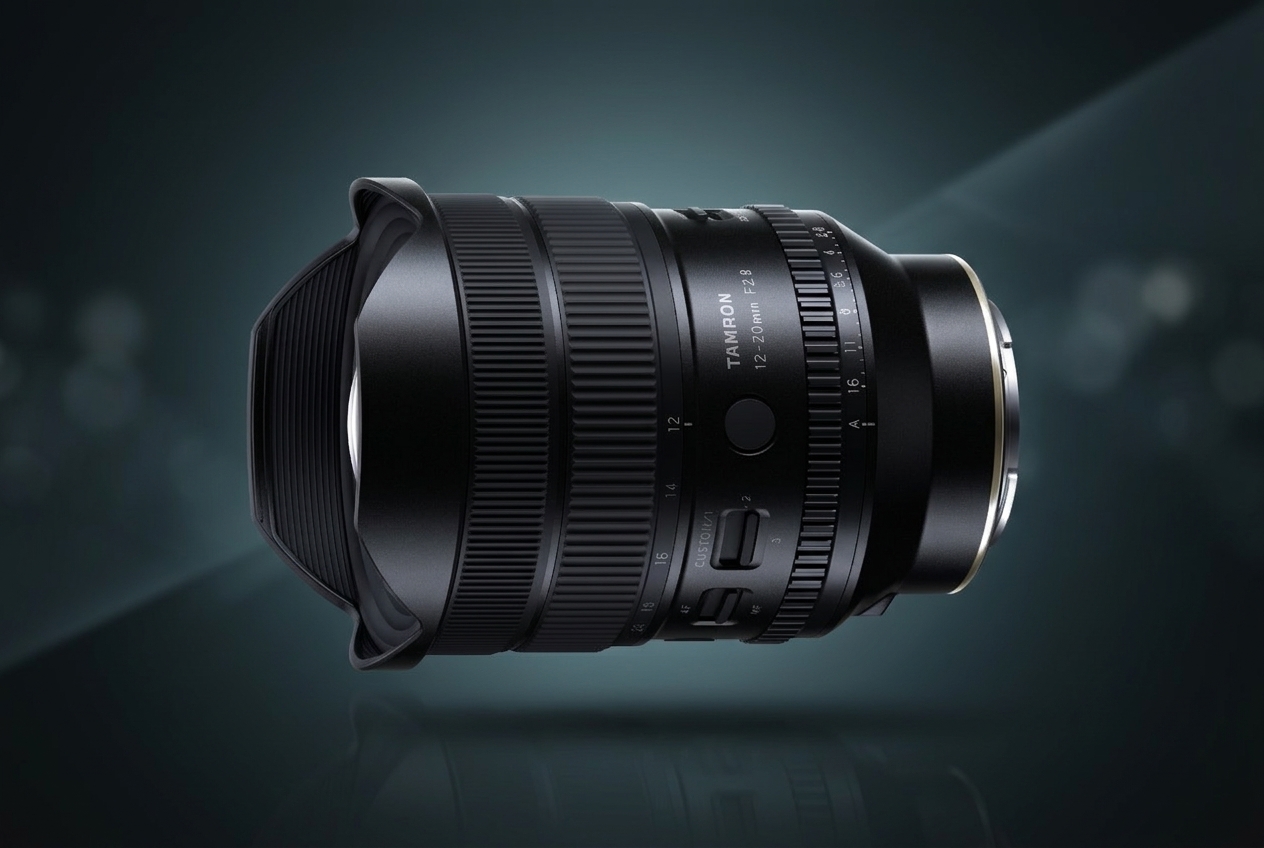
Quick Facts:
- Product: Tamron 12-20mm f/2.8 (Model A084)
- Mounts: Sony E and Nikon Z, full-frame
- Aperture: Constant f/2.8, wide-open through f/16
- Weight: 570g (Sony E), 585g (Nikon Z)
- Filter: Rear gel holder, no front thread
- Autofocus: VXD linear motor
- Price: $1,699 (Sony E), $1,799 (Nikon Z)
- Availability: July 30 (Sony), August 27 (Nikon)
- Best for: Landscape, real estate, and travel shooters who want 12mm reach
7 min read
In This Review
Tamron 12-20mm f/2.8 Overview: Ultra-Wide Value for Sony and Nikon
The Tamron 12-20mm f/2.8 is a full-frame ultra-wide zoom for Sony E and Nikon Z. It reaches a true 12mm and holds f/2.8 across the whole range. Tamron announced the lens on July 15, 2026, with a $1,699 launch price for Sony. Because it chases the same buyers as first-party G Master glass, the value question drives this review.
You get the widest autofocus zoom Tamron has built for full-frame mirrorless. Landscape shooters gain two extra millimeters over the common 14mm starting point. Cramped interiors and real estate shoots benefit from the same width. Meanwhile, astrophotographers get an f/2.8 aperture in a compact body for travel. For example, the lens weighs 570 grams on Sony E, well under most rivals.
Tamron sold a 17-28mm f/2.8 as its earlier full-frame ultra-wide. However, the new model pushes 5mm wider at the short end. It also drops the old naming suffixes and adopts a cleaner name. At $1,699, the lens costs roughly half of Sony’s 12-24mm f/2.8 GM. This price gap frames the whole pitch.
Picture a Sony shooter photographing a narrow canyon at blue hour. The extra width at 12mm captures the walls without a stitched panorama. Similarly, a Nikon Z owner shooting a cramped kitchen frames the whole room in one exposure. Because the aperture holds at f/2.8, both keep shutter speeds workable in dim light.
See Tamron’s official introduction to the lens below.
Key Tamron 12-20mm f/2.8 Specs at a Glance
The table below lists the confirmed specs from Tamron’s official announcement. Every figure comes straight from the manufacturer release.
| Specification | Details |
|---|---|
| Mounts | Sony E, Nikon Z (full-frame) |
| Focal length | 12-20mm |
| Aperture range | f/2.8 to f/16 |
| Construction | 17 elements in 12 groups (1 XGM, 3 GM aspherical) |
| Diaphragm | 12 rounded blades |
| Angle of view | 121°58′ to 94°30′ |
| Minimum focus | 0.18m at 12mm, 0.28m at 20mm |
| Maximum magnification | 1:5.8 at 12mm, 1:9.1 at 20mm |
| Filter | Integrated rear gel holder |
| Dimensions | 90mm diameter, 119.3mm long (Sony E) |
| Weight | 570g (Sony E), 585g (Nikon Z) |
| Autofocus | VXD linear motor |
| Sealing | Moisture-resistant, fluorine coating |
| Price | $1,699 (Sony E), $1,799 (Nikon Z) |
| Availability | July 30 (Sony), August 27 (Nikon) |
Shop the Predecessor
Tamron 17-28mm f/2.8 at MPB
The A084 ships July 30. Until then, its full-frame predecessor sells used at MPB from around $520, with a 6-month warranty and free shipping.
Price and Weight vs. G Master Ultra-Wides
Price is where the new Tamron makes its case. Sony’s 12-24mm f/2.8 GM sells for about $3,150 at major retailers. Nikon’s 14-24mm f/2.8 S runs near $2,400. Therefore, the lens undercuts the Sony by roughly $1,450 and the Nikon by about $700. For many buyers, the spread covers a second lens or a body upgrade.
Weight tells a similar story. The lens weighs 570 grams on Sony E. By comparison, the Sony GM weighs 847 grams, while the Nikon S hits 650 grams. As a result, the Tamron travels lighter for hikes and long handheld sessions. Still, it trades the Sony’s extra reach to 24mm for the lower mass. Tamron’s zoom lineup holds a strong value record, as our Tamron 28-75mm f/2.8 review shows.
Value also depends on what you give up. First-party lenses keep native firmware support and full autofocus integration. Yet this Tamron matches modern AF features and sells for far less. For buyers who shoot wide only part of the time, the savings make the compromise easy. As a result, the price advantage carries real weight in this class.
Design, Hood, and the Rear Filter Trade-Off
The biggest design change sits at the front. Tamron fixed a petal hood permanently to the barrel. As a result, standard screw-in filters no longer thread onto the front. Instead, you load gel-style cut filters into a holder at the rear mount. For landscape shooters who lean on graduated and polarizing filters, this workflow adds friction.
Rivals share this limit, so the trade-off is not unique here. Sony’s 12-24mm GM also skips front threads, while Nikon’s 14-24mm S needs a bulky hood adapter for filters. Meanwhile, the rest of the build reads professional. You get moisture-resistant seals, a fluorine-coated front element, and a customizable control ring on both the Sony and Nikon versions. For a wider set of options, see our roundup of the best Nikon Z landscape lenses.
Build and Handling in the Field
Build quality reads professional. The barrel wears a darker matte finish with newly textured control rings. Because Tamron added moisture seals and a fluorine front coating, the lens shrugs off light rain and fingerprints. A customizable ring handles aperture, ISO, or exposure compensation on both mounts. The USB-C port lets you update firmware and tune focus behavior through Tamron’s desktop software. For a sub-600-gram ultra-wide zoom, the handling feels dense and deliberate. Zoom action stays smooth across the short throw from 12mm to 20mm.
Autofocus and Astrophotography Performance


Tamron fits its VXD linear motor to drive autofocus. The VXD design targets fast, quiet, and smooth focus for stills and video. Because the motor moves light internal elements, focus breathing stays modest. For run-and-gun video and event coverage, the near-silent drive helps a lot. Still, f/2.8 leaves a thin margin for fast action, so track critical subjects with care.
Astrophotography sits high on Tamron’s target list. The f/2.8 aperture gathers enough light for the Milky Way at reasonable ISO settings. Tamron leans on three GM aspherical elements for coma control at the edges, which should keep stars tight in the corners. Yet dedicated nightscape shooters sometimes want f/1.8 or faster for shorter exposures. For a budget starting point, our guide to astrophotography gear and tips covers the basics.
Tamron 12-20mm f/2.8 vs. Sony and Nikon G Master: Which Wins?
Choosing between the Tamron and the G Master options comes down to three factors. First, reach: the Sony 12-24mm GM stretches to 24mm, while the Tamron stops at 20mm. Second, price: the Tamron saves roughly $1,450 over the Sony. Third, weight: the Tamron shaves 277 grams off the Sony GM.
Pick the Sony 12-24mm f/2.8 GM if you need 24mm and top-tier corner sharpness. Nikon shooters who want native 14-24mm f/2.8 S support and 14mm reach should stay first-party. The Tamron 12-20mm f/2.8 fits you if 12mm width, low weight, and price rank first. For most enthusiasts, it delivers the widest view for the least money. Our Tamron 17-70mm f/2.8 review shows a similar value pattern on crop bodies.
Optically, the Tamron is not a flawless G Master clone. Expect some corner softness at 20mm and vignetting wide open, both common in ultra-wide zooms. Still, the fast f/2.8 core and premium glass point to strong center sharpness, especially at 12mm. Because raw profiles correct most vignetting, the gap narrows in real edits.
Not Ready to Wait for the A084?
Buy the Tamron 17-28mm f/2.8 Used
Shoot wide today for a fraction of any G Master. MPB stocks inspected, warrantied Tamron 17-28mm f/2.8 copies for Sony E from around $520.
Final Verdict
The Tamron 12-20mm f/2.8 gives Sony and Nikon shooters one of the widest autofocus zooms in its class at a mid-tier price. Its biggest strength is the mix of 12mm reach, 570-gram weight, and a $1,699 sticker. For landscape, real estate, and travel work, the value is hard to match.
The lens asks for compromises, though. A permanent hood blocks front filters, so heavy filter users lose a familiar workflow. Corner sharpness at 20mm should trail the pricier Sony GM. Photographers who need 24mm reach or flawless edges should spend more on first-party glass.
On value, few full-frame ultra-wide zooms compete at this price. The lens undercuts the Sony GM by about $1,450 and the Nikon S by roughly $700. Consequently, it opens 12mm f/2.8 shooting to buyers who skipped the pricier options.
For most Sony and Nikon owners who shoot wide, the Tamron 12-20mm f/2.8 earns a clear recommendation. If you want the lens now, the A084 ships July 30 for Sony and August 27 for Nikon. While you wait, the used Tamron 17-28mm f/2.8 at MPB covers wide duty for well under half the price.
Frequently Asked Questions
When does the Tamron 12-20mm f/2.8 come out?
The Sony E version ships July 30, 2026, at $1,699. Its Nikon Z counterpart follows on August 27, 2026, at $1,799. Both opened for pre-order after the July 15 announcement.
Is the Tamron 12-20mm f/2.8 good for astrophotography?
Yes, the f/2.8 aperture and strong coma control suit wide starfield work. However, the f/2.8 ceiling limits how short your exposures get. Dedicated nightscape shooters sometimes prefer a faster f/1.8 prime for the darkest skies.
Does the lens take screw-in filters?
Not on the front. The permanent petal hood blocks screw-in threads. Instead, the lens accepts gel-style cut filters in a holder at the rear mount, the same approach Sony and Nikon use on rival ultra-wides.
How does it compare to the Sony 12-24mm f/2.8 GM?
The Tamron costs about $1,450 less and weighs 277 grams less. However, the Sony reaches 24mm and holds a slight edge in corner sharpness. For width and value, the Tamron wins; for reach and peak optics, the Sony leads.
What camera mounts does the lens support?
The lens ships in Sony E and Nikon Z mounts, both for full-frame bodies. It also mounts on Sony and Nikon APS-C cameras, where it delivers a cropped field of view around 18-30mm equivalent. On those crop bodies, autofocus still runs at full speed.
Is the 12mm view too wide for everyday shooting?
For street and travel work, 12mm feels extreme at times. However, the zoom to 20mm pulls the frame back to a practical wide angle. Most shooters treat 16-20mm as the daily range, then save 12mm for tight interiors and big scenes.
Is the Tamron 17-28mm f/2.8 still worth buying?
Yes, as a used full-frame ultra-wide. It keeps a 67mm front filter thread the newer lens drops. At used prices from around $520, it stays a strong Sony E value while you wait for the A084 to ship. MPB inspects and grades every copy, then backs it with a six-month warranty.

