


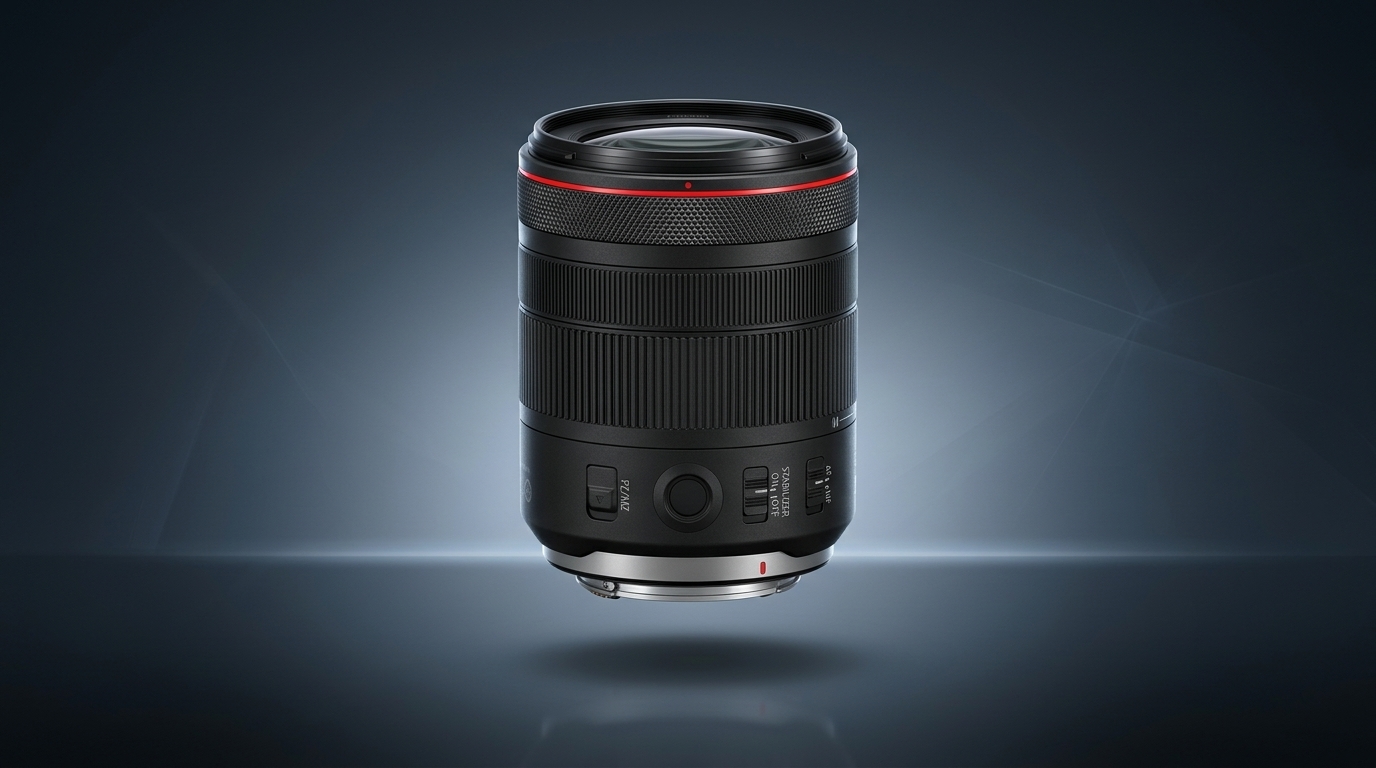
Quick Facts:
- Product: Canon RF 20-50mm F4 L IS USM PZ
- Focal range: 20-50mm, constant f/4 aperture
- Zoom control: Power zoom and manual zoom switch (PZ/MZ)
- Stabilization: Up to 6 stops optical IS
- Weight: 14.8 oz (420g)
- Filter thread: 67mm
- Weather sealing: Dust and moisture resistant
- Price: $1,399
- Best for: Hybrid stills and video shooters on Canon RF bodies
8 min read
In This Review
Canon’s First Full-Frame RF Power Zoom
The Canon RF 20-50mm F4 PZ is Canon’s first full-frame RF power zoom lens with a hybrid switch aimed at photographers. Canon announced it in May 2026 alongside the EOS R6 V, with availability from late June 2026. Priced at $1,399, this L-series zoom covers a 20-50mm range at a constant f/4 aperture. Most power zooms target video shooters who control zoom with a toggle. This one adds a switch, so you flip to a ring-driven zoom for photos instead.
You get two ways to change focal length. First, the spring-loaded W-T area of the zoom ring drives the motors for smooth video pushes. Second, a PZ/MZ switch hands the same ring over to manual-style zoom, so the lens behaves closer to a traditional design. For photographers who never warmed to power zoom, this hybrid power zoom approach matters.
Who is the lens for? Hybrid shooters who want one compact lens for stills and video benefit most. Landscape and travel photographers also gain a 20mm wide end in a lens weighing 14.8 oz. However, the manual zoom mode is still motor-driven, so it is not identical to a mechanical ring. Below, we cover how this Canon RF 20-50mm lens handles in the field, along with used Canon RF alternatives worth weighing.
Key Specs at a Glance

Here are the confirmed specifications, drawn from Canon’s official product page. These numbers frame every handling note in the rest of this Canon RF 20-50mm lens review.
| Specification | Details |
|---|---|
| Lens mount | Canon RF (full-frame) |
| Focal length | 20-50mm |
| Maximum aperture | f/4, constant across the zoom range |
| Aperture blades | 9 |
| Angle of view (full-frame) | 94° at 20mm to 46° at 50mm |
| Lens construction | 13 elements in 11 groups |
| Special elements | 3 UD, 2 aspheric |
| Coatings | Super Spectra, Air Sphere, Fluorine |
| Image stabilization | Up to 6 stops, optical |
| Zoom system | Power zoom plus manual zoom switch, three USM motors |
| Minimum focus distance | 9.5 in (0.24m) |
| Maximum magnification | 0.33x at 50mm |
| Filter thread | 67mm |
| Dimensions | 3.15 x 3.9 in (79.9 x 98.4mm) |
| Weight | 14.8 oz (420g) |
| Lens hood | EW-73H, included |
| Price | $1,399 |
Shop Canon RF Lenses
Find a Used Canon RF Lens at MPB
Browse hundreds of used Canon RF lenses, each inspected and photographed before sale. Every purchase includes a six-month warranty.
How the Hybrid Power and Manual Zoom Switch Works
The headline feature is the PZ/MZ switch. In power zoom mode, the spring-loaded W-T area of the zoom ring drives the focal length. Push it slightly for a slow, deliberate zoom. Push it further, and the zoom speeds up toward a fast crash zoom. For video, this variable-speed control works well.
Flip the switch to manual zoom, and the ring on the barrel takes over. However, the ring is not mechanical. Canon uses three USM motors inside the lens, two for zooming and one for focus. Turning the ring tells the motors where to go, so a slight delay follows your input. Zoom a little, and the lag barely registers. Move from 20mm to 50mm quickly, and you notice the motors catching up.
DPReview’s Mitchell Clark noted the ring turns a bit too easily, which makes accidental zoom shifts likely. Still, after an hour or two of shooting, most of these quirks fade into the background. Compared to a rocker-only power zoom, the ring feels far more natural for photos. The old power zoom vs manual zoom split finally has a middle ground.
Focal Length Memory Between Shots
One practical detail helps stills shooters. The Canon RF 20-50mm F4 PZ keeps its focal length when you power the camera off. Turn the camera back on, and you shoot right away with no reset lag. However, if you bump the ring while the camera sleeps, the motors need a moment to move to the new focal length before live view returns. For street and event work, leaving the switch in manual zoom reduces accidental nudges.
Shooting Stills With the Canon RF 20-50mm F4 PZ
Drawing on DPReview’s hands-on report and Canon’s published specs, here is how the lens performs for photos. The 20-50mm range proves more useful than the numbers suggest. At 20mm, you get a genuine wide angle for interiors, landscapes, and street scenes. At 50mm, you reach a classic portrait-friendly length. Because the f/4 aperture holds steady across the range, exposure stays predictable as you zoom.
Notably, image stabilization rates up to 6 stops on its own. Pair the lens with an in-body stabilized camera like the EOS R6 V, and handheld shooting at slow shutter speeds becomes reliable. With a close focus of 9.5 inches and 0.33x magnification at 50mm, you also shoot tight detail shots without a dedicated macro lens.
Sharpness benefits from Canon’s L-series optics, including three UD elements and two aspheric elements. Air Sphere and Super Spectra coatings reduce flare when you shoot toward the sun. Since the lens weighs only 14.8 oz, it stays comfortable for all-day travel and hiking. For many photographers, hybrid power zoom removes the main reason to avoid an electronic zoom on stills.
Video and Hybrid Shooting
For video, the Canon RF 20-50mm F4 PZ is a pleasure to use, especially on a body with a dedicated zoom lever like the EOS R6 V. Even without one, the on-lens power zoom control delivers smooth, purposeful pushes and pulls. Slow zooms feel cinematic, while a firmer push gives you a quick crash zoom.
The manual zoom mode also helps here. Because the ring turns so easily, smooth zoom pulls become simple. A stiff mechanical ring makes the same move harder. Hybrid shooters therefore get two zoom methods in one lens. If you shoot video often, pair it with the Canon R6 Mark II hybrid body or the newer EOS R6 V for coordinated stabilization.
How the RF 20-50mm Fits the Canon RF Zoom Lineup
Canon’s RF standard-zoom lineup already includes several options. For example, the RF 24-105mm f/4 L covers a longer range for similar money on the used market. The RF 24-70mm f/2.8 L gives you a brighter aperture for low light, though it costs more and weighs more. Against those, the 20-50mm trades reach and aperture for a smaller body with power zoom.
If you want to understand the Canon RF standard zoom trade-offs, owners of the f/2 zooms weigh aperture against size and price every day. For a closer look at how an RF L zoom holds up over years, this RF 28-70mm f/2L zoom review covers sharpness, autofocus, and focus breathing.
On the used market, a Canon power zoom lens like the Canon RF 20-50mm F4 PZ sits beside cheaper alternatives. For example, a used RF 24-105mm f/4 L runs roughly $440 to $1,060 at MPB, depending on condition. Buying used Canon RF glass through a trusted reseller saves several hundred dollars versus new. MPB stocks hundreds of inspected Canon RF lenses, so you compare conditions and prices before you commit.
Who Should Buy the Canon RF 20-50mm F4 PZ
Buy this lens if you shoot both stills and video and want one compact lens for both. For instance, travel photographers, vloggers, event shooters, and content creators fit this profile well. The 20mm wide end also suits real estate and interior work, where every extra degree of coverage counts.
Skip it if you demand a true mechanical zoom ring or need an aperture faster than f/4. Low-light and shallow-depth shooters will prefer an f/2.8 zoom or a fast prime. If landscapes are your focus, compare the wide end against the best Canon RF lenses for landscapes first, since a 14-35mm reaches noticeably wider.
Final Verdict
Canon built a genuinely useful hybrid lens. For hybrid shooters, the Canon RF 20-50mm F4 PZ solves a real problem: smooth power zoom for video, plus a ring-driven feel for stills. Its 6-stop stabilization, constant f/4 aperture, and 14.8 oz weight make it a strong everyday companion on an RF body.
The trade-offs are honest. Because the manual zoom stays motor-driven, it never feels fully mechanical. The ring also turns too easily, and the 20-50mm range asks you to give up telephoto reach. Photographers who want a do-everything zoom should look at the RF 24-105mm f/4 L instead.
At $1,399 new, the lens sits in familiar L-series territory. You pay for the hybrid zoom system and the L-series optics. As a Canon power zoom lens, it asks more than a used RF 24-105mm f/4 L, so your choice comes down to the power zoom feature versus longer reach for less money.
For hybrid creators shooting a Canon RF body, this lens earns a clear recommendation. However, if you only shoot stills and never touch video, a used RF 24-105mm f/4 L or the RF 24-70mm f/2.8 L delivers more flexibility for the money.
Ready to Buy?
Shop Used Canon RF Lenses at MPB
Skip the new-lens premium. MPB grades and photographs every used Canon RF lens, with free shipping and a six-month warranty on each order.
Frequently Asked Questions
Is the Canon RF 20-50mm F4 PZ good for still photography?
Yes. After an hour of shooting, the ring-driven manual zoom feels natural for photos, unlike a rocker-only power zoom. The 20-50mm range, constant f/4 aperture, and 6-stop stabilization suit travel, street, and landscape work.
What is the difference between power zoom and manual zoom on this lens?
Power zoom mode uses the spring-loaded W-T area of the zoom ring to drive the motors at variable speed. Manual zoom mode routes the same motors through the ring for a traditional feel. The power zoom vs manual zoom switch lets you pick either method instantly.
Does the Canon RF 20-50mm F4 PZ work with in-body stabilization?
Yes. The lens provides up to 6 stops of optical stabilization on its own. Paired with a stabilized RF body such as the EOS R6 V, the coordinated system supports slower handheld shutter speeds.
Is the manual zoom mode mechanical?
No. The barrel ring still commands the internal zoom motors, so a brief delay follows fast turns. It feels closer to a mechanical ring than a rocker, yet it is not a direct mechanical link.
How much does the Canon RF 20-50mm F4 PZ cost?
The lens launched at $1,399 new. Used Canon RF glass often sells for several hundred dollars less through resellers like MPB, so a pre-owned copy lowers the entry price once units reach the used market.
What cameras pair best with this lens?
Any Canon RF-mount body works. Hybrid shooters gain the most from a stabilized body with a dedicated zoom lever, such as the new EOS R6 V. The Canon R6 Mark II has no zoom lever, yet it still adds coordinated stabilization for handheld video.

