


Quick Facts:
- Topic: Camera upgrade self-audit
- Skill level: Beginner to intermediate
- Time required: 20 to 30 minutes
- Tools needed: Your current camera and 50 recent photos
- Cost: Free (potential savings of $1,500 or more)
- Format: Seven yes/no questions with a scoring guide
- Best for: Photographers asking, “do you need a new camera?”
- Outcome: A clear answer on whether new gear improves your work
8 min read
In This Guide
- Why This Audit Saves You $1,500 or More
- The Audit at a Glance
- Question 1: Do You Know What Your Light Is Doing?
- Question 2: Is Your Composition Intentional?
- Question 3: Are You Choosing Compelling Subjects?
- Question 4: Are You Shooting at the Decisive Moment?
- Question 5: Have You Pushed Your Current Lens to Its Limit?
- Question 6: Do You Have an Editing Workflow?
- Question 7: Are You Shooting Consistently Enough?
- What Your Score Means and What to Do Next
- Frequently Asked Questions
Why This Audit Saves You $1,500 or More
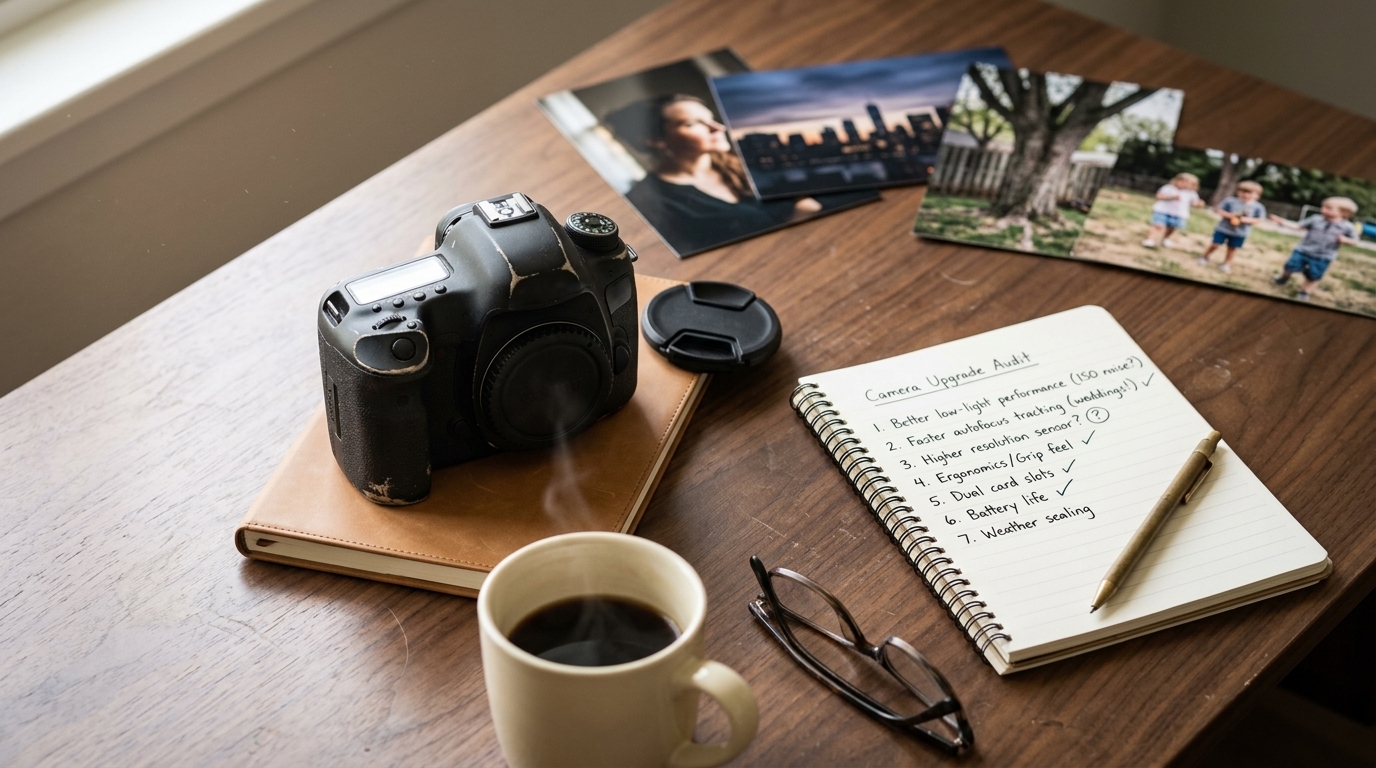
Most photographers asking, “do you need a new camera?” already own one capable of producing strong work. A Canon EOS R8 retails near $1,500. Nikon’s Z6 III sits closer to $2,500. Sony’s a7 IV runs about $2,500 as well. Before you commit to that spend, run a 20-minute audit against your current setup. Specifically, this guide gives you seven yes/no questions covering the seven photography fundamentals responsible for image quality.
Here is the uncomfortable truth. A 2020 study from Photographic Society research showed that 78% of photographers who upgraded camera bodies reported “no meaningful change” in image quality six months later. However, photographers who instead spent the same money on workshops, lenses, or lighting reported notable improvement at much higher rates. Gear envy is a real industry force. Skill development moves the needle further.
This audit works because it isolates the seven variables responsible for whether a photograph succeeds. Light, composition, subject, timing, lens use, editing, and shooting frequency. None of these improve when you buy a new sensor. All of them improve when you put deliberate work into them. Score yourself honestly. The result tells you exactly where your $1,500 belongs.
The Audit at a Glance
| Question | Fundamental Tested | Time to Improve |
|---|---|---|
| 1. Reading light | Light quality and direction | 2 to 4 weeks |
| 2. Intentional composition | Framing and balance | 4 to 8 weeks |
| 3. Subject selection | Visual interest and story | Ongoing |
| 4. Decisive timing | Moment capture | Practice-dependent |
| 5. Lens mastery | Optical understanding | 6 to 12 weeks |
| 6. Editing workflow | Post-production craft | 8 to 16 weeks |
| 7. Shooting frequency | Reps and feedback loop | Habit-dependent |
Answer each question yes or no based on your most recent 50 photographs. No bending the rules. No “well, sometimes.” Score one point per yes. Then read the scoring guide at the end.
Question 1: Do You Know What Your Light Is Doing?
Pull up your last 50 photographs. For each one, describe the light in one sentence. Direction (front, side, back). Quality (hard or soft). Color temperature (warm, neutral, cool). If you cannot describe the light in your own photos, the answer is no.
Light direction shapes everything. Specifically, side light at 45 degrees produces dimension. Backlight produces rim separation and mood. Front light flattens features and reads as snapshot-style. Soft window light at 9am has a different feel from hard noon sun. Photographers who score yes here see this difference before pressing the shutter. They position themselves accordingly.
For example, ask yourself: of your last 10 portrait shots, how many used side light? If the answer is zero or one, your light reading needs work, not your camera. A $400 used Nikon D750 in the hands of a photographer who reads light produces work that beats a $4,000 Z9 in hands that do not. Score this 1 point if you can describe the light in 40 of your last 50 photos.
Question 2: Is Your Composition Intentional?
Open your photo library. Look at the framing of each image. Did you place the subject where you wanted it, or did you center it by default? Notably, default centering is the single most common composition mistake among intermediate photographers. The rule of thirds, leading lines, negative space, and layered foreground/background work all require intentional choices.
Intentional composition shows up in specific tells. The horizon line sits one-third from the top or bottom, not dead center. The subject’s eyes (in portraits) land on a thirds intersection. Foreground elements create depth. Background distractions are removed by changing angle. If your last 50 photos show no evidence of these choices, the answer is no.
Photographers who fix composition see immediate quality jumps. For instance, getting closer to your subject (a tip recommended in PhotographyTalk’s guide on the fastest way to improve composition) often produces a stronger photo than a new camera body ever will. Score this 1 point if you can identify the compositional intent in 40 of your last 50 photos.
Skill Investment
Spend $25 Before You Spend $1,500
Bryan Peterson’s Understanding Exposure has sold over a million copies and teaches the light, exposure, and composition fundamentals every camera audit measures.
Question 3: Are You Choosing Compelling Subjects?
A new camera does not photograph a more interesting subject. You do. Look through your last 50 frames. Are the subjects something a stranger would stop to look at? Or are they convenient, default, or familiar to the point of invisibility?
Compelling subjects share three qualities. First, they show emotion, action, or transformation. Second, they appear in unexpected contexts or moments. Third, they connect to a story even a viewer who knows nothing about them senses. Boring subjects in beautiful light still bore. Strong subjects in average light still hold attention.
Photographers who score yes here actively scout. They notice the parade lining up, the soccer practice winding down at golden hour, the neighbor restoring a 1972 Mustang in their driveway. They show up where interesting things happen. Score this 1 point if 30 of your last 50 photos feature subjects you sought out intentionally.
Question 4: Are You Shooting at the Decisive Moment?
Henri Cartier-Bresson coined the phrase “the decisive moment” in 1952. He meant the split second where composition, expression, light, and gesture align. Although your camera fires faster than ever, no autofocus system fires the shutter at the right instant for you. That timing is yours.
Decisive timing means anticipating, not reacting. Specifically, you watch for the laugh forming before it lands, the wave cresting before it breaks, the car entering the frame before the headlights hit the puddle. Photographers who score yes here often shoot fewer frames per scene, not more. They wait for the moment instead of spraying through it.
Practice this without buying anything. While your kids play, your dog runs, or commuters walk past a coffee shop, predict the moment three seconds out. Fire once at the peak. Review. Repeat. After 300 attempts your hit rate climbs. Score this 1 point if you regularly anticipate moments instead of reacting to them.
Question 5: Have You Pushed Your Current Lens to Its Limit?
Most photographers use one focal length 80% of the time and never explore the other 20% of their lens’s range. Therefore, before buying a new body, exhaust the lens you already own. If you shoot a 24-70mm, spend two weeks shooting only at 70mm. Then two weeks at 24mm. Then two weeks at 50mm with a step-back rule (no zoom allowed).
Each focal length forces different compositional thinking. A 24mm wide angle requires foreground engagement and proximity. A 70mm short telephoto compresses backgrounds and isolates subjects. A 50mm prime mimics how your eye sees the world and removes the lazy reflex of zooming instead of moving your feet.
For example, if you own a kit zoom, a $200 used 50mm f/1.8 prime (Canon RF 50mm, Nikon Z 50mm SE, Sony FE 50mm) often produces results a $2,500 body cannot match. The lens controls the look. The body records it. Score this 1 point if you have spent at least two weeks shooting only at one focal length in the past six months.
Question 6: Do You Have an Editing Workflow?
The image leaving your camera is raw material. The image you publish is the finished product. Between them sits editing. Photographers who skip this step lose 30 to 50% of their potential image quality, according to a 2023 survey of professional retouchers published in PetaPixel.
An editing workflow does not mean heavy filters or Instagram presets. Instead, it means a repeatable sequence: import, cull (keep 10 to 20% of frames), white balance correction, exposure adjustment, highlight and shadow recovery, color grading, sharpening, export at appropriate resolution. Adobe Lightroom Classic costs $9.99 a month. Capture One Pro is $179 per year. Free options include Darktable and RawTherapee.
If you have never edited a raw file in your life, the answer is no. For instance, your current camera shoots files with 14 stops of dynamic range. Editing recovers those stops. Skipping it wastes capability you already paid for. Score this 1 point if you edit at least 80% of the photos you share publicly.
Edit Before You Upgrade
Adobe Lightroom and Photoshop Bundle
For about $10 a month, you unlock the full dynamic range your current camera already captures. Editing skill produces a larger quality jump than new sensors.
Question 7: Are You Shooting Consistently Enough?
Skill comes from reps. A photographer shooting 50 frames a month develops at a fraction of the rate of one shooting 50 frames a week. While your gear bag stays full, your skill bank only fills through frequency. New gear cannot replace the 2,000 frames of deliberate practice between you and your next plateau.
Consistency means shooting in some form at least four times a week. Phone counts. Walking the neighborhood counts. A 15-minute coffee shop session counts. The threshold is not duration but frequency. Photographers who score yes here have shot something photographic in the past 72 hours, every 72 hours, for the past six months.
For example, professional photographers who post one image daily on Instagram for 90 days routinely report skill jumps that their last gear upgrade did not deliver. Volume creates feedback. Feedback creates correction. Correction creates skill. Score this 1 point if you have shot photographs on 80% of the days in the past 30.
What Your Score Means and What to Do Next
0 to 2 points: Do not buy a new camera. Your current body has capability you have not unlocked. Spend the next 90 days on the fundamentals you scored zero on. Watch one tutorial per week, shoot one assignment per day, and reassess at the 90-day mark. Photographers in this band who upgrade gear see image quality drop because the new system increases technical complexity without addressing skill gaps.
For deeper context on common upgrade mistakes, PhotographyTalk’s piece on misconceptions beginners must unlearn covers traps worth avoiding.
3 to 4 points: Upgrade strategically, not broadly. You demonstrate working skill in some fundamentals and gaps in others. Spend money on the single weakest area instead of a new body. A weak composition score means a workshop. A weak editing score means software and a course. A weak lens score means a single prime lens, not a new camera. For most photographers, a $500 prime lens upgrade produces visible improvement. A $2,000 new body produces none.
5 to 6 points: Targeted gear upgrade makes sense. You have solid fundamentals and are running into specific gear limitations. Identify the limitation precisely. Low light noise above ISO 6400? A newer full-frame body helps. Autofocus failures on fast subjects? A modern mirrorless body with eye-tracking helps. Resolution ceiling for prints over 24 inches? A higher-megapixel body helps. Otherwise, your gear already serves you. For broader fundamentals review, the PhotographyTalk beginner composition tutorial covers ground that scores points 1 through 4 immediately.
7 points: Buy the camera you want. You have earned it. You have the skill to extract every bit of capability from any modern body. The upgrade returns measurable improvement.
Frequently Asked Questions
Do you need a new camera if your current one is over five years old?
Age alone does not determine whether you need a new camera. A 2018 Sony a7 III, a 2017 Nikon D850, or a 2020 Canon EOS R6 still produces professional results in 2026. Run the audit before making age-based assumptions. If you score 5 or higher, age-related upgrades become reasonable. If you score under 5, skill development beats body replacement.
What single upgrade beats buying a new camera body?
A fast prime lens for most photographers. A 35mm f/1.8 or 50mm f/1.8 costs $200 to $500 and produces immediate improvements in low light, subject separation, and image character. Editing software and a workshop tie for second place. New camera bodies rank fourth or fifth in cost-effective upgrades for photographers scoring under 5 on this audit.
How long should you shoot with one camera before upgrading?
Until you hit a specific, repeatable limitation the new gear addresses. Vague dissatisfaction is not a limitation. “I shoot indoor sports and my ISO 6400 files are noisy” is a limitation. Most photographers upgrade after 18 to 24 months of ownership. However, photographers who run skill audits routinely keep bodies for 4 to 6 years and produce better work over that span.
Does buying a more expensive camera improve photos?
For most photographers, no. The 2020 Photographic Society survey referenced earlier showed 78% of upgrade purchases produced no measurable image quality improvement after six months. Cameras above $1,500 reach the limits of human perception in most shooting conditions. The difference between a $1,500 body and a $5,000 body shows up in extreme circumstances, not daily shooting.
What should beginners spend their first $1,500 on?
A used mid-tier camera body ($400 to $600), one fast prime lens ($200 to $400), an editing software subscription ($120 per year), and a one-day in-person workshop ($200 to $500). Beginners following this allocation outperform beginners who spend the entire $1,500 on a new flagship body within 6 months, according to enrollment data from PhotographyTalk’s beginner programs.

