


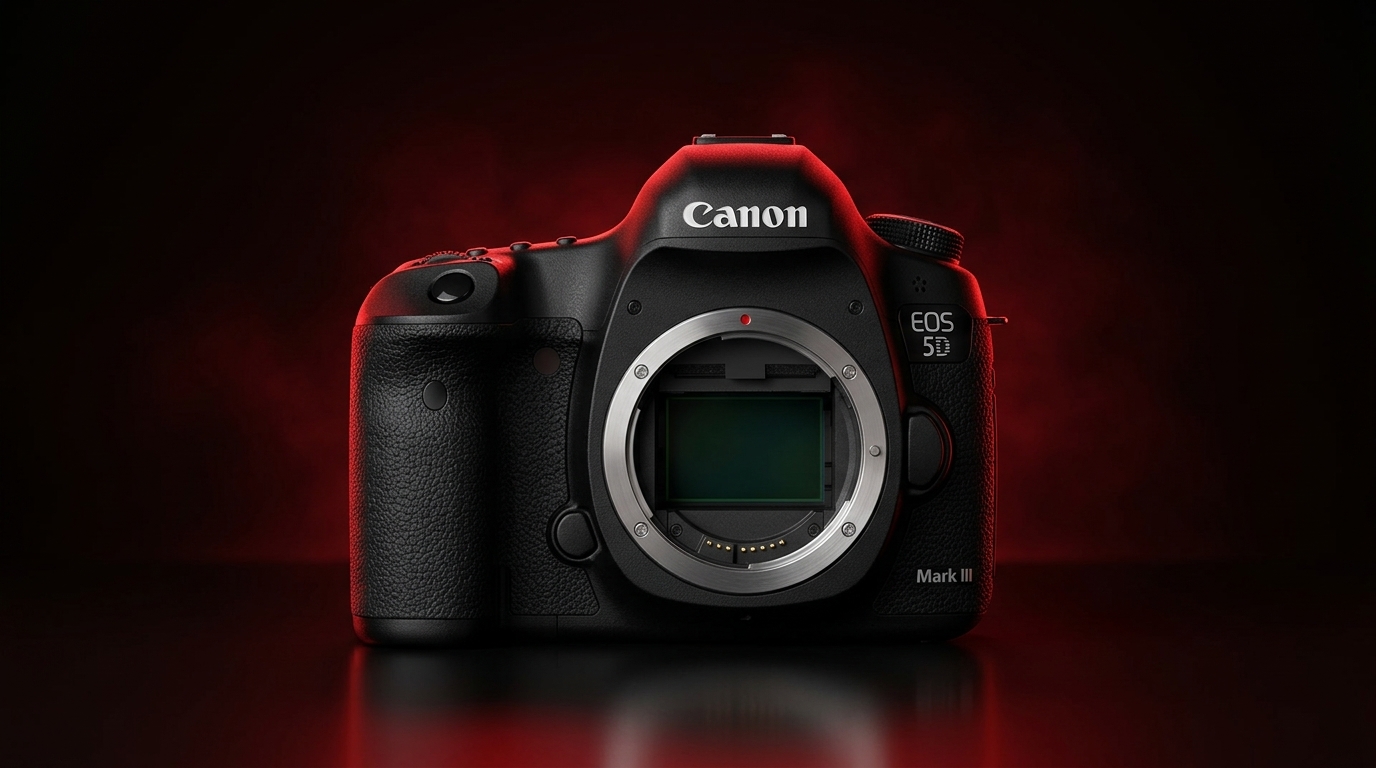
Quick Facts:
- Product: Canon 5D Mark III, full-frame DSLR from 2012
- Sensor: 22.3MP full-frame CMOS with DIGIC 5+
- Autofocus: 61 points, up to 41 cross-type, working to EV -2
- Burst: 6fps, dual CF and SD slots
- Video: 1080p at 30fps, no 4K, headphone jack fitted
- Shutter rating: 150,000 cycles
- Weight: 950g with battery and card
- Price: $3,499 at launch, $154 to $554 used
- Canon support: Retired, with parts and assisted support ended
- Best for: Wedding and portrait shooters who want full frame for the least money
9 min read
This review is sponsored by MPB. Pricing figures came from MPB’s public inventory and were current in late July 2026. Editorial conclusions are our own.
In This Review
- Canon 5D Mark III Review: What $400 Buys in 2026
- Key Specs at a Glance
- Image Quality and Dynamic Range
- The 61-Point Autofocus System
- Video, Screen, and the Known Flaws
- What a Used Body Costs and What the Shutter Count Tells You
- Canon Has Retired This Camera
- Canon 5D Mark III vs 5D Mark IV
- Canon 5D Mark III Review Verdict
- Canon 5D Mark III Review FAQ
Canon 5D Mark III Review: What $400 Buys in 2026
The Canon 5D Mark III cost $3,499 when it arrived in March 2012. A used 5D Mark III now runs $154 to $554 on the second-hand market. The camera has shed most of its value while keeping the sensor, the autofocus, and the weather sealing intact. Few professional tools depreciate this far and still work.
What you get is a proper working DSLR. Canon paired a 22.3MP full-frame sensor with a 61-point autofocus array. Around it sit dual card slots, a 100% pentaprism viewfinder, and a sealed magnesium shell. No new camera near this money offers the same combination today.
Wedding, portrait, and event photographers form the natural audience for a used 5D Mark III. The body handles low light well and takes any EF lens. A working kit built on used glass therefore costs less than one modern lens. In contrast, anyone needing 4K video, a touchscreen, or wireless transfer should look at mirrorless instead.
One caveat outweighs every spec, and we return to it below: Canon has retired this model. Repair support has ended and parts have run out, so a broken body stays broken. Our piece on why the used DSLR market is thriving covers the wider trend feeding these prices.
Key Specs at a Glance
The spec sheet reads its age in two places and holds up everywhere else. Autofocus and build quality still compete; the screen and the video do not.
Used Canon 5D Mark III Bodies in Stock at MPB
| Specification | Details |
|---|---|
| Sensor | 22.3MP full-frame CMOS, 36 x 24mm |
| Processor | DIGIC 5+ |
| ISO range | 100 to 25,600 native, expandable to 102,400 |
| Autofocus | 61 points, up to 41 cross-type, EV -2 to 18 |
| Metering | 63-zone dual-layer sensor |
| Burst | 6fps, buffer 65 JPEG or 13 raw |
| Viewfinder | Pentaprism, 100% coverage, 0.71x magnification |
| Rear screen | 3.2-inch fixed LCD, 1.04M dots, no touch input |
| Video | 1080p at 30fps maximum, ALL-I and IPB, headphone jack |
| Shutter | 1/8000 to 30 seconds plus Bulb, flash sync 1/200 |
| Storage | Dual slots, one CompactFlash and one SD |
| Battery | LP-E6, 950 frames CIPA, 200 in Live View |
| Build | Sealed magnesium alloy, no built-in flash, no Wi-Fi or GPS |
| Size and weight | 152 x 116.4 x 76.4mm, 950g with battery and card |
Two rows deserve attention. First, the 950-frame rating still beats the standard CIPA figure of almost every mirrorless camera since, because an optical viewfinder draws no power. Second, the missing Wi-Fi matters more in 2026 than it did in 2012, since clients now expect same-day previews.
Image Quality and Dynamic Range
Files from the 22.3MP sensor hold up better than the pixel count suggests. Colors land pleasingly out of camera, and skin tones need little work. Prints at 20 inches show no shortage of detail. For portrait and wedding delivery, resolution has never been the limiting factor.
Dynamic range, however, is the honest weak spot. DxOMark measured 11.7 EV of dynamic range. It also scored the sensor 81 overall, with a low-light ISO figure of 2293. For context, the older 5D Mark II measured 11.9 EV and the rival Nikon D800 reached 14.4 EV.
Shadow recovery therefore needs care. Lift a raw file several stops and banding appears in a way modern sensors avoid entirely. Expose to the right, protect your highlights, and the sensor rewards you; underexpose badly and the file punishes you.
High ISO, in contrast, remains the camera’s quiet strength. Native sensitivity runs to 25,600 with expansion to 102,400. Files therefore stay usable through ISO 6400 for reception and ceremony work. DPReview awarded the camera 82% and a Gold Award on release, with raw image quality scored 9.1 out of 10.
The 61-Point Autofocus System
Autofocus is the main reason working photographers still buy this body. Canon transplanted the 61-point array from the professional 1D X. Up to 41 points are cross-type, and sensitivity reaches EV -2. Focusing by candlelight is realistic rather than aspirational.
Cross-type coverage also depends on the lens you mount, since Canon quotes up to 41 cross-type points rather than a fixed figure. The exact count varies by lens group, so check Canon’s compatibility chart for the glass you own. Wedding photographers running an EF 85mm f/1.8 USM, which MPB lists from $239, feel the difference on every shot.
Speed, meanwhile, is adequate rather than impressive. The camera shoots 6fps and fills its buffer after 13 raw frames. Ceremonies and portraits suit it; sports do not. A 63-zone dual-layer metering sensor backs it up with reliable exposure in mixed light.
Video, Screen, and the Known Flaws
Video tops out at 1080p and 30fps, with no 4K at any setting. Canon did fit a headphone jack, along with ALL-I and IPB codecs, so audio monitoring works properly. Reviewers praised the moiré control while noting the same processing left footage softer than the stills.
The screen, similarly, shows its age immediately. A 3.2-inch fixed LCD with 1.04 million dots offers no touch input and no articulation. Live-view work and menu navigation both feel slow as a result. Anyone arriving from a phone or a modern body will find the interface dated.
Connectivity is absent altogether. There is no Wi-Fi, no Bluetooth, and no GPS without the optional accessories Canon sold separately. Tethering happens over a cable, and card readers do the rest.
Finally, one historical fault deserves a mention. Early bodies suffered a light leak from the illuminated top LCD panel. In near-total darkness it shifted metering by roughly a third of a stop. Canon offered free inspections, and the fix was straightforward, so surviving bodies rarely show the fault.
What a Used Body Costs and What the Shutter Count Tells You
The 5D Mark III price has collapsed further than almost any professional camera. Against a $3,499 launch figure, MPB lists 48 bodies between $154 and $554. Those numbers land 84% to 96% below the original. Depreciation on this scale is what pushes the 5D Mark III price into entry-level territory.
| Body | Recent MPB used price | Units listed | Canon repair support | Who it suits |
|---|---|---|---|---|
| Canon 5D Mark III | $154 to $554 | 48 | Ended | Full frame and pro autofocus for the least money |
| Canon 5D Mark IV | $574 to $1,059 | 51 | To November 2032 | Better sensor and 4K video |
| Canon 6D Mark II | $454 to $689 | 54 | To June 2030 | Lighter body with a flip-out touchscreen |
| Canon EOS RP | $439 to $649 | 97 | No end date announced | Mirrorless on the current RF mount |
| Nikon D750 | $234 to $724 | 51 | Not a Canon product | More dynamic range, tilting screen |
Those figures come from MPB’s live inventory in late July 2026 and move week to week. Note the EOS RP row carefully. A 2019 full-frame mirrorless body starts below a top-condition 5D Mark III, and Canon still supports it. The older DSLR answers back with dual card slots, weather sealing, and a 950-frame battery, which the RP does not match.
Reading the Shutter Count Before You Buy
Canon rated the 5D Mark III shutter at 150,000 cycles. MPB publishes an exact actuation figure on its camera listings. Bodies we checked spanned roughly 31,900 to 99,400 actuations, putting even the highest example at two-thirds of rated life. Actuations are shutter firings, so a body under 60,000 has plenty left.
Match the 5D Mark III shutter figure to the price rather than chasing the lowest number. A 40,000-actuation body near $400 beats a 95,000-actuation body at $250. The cheaper one leaves less runway before a repair. Our guide to what to check when buying used covers the physical inspection.
Treat any example past 100,000 actuations as a spare rather than a main camera. The retirement risk covered below therefore makes a high count harder to live with.
Canon Has Retired This Camera
Canon lists the EOS 5D Mark III as retired, and assisted support has ended. The company’s parts schedule, current to July 2026, shows replacement parts are no longer available either. A failed shutter, a mirror fault, or a dead main board therefore means a third-party repair or a replacement body.
Weigh the risk against the price rather than treating it as a dealbreaker. At $250 the body sits close to consumable, and a graded dealer purchase with a six-month warranty covers the first months. Buy at the top of the range and the calculation tightens considerably.
Lenses are the durable asset here. Every EF lens mounts on a Canon RF mirrorless body through an adapter, which MPB lists from $130, while RF lenses never fit the other way. Spending on glass now therefore survives a body swap, and our data-backed look at how gear holds its value explains why.
EF Lenses for the 5D Mark III, Used at MPB
Canon 5D Mark III vs 5D Mark IV
Against a good-condition Mark III near $400, a used Mark IV costs about $174 more and fixes most of the older camera’s real faults. It brings 30.4 megapixels, 13.6 EV of dynamic range, and 4K video. A touchscreen, Wi-Fi, and Dual Pixel autofocus in live view follow. Canon also supports it until 2032.
Support alone therefore settles the argument for anyone shooting professionally. Paying $574 for a body Canon still repairs beats saving $174 on one it does not. Our used Canon 5D Mark IV buying guide sets out the shutter tiers and pricing in detail.
Still, the older body wins on one axis: outlay. For a reception camera, a loaner for a second shooter, or a first full-frame body, $250 goes a long way. Our take on whether the Mark IV is worth it covers the newer camera on its own terms.
Canon 5D Mark III Review Verdict
Buy this camera as a second body, a backup, or a first step into full frame. Aim for the $250 to $400 band, where good-condition bodies sit, and the 5D Mark III price undercuts a professional 70-200mm zoom. You still get professional autofocus, weather sealing, dual card slots, and a 950-frame battery. Few cameras at the price offer the same working reliability.
Accept the trade-offs first. Dynamic range trails the Mark IV by nearly two stops and the old Nikon D800 by nearly three, while video stops at 1080p. The screen neither tilts nor responds to touch, and wireless features are absent. Landscape photographers and video-first buyers should look elsewhere without hesitation.
The retirement is the real limit on value. Canon no longer supplies parts or assisted support. A purchase here therefore carries a risk the Mark IV does not. Pay attention to the actuation figure, keep the total under $400, and treat the camera as consumable rather than permanent.
If the budget stretches, a used 5D Mark IV at $574 adds 4K, a better sensor, and six more years of Canon support. Photographers who want a current lens mount should compare a used Canon EOS RP at $439 instead, accepting a single card slot in return. For a wedding second body or a first full-frame kit, though, the older camera remains the cheapest serious option. The best Canon lenses for weddings mount straight onto it, and a used EF 50mm f/1.8 STM starts at $96.
Canon 5D Mark III Review FAQ
Is the Canon 5D Mark III still worth buying in 2026?
As a backup or a first full-frame body, yes. Under $400 it gives you professional autofocus and weather sealing for entry-level money. As a sole professional camera, no, because Canon has ended repair support.
What shutter count is high for a 5D Mark III?
Canon rated the shutter at 150,000 cycles. Listings we checked ran roughly 31,900 to 99,400 actuations, so treat anything under 60,000 as low and anything past 100,000 as a spare body.
Does the Canon 5D Mark III shoot 4K?
No. Video maxes out at 1080p and 30fps in ALL-I or IPB. Canon did fit a headphone jack for audio monitoring, though buyers who need 4K should move to the 5D Mark IV or a mirrorless body.
Is the 5D Mark III good for weddings?
Yes, especially as a second body. Autofocus works to EV -2, ISO 6400 files stay usable, dual card slots give instant backup, and the battery lasts 950 frames. Many photographers still run one alongside a newer camera.
Does Canon still repair the 5D Mark III?
No. Canon lists the model as retired, assisted support has ended, and parts are no longer available. Any repair now goes through a third party, which is the strongest argument for spending less on the body.
Related Reading

