


Quick Facts:
- Topic: Whether AI can produce historically accurate AI images
- The claim: Grok Imagine will make a “historically accurate” full-length Odyssey film in 2026
- Who said it: Elon Musk, on X, July 22, 2026
- The catch: Homer’s Odyssey is myth, with gods, a Cyclops, and a nymph, so no history exists to match
- The photography issue: AI images synthesize patterns from training data and record no real light
- Rival film: Christopher Nolan’s The Odyssey, $264 million global opening, 97% audience score
- Best for: Photographers weighing AI images against real photographs
8 min read
In This Article
- What Musk Promised
- The Nolan Feud Behind the Announcement
- Can AI Generate Historically Accurate Images?
- Why Historically Accurate AI Images Break Down
- How AI Images Differ From a Real Photo
- How Photographers Prove an Image Is Real
- What This Means for Your Photography
- Why Historically Accurate AI Images Are the Wrong Test
- Frequently Asked Questions
What Musk Promised
Elon Musk says his AI platform will produce historically accurate AI images at feature length. In a July 22, 2026, post on X, he promised a “full-length movie of The Odyssey” both “historically accurate and true to the art of Homer” before the year ends. Alongside the promise, he attached a three-minute clip of Odysseus and the nymph Calypso.
The promise sounds simple. However, it collapses on two fronts. First, the source is myth, not a record of real events. Second, no AI image generator records history at all, since it predicts pixels from learned patterns.
This distinction matters to photographers, because the word “accurate” is doing heavy lifting. A photograph carries a real referent, since light bounced off a real subject and struck a sensor. An AI frame carries no such anchor. Therefore, calling it historically accurate blends two separate kinds of pictures, and the blend is the whole story.
The Nolan Feud Behind the Announcement
The announcement did not arrive in a vacuum. Instead, it followed weeks of public attacks by Musk on Christopher Nolan’s live-action version of the same poem. Nolan’s film stars Matt Damon as Odysseus and Anne Hathaway as Penelope. After its release, critics praised it, and audiences quickly followed. In fact, the film opened to near-universal acclaim.
Musk objected to the casting. He reposted abusive messages attacking Nolan for casting Lupita Nyong’o, a Black actor, as Helen of Troy and Clytemnestra, along with Elliot Page, a trans actor, as Sinon. Beyond the casting, he claimed Nolan “wants the awards” and “has lost his integrity.”
| Key Fact | Detail |
|---|---|
| AI platform | Grok Imagine, from Musk’s company xAI |
| Announced | Elon Musk, on X, July 22, 2026 |
| The claim | A “historically accurate” full-length Odyssey in 2026 |
| Rival film | Nolan’s The Odyssey (Damon, Hathaway) |
| Opening box office | $264 million worldwide |
| Audience score | 97% on Rotten Tomatoes |
The campaign changed little. Nolan’s film took $264 million worldwide in its opening weekend, and it holds a 97% audience rating on Rotten Tomatoes. Notably, Nyong’o answered the critics plainly: “Our cast is representative of the world. I’m not spending my time thinking of a defence.” As a result, the AI Odyssey reads less as film-making and more as a counterpunch.
Can AI Generate Historically Accurate Images?
Set the feud aside, and a real technical question remains. Short answer: not in the way the word implies. AI image generation works by learning statistical patterns from millions of scraped pictures, then predicting a fresh arrangement of pixels to match your prompt. Notably, the model never consults a historical record. Instead, it consults itself.
Ask for a Bronze Age warrior, and the model returns the average of every warrior image it absorbed. For example, movie stills, video-game art, and modern illustrations all feed the average. As a result, the output looks like our era’s idea of the past, dressed in plausible costume. It looks convincing, yet it descends from pop culture, not from archaeology. Prompt the same model twice, and it yields two different scenes, since it guesses rather than remembers.
The Odyssey makes the gap obvious. For instance, Homer’s poem features a Cyclops, the witch Circe, and a sea nymph. Since no historical version of those beings exists, the phrase historically accurate fails before a single frame renders. As a result, you cannot fact-check a myth against reality.
Christopher Nolan’s The Odyssey, official trailer (Universal Pictures). Musk’s AI version aims to answer this live-action film.
Why Historically Accurate AI Images Break Down
Even for real history, the label fails in practice. Because generators optimize for images pleasing to a modern eye, they skip a scholar’s review, and their training data bakes in current-day bias. As a result, small anachronisms slip in constantly: wrong armor, invented insignia, plus stitching and buttons from the wrong century.
A well-known failure showed the pattern at scale. In February 2024, for example, Google paused image generation in its Gemini model after it produced historically inaccurate depictions of well-documented subjects. Specifically, the system prioritized a diversity rule over the historical record, and the record lost. Musk’s own tools rest on the same foundations. In other words, a bigger model or a sharper render fixes none of this, since the flaw lives in the method, not the resolution.
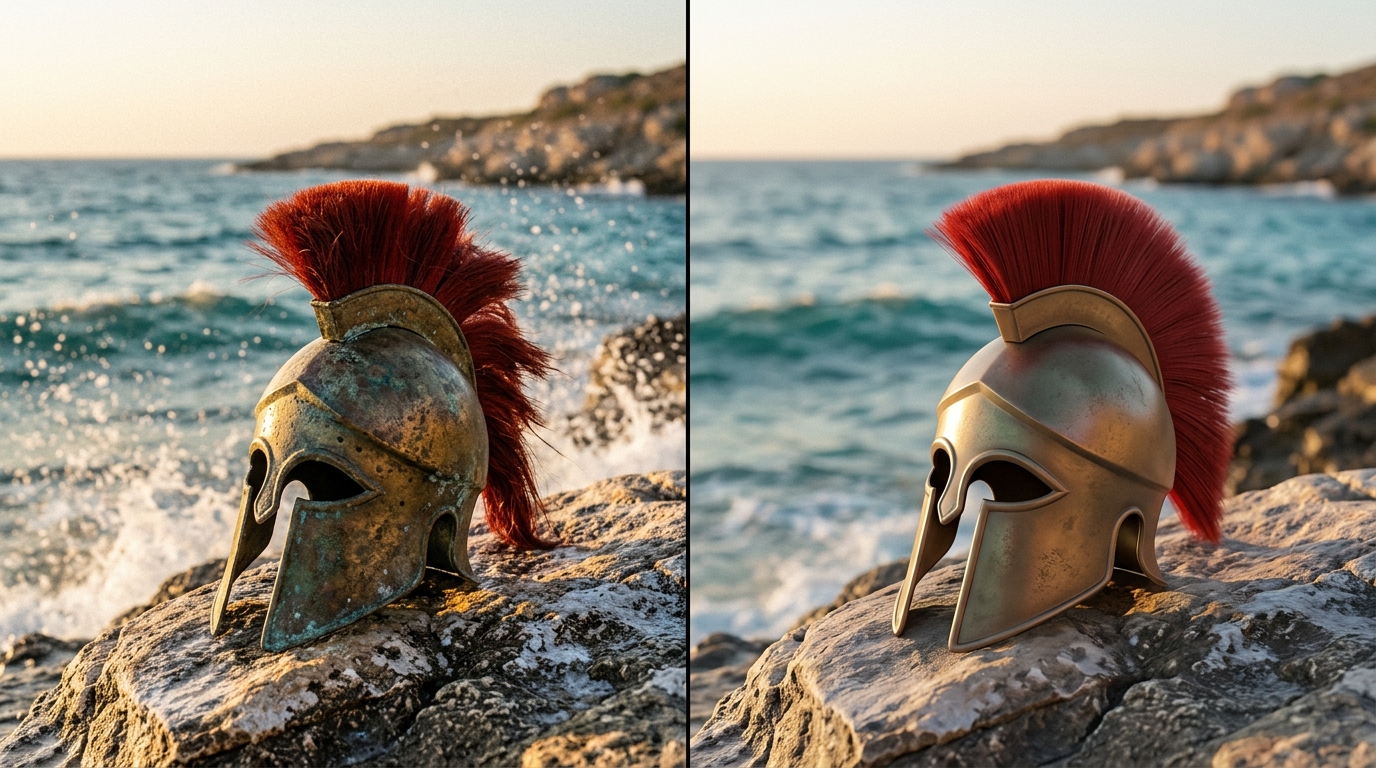
The deeper issue is intent. A generator holds no concept of truth. Because it never learned history as fact, it has no way to know a helmet is wrong. It learned pixels as probability. Consequently, historically accurate AI images stay out of reach, however sharp the render looks.
How AI Images Differ From a Real Photo
Photographers already grasp the core distinction, even when the public does not. A photograph is an index. Real photons left a real scene, passed through glass, and struck a sensor at a real moment. Therefore, the file points back to something physical.
An AI frame points back to nothing outside its model and its training set. There is no scene, no light, no captured moment. Consequently, an AI portrait of a soldier documents zero soldiers. Instead, it documents a data distribution. Behind those pixels sit the same AI tools reshaping photo editing, not a lens.
This gap should bother anyone who shoots for a living. In photography, accuracy means fidelity to a real subject. Swap the subject for a statistical guess, and the meaning of the word shifts. For this reason, learning how to tell if an image is AI generated now belongs in every working photographer’s kit.
Homer's Odyssey: the translations worth reading


How Photographers Prove an Image Is Real
Because fakes keep improving, provenance beats eyeballing. Trained viewers still catch tells, such as mangled hands, impossible reflections, warped text, and light from two directions at once. However, those tells shrink with every model update, so habits matter more than hunches.
Content credentials give you a durable answer. The C2PA standard, backed by the Content Authenticity Initiative, attaches signed metadata at capture and through each edit. As a result, a viewer reads the trail and sees where an image came from. Notably, major camera makers and editing apps now write these tags directly into exports. For example, Leica, Nikon, and Sony have shipped cameras with C2PA capture, while Adobe writes the same trail through Lightroom and Photoshop.
Your own workflow strengthens the case. First, keep your RAW files, since a RAW sidecar and its capture data resist tampering. Next, register important work, label any AI-assisted step openly, and lean on content credentials for client and contest submissions. Because AI images and disinformation keep spreading, this paper trail becomes an asset, not a chore. Buyers who need proof will pay for it, especially as synthetic images flood stock libraries and social feeds.
What This Means for Your Photography
The market splits into two lanes. One lane wants cheap, generic visuals, and AI image generation serves it well enough. However, the other lane wants proof, presence, and a real moment, and this lane is yours. For example, weddings, journalism, documentary, product, and portrait work all depend on a subject who existed.
Your advantage grows as fakes flood the feed. Because buyers struggle to trust a random image, a verifiable photograph gains value. Similarly, the argument behind will AI replace photographers shows how the fear misreads demand for authenticity. Meanwhile, agencies and newsrooms increasingly require a verifiable capture trail, which rewards photographers who document provenance from the first frame.
Nolan made the same point bluntly, calling the idea of AI replacing human creativity “a nonsense.” For your own work, the takeaway stays practical. Shoot the real thing, document how you made it, and let the provenance travel with the file.
Why Historically Accurate AI Images Are the Wrong Test
Grade the promise on its own terms, and it still fails. First, a myth holds no history to match, so accuracy cannot apply. Second, a generator holds no referent, so its output records nothing real. Two independent problems produce one broken slogan.
For photographers, the lesson runs deeper than one movie stunt. Your value does not come from resolution or polish, since a model now fakes both on demand. Instead, it comes from your presence at a real event, and from the file you hold to prove it. A model reproduces a look, yet it cannot reproduce a witness.
So treat “historically accurate” as marketing, not a technical spec. Judge AI images by what they are, which is synthesis. In contrast, judge your photographs by what they carry, which is truth. On this test, historically accurate AI images lose to one honest frame every time.
Frequently Asked Questions
Can AI create historically accurate images?
Not reliably. AI image generation predicts pixels from patterns in scraped pictures, so it reflects modern pop culture more than the historical record. It also invents anachronisms, such as wrong armor or insignia, because it holds no concept of historical fact.
What does historically accurate mean for an AI image?
Little in practice. The phrase implies fidelity to real events, yet a generator holds no record to check against. For a myth like the Odyssey, no real history exists at all, so the label describes marketing rather than method.
How is an AI generated image different from a real photograph?
A photograph records real light from a real subject at a real moment, which gives it a physical referent. An AI frame points back only to its training data. One documents the world; the other averages a dataset.
Why do AI models get historical details wrong?
They optimize for images pleasing to a modern viewer, not scholarly accuracy. Google paused Gemini image generation in February 2024 for this reason, after it rendered documented figures incorrectly. Bias in the training data drives most errors.
How do content credentials prove a photo is real?
Content credentials use the C2PA standard to attach signed metadata at capture and through every edit. A viewer reads the trail to confirm the source and any edits. Many cameras and editing apps now write these credentials into exported files.

