


Quick Facts:
- Product: Godox Lux Junior II (and Lux Junior II S for Sony)
- New features: TTL metering, dual-axis bounce head, built-in wireless receiver
- Battery: 7.4V, 700mAh rechargeable lithium, USB-C charging
- Weight: 5.4 ounces (153 grams)
- Compatibility: Canon, Nikon, Fujifilm, OM System, Panasonic (standard); Sony (II S)
- Works with: Both digital and film cameras
- Price: $79, available for pre-order now
- Best for: Street, documentary, portrait, and everyday photographers who want a compact bounce flash
8 min read
In This Article
Godox Lux Junior II Overview
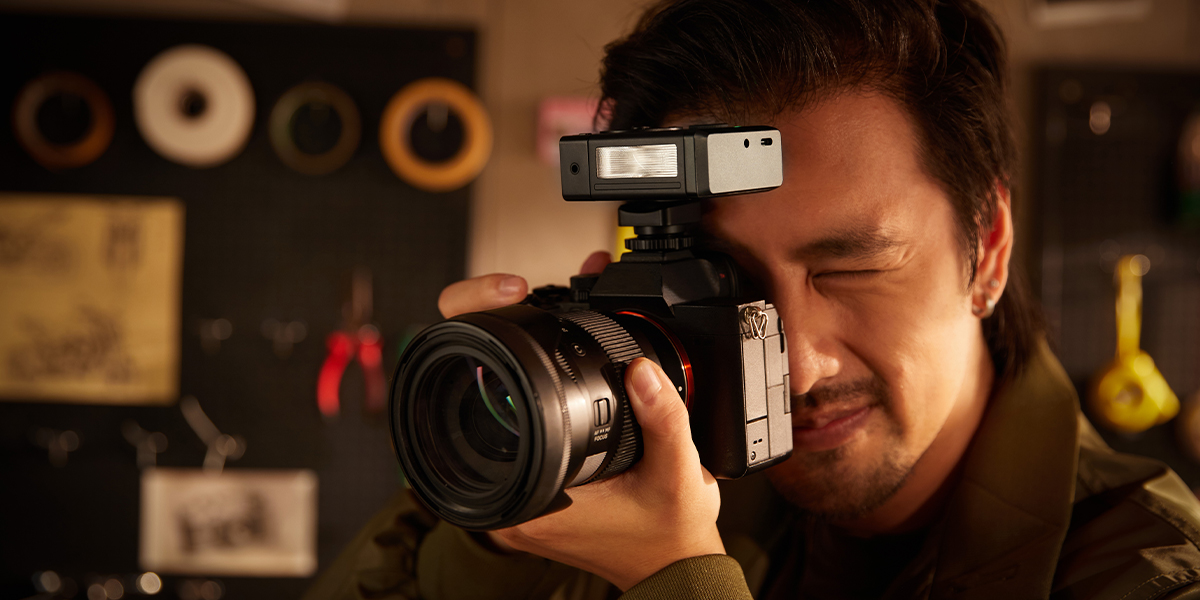
Godox announced the Lux Junior II, an update to its retro-styled on camera flash. The new version adds TTL metering, a rechargeable battery, and a wireless receiver. Notably, none of those existed on the original model. Godox opened pre-orders for two versions at once. A standard Lux Junior II uses a hybrid hot shoe built for Canon, Nikon, Fujifilm, OM System, and Panasonic bodies. A Sony-specific Lux Junior II S adds global shutter synchronization support.
The nearest comparison point is the flash it replaces. The 2022 Lux Junior sold for $69. Specifically, it ran on two AAA batteries and offered a fixed head with no bounce, no TTL, and no wireless triggering. Notably, Godox priced the new retro camera flash at $79 for pre-order. The $10 jump buys a far more capable flash.
Godox positions the Lux Junior II for street photography, documentary work, portraits, and everyday shooting. A photographer switching between a digital mirrorless body and a 35mm film camera uses one flash for both. The Lux Junior II works as a TTL flash on digital cameras and switches to an AUTO mode for film. As a result, few $79 film camera flash choices offer this dual-format support, a real reason the launch stands out beyond retro looks.
The Lux Junior II opened for pre-order this week, so no outlet has published hands-on test results yet. This article covers what Godox has confirmed and compares the flash against its predecessor.
| Original | Most Compact | Best Rated | |
|---|---|---|---|
| Product | 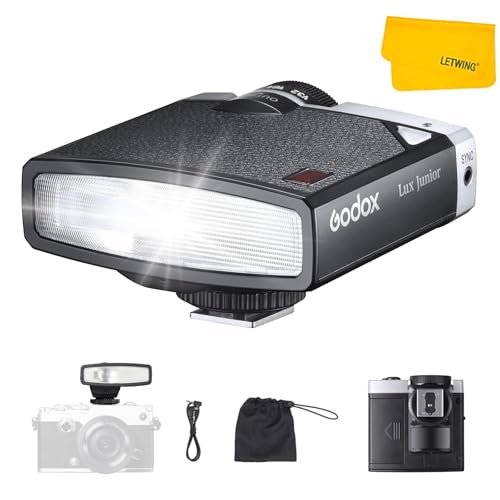 Godox Lux Junior Godox Lux Junior |  Godox Lux Elf Godox Lux Elf | TOP PICK Godox Lux Cadet Godox Lux Cadet |
| Rating | ★★★★☆ 4.1 | ★★★★☆ 4.2 | ★★★★☆ 4.6 |
| Price | $69 | $49 | $69 |
| Battery | AAA (2, not included) | Built-in 350mAh rechargeable, USB-C | Built-in 1700mAh rechargeable, USB-C |
| Bounce Head | Fixed, no bounce | Fixed, no bounce | Fixed, no bounce |
| TTL Support | No | No | No |
| Price | $69.00 as of Jul 22, 10:09 pm | $49.00 as of Jul 22, 10:24 pm | |
| Check Price → | Check Price → | Check Price → |
None of these in-stock Godox retro flashes bounce or offer TTL metering, a gap the new Lux Junior II fixes.
Designed for Digital and Film Photography
The Lux Junior II works across modern digital cameras and older film bodies. This dual role shapes most of its feature set. On digital cameras, the flash adds TTL automatic exposure alongside manual and multi-flash modes. Exposure calculation happens through the camera instead of guesswork. The upgrade marks a genuine step up from the manual-only original for anyone shooting fast-moving scenes.
Godox’s official launch video for the Lux Junior II, covering the hybrid hot shoe, dual-axis bounce, and TTL auto flash. Video: Godox
Film photographers keep access to an AUTO mode. This mode relies on an integrated metering sensor to set flash output, based on the camera’s ISO and aperture. Most film cameras cannot communicate flash exposure data digitally, unlike modern digital bodies. A 2.5-millimeter sync port rounds out film support. It lets the flash connect to select film cameras equipped with PC sync connections, instead of a standard hot shoe.
Godox says the flash suits street photography, documentary work, portraits, and everyday shooting, a broader use case than the original’s mostly casual pitch. Readers who already lean on budget event photography flash setups will recognize the appeal of one flash covering both a digital mirrorless body and a backup film camera.
Dual-Axis Bounce Design
The Lux Junior II introduces a dual-axis bounce design, the biggest physical change on the flash. Specifically, body rotation reaches up to 180 degrees. The head then tilts upward as much as 90 degrees, with multiple locking positions along the way. Together, these two movements keep the flash aimed at a ceiling or wall for soft, indirect light. As a result, the angle stays consistent no matter which way the camera turns.
The original Lux Junior had a fixed head, with no bounce capability at all. Still, this is not a minor tweak. It solves one of the most common complaints about compact retro flashes: harsh, direct light aimed straight at the subject. Photographers already familiar with bouncing flash off a ceiling or wall for softer portrait lighting will welcome the change. As a result, the technique now works in a compact $79 retro-styled unit.
Wireless Control and Rechargeable Battery
Unlike the original Lux Junior, the new model includes a built-in 2.4 gigahertz wireless receiver for the Godox X ecosystem. Photographers gain remote triggering in multi-light setups when paired with an optional Godox transmitter. Notably, wireless triggering like this has been unusual for Godox’s compact retro flashes until now. The flash still functions only as a receiver. It cannot act as a transmitter for triggering other Godox flashes on its own.
Power now comes from an integrated 7.4-volt, 700 milliamp-hour rechargeable lithium battery, charged over USB-C. Consequently, this replaces the AAA batteries the original Lux Junior required. Godox rates the battery for about 400 full-power flashes per charge. This is enough for a full evening of event or street shooting between charges. A 1.5-second recycle time also keeps pace with fast-moving subjects, instead of leaving photographers waiting between shots. Additional specs include high-speed sync up to 1/8,000 second, front and rear curtain sync, flash exposure compensation from -3 to +3 EV, and manual power down to 1/128. Sony shooters using the Lux Junior II S also gain support for global shutter synchronization on compatible camera bodies.
Compact Retro Styling
Despite the expanded feature set, the Lux Junior II keeps the flat-folding, pocketable design of the original. Godox lists the flash at 5.4 ounces (153 grams), light enough for everyday carry without added bulk. The retro-inspired shape and lever controls echo classic flash units from decades ago. Godox has built this look into every Godox flash in its Lux line, including the Lux Senior and Lux Cadet. The Lux Junior II remains a pocketable on camera flash despite its added electronics.
Godox also bundles magnetic color accessories with the kit: one full CTO orange filter, one half CTO orange filter, and a magnetic diffuser. Additional filter kits will be available separately. These magnetic filters help match flash color to ambient tungsten or sunset light, without gels or tape.
Photographers building a budget-friendly street photography kit now have another compact retro camera flash option. The Lux Junior II fits in a jacket pocket next to a rangefinder or mirrorless body. It skips the bulk of a full-size speedlight and its dedicated bag.
Godox Lux Junior II vs. the Original
The gap between the two generations comes down to control and flexibility, not looks. The original Lux Junior, still sold today for around $69, offers manual power adjustment across seven levels. It has a fixed, non-bounce head and runs on two AAA batteries. It skips TTL metering, wireless triggering, and a rechargeable battery. The original also weighs less, at a published 4.6 ounces (130 grams) compared to the new model.
The Lux Junior II adds TTL exposure, a bounce head, and a built-in wireless receiver. It also swaps AAA batteries for a rechargeable lithium cell, all for $10 more. Photographers who found the original too limited for casual snapshots now gain real tools for event and portrait work. The compact, retro-styled body stays intact, the same design responsible for the line’s original popularity.
Anyone deciding between the two should weigh how much control they need. A photographer who wants a simple, direct on camera flash for casual film shots might still prefer the cheaper original. Meanwhile, photographers who want bounce lighting, TTL accuracy, or wireless off-camera triggering will find the Lux Junior II a clearer match.
The Godox Lux Junior II launches for pre-order at $79 and is not yet available on Amazon. Below, compare the original Godox Lux Junior and other in-stock Godox retro flashes to help build your kit today.
Final Thoughts
The Lux Junior II answers the most common criticisms of the original Lux Junior. Manual-only exposure, a fixed head, and disposable AAA batteries all disappear. TTL metering, a bounce mechanism, and a rechargeable lithium cell take their place. Meanwhile, the price only climbs by $10. This Godox flash suits street, documentary, and portrait photographers who need something small for a fast-moving day. Consequently, this combination is hard to find elsewhere near $79.
The trade-offs are narrow but worth naming. The flash cannot transmit to other Godox units wirelessly. Photographers who want a controller for a full multi-light setup still need a separate transmitter and additional flash heads. Sony shooters also need the correct II S variant, since the hot shoes are not interchangeable between versions.
Value here depends on what a photographer already owns. Anyone happy with the manual-only original has little reason to upgrade for TTL alone. The fixed head and simpler controls still work fine for casual, direct-flash shots. Photographers starting from scratch, or those frustrated by the original’s missing bounce and wireless support, gain real capability here. Trading in older flash gear through MPB helps offset the $79 cost.
Godox has not announced a firm ship date beyond confirming pre-orders are open now at $79. Specifically, the company notes regional pricing varies with local taxes and import duties. Photographers considering the Godox Lux Junior II should confirm hot shoe compatibility for their camera body before ordering. The standard version and the Sony-only II S are not interchangeable.
Godox Retro Flash Options Available Now on Amazon
FAQ
What is different about the Godox Lux Junior II compared to the original Lux Junior?
The Lux Junior II adds TTL metering, a dual-axis bounce head, and a built-in wireless receiver. It also swaps AAA batteries for a rechargeable lithium cell with USB-C charging. The original Lux Junior, by comparison, offered manual-only exposure, a fixed non-bounce head, and AAA battery power.
Does the Godox Lux Junior II have TTL metering?
Yes. The Lux Junior II works as a TTL flash for digital cameras, a first for this line. Film photographers still use a dedicated AUTO mode based on an integrated metering sensor.
Does the Godox Lux Junior II work with film cameras?
Yes. This film camera flash includes a 2.5-millimeter sync port for cameras with PC sync connections. It also keeps an AUTO mode which calculates output from ISO and aperture.
What is the difference between the Godox Lux Junior II and the Lux Junior II S?
The standard Lux Junior II uses a hybrid hot shoe compatible with Canon, Nikon, Fujifilm, OM System, and Panasonic cameras. The Lux Junior II S is a Sony-specific version with a matching hot shoe and added global shutter sync support.
How much does the Godox Lux Junior II cost and when does it ship?
Godox has both the Lux Junior II and Lux Junior II S available for pre-order at $79 each. The company notes regional pricing varies based on local taxes and import duties. Godox has not published a specific ship date beyond confirming pre-orders are open now.
Does the Godox Lux Junior II trigger other flashes wirelessly?
No. The built-in 2.4GHz wireless system on the Lux Junior II works only as a receiver within the Godox X ecosystem. A separate Godox transmitter triggers it remotely, but it cannot act as a transmitter to fire other Godox flashes itself.

