


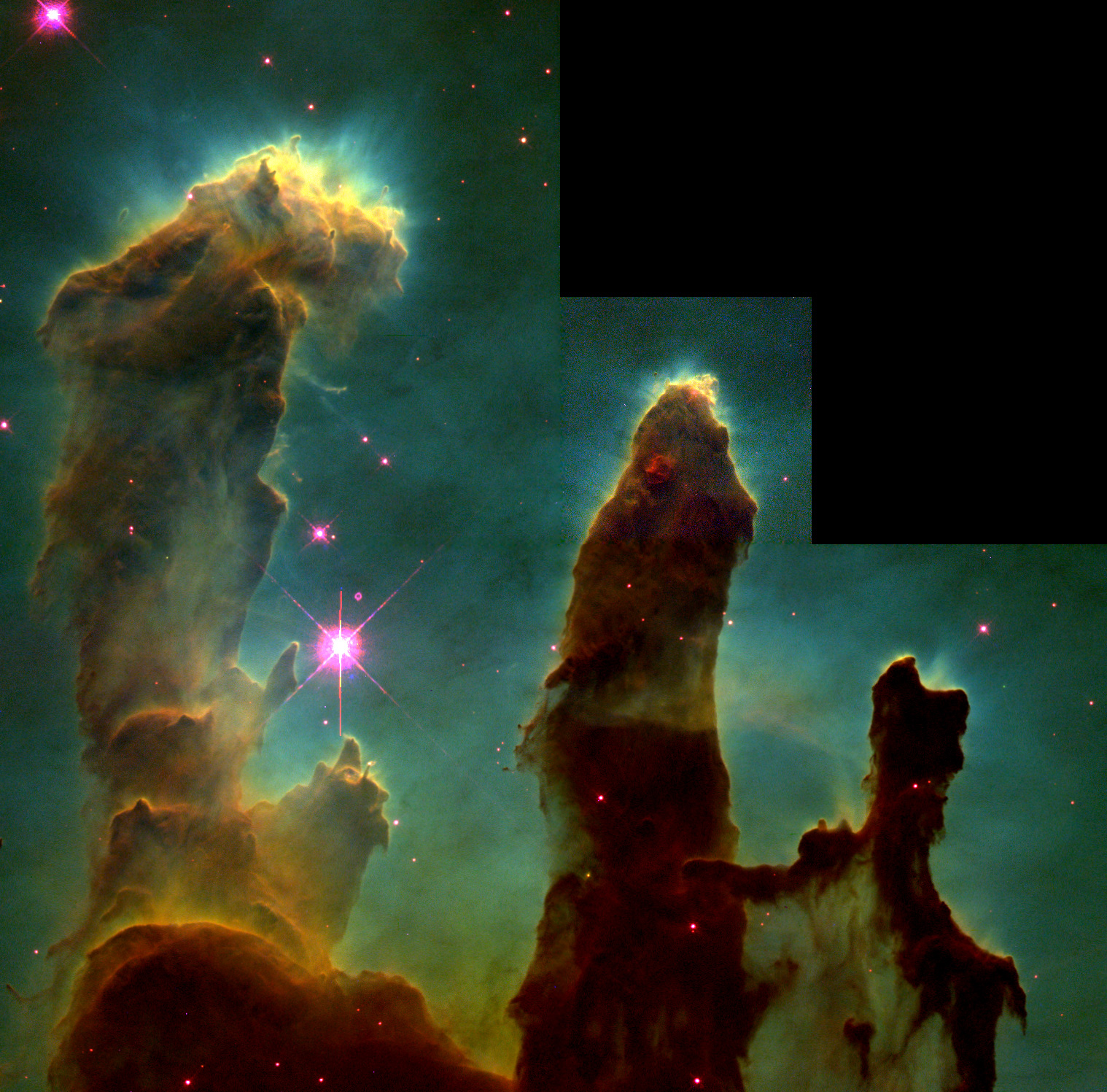
Quick Facts:
- Photograph: Pillars of Creation, in the Eagle Nebula (M16)
- Date taken: April 1 and 2, 1995
- Date released: November 2, 1995
- Photographers: Jeff Hester and Paul Scowen, Arizona State University
- Telescope: Hubble Space Telescope
- Camera: Wide Field and Planetary Camera 2 (WFPC2)
- Composite: 32 exposures across four CCDs in two visits
- Filters: Narrowband sulfur, hydrogen, and oxygen (the Hubble Palette)
- Subject distance: About 6,500 light-years, in the constellation Serpens
- Rights: Public domain, produced by NASA, ESA, and STScI
- Best for: Readers exploring the story behind the Pillars of Creation and modern astrophotography
9 min read
In This Article
Pillars of Creation Overview: How a Photograph Saved Hubble’s Reputation

The Pillars of Creation shows three towering columns of cool gas and dust in deep space, glowing against a backdrop of stars. Two photographers at Arizona State University, Jeff Hester and Paul Scowen, made the image with the Hubble Space Telescope on April 1 and 2, 1995. The composite arrived seven months later as a single frame, and it remade public faith in a telescope the public had come to mock. It is also one of the most reproduced astronomy photographs of the modern era.
This story runs from a flawed mirror and a costly repair mission to one of the era’s most reproduced astronomy photographs. You will learn who pressed the shutter, which camera made the frame possible, why the colors are not the colors a human eye would see, and how the James Webb Space Telescope returned to the same target in 2022. Most of the picture sits cleanly on the history of photography timeline as the first deep-space frame an entire generation knew on sight.
The image is a real photograph, yet it is also a deliberate composite, processed in chosen colors, and possibly showing a scene which no longer exists. Notably, Earthrise and Migrant Mother face similar honesty debates of their own. The Pillars belong in the same company.
At a Glance
Here are the core details of the photograph. The table below sets out the frame, the photographers, the gear, and the holdings before the full story.
| Detail | Information |
|---|---|
| Title | Pillars of Creation |
| Dates exposed | April 1 and 2, 1995 |
| Date released | November 2, 1995 |
| Photographers | Jeff Hester and Paul Scowen, Arizona State University |
| Telescope | Hubble Space Telescope |
| Camera | Wide Field and Planetary Camera 2 (WFPC2) |
| Composite | 32 exposures from four CCDs |
| Filters | Narrowband S II, H-alpha, O III (the Hubble Palette) |
| Subject | A star-forming region in the Eagle Nebula (M16) |
| Distance | About 6,500 light-years, constellation Serpens |
| Rights | Public domain, NASA, ESA, and STScI |
The Two Nights Hubble Saw the Pillars
Earlier in 1995, Hester and Scowen submitted their observing plan. First, they aimed Hubble at a young star cluster in the Eagle Nebula, hoping to study how radiation from hot, massive stars shaped the surrounding cloud of gas and dust. The pillars themselves were part of the broader scene, not the headline target.
Across the nights of April 1 and 2, 1995, the Wide Field and Planetary Camera 2 collected 32 separate exposures. In particular, the work used narrowband filters tuned to specific atomic lines: ionized sulfur, hydrogen-alpha, and doubly ionized oxygen. Each filter captured one slice of the same scene.
Back at Arizona State, Hester and Scowen began the long process of building one picture from many. After months of work, the team released the image on November 2, 1995. The first reaction was disbelief, then awe. Within months, the photograph was on textbooks, T-shirts, and the cover pages of newspapers around the world.
Inside the Eagle Nebula
The Eagle Nebula is a star-forming region about 6,500 light-years away in the constellation Serpens. Charles Messier cataloged it in 1764 as M16. Inside, a cluster of young, hot stars known as NGC 6611 is steadily breaking apart the surrounding cloud of cool gas.
The young cluster lighting the scene is NGC 6611. In particular, its stars are roughly two million years old, hot, and bright in the ultraviolet. Astronomers estimate the cluster holds about 8,500 members. As a result, their combined radiation pushes the cloud apart and carves the pillars into the shapes Hubble captured.
The pillars themselves are columns of denser material. Ultraviolet radiation and stellar winds from the nearby cluster have eroded the lighter gas around them, leaving the densest cores standing as tall, finger-shaped towers. Each pillar runs for several light-years. The tallest stretches roughly four light-years from base to tip, about 24 trillion miles.
At the tips of the pillars, smaller blobs glow more brightly. Astronomers call them Evaporating Gaseous Globules, or EGGs. Some EGGs hold newborn stars inside, still gathering mass while the gas around them boils away. The name “Pillars of Creation” comes from those nascent stars. Even so, the same radiation eats the cloud and lights the stove on which the next generation of stars cooks.
The Camera and Filters Behind the Photograph
The instrument on duty was the Wide Field and Planetary Camera 2, installed during the 1993 Hubble repair mission to fix the telescope’s flawed mirror. Notably, WFPC2 carried four CCD detectors, three Wide Field chips and one higher-resolution Planetary Camera chip. The four sensors sat in an L-shape, so a single composite mosaic showed a distinctive staircase corner where the smaller Planetary chip met its neighbors.
For the Pillars run, Hester and Scowen used the four CCDs together to cover the full scene. Each filter required separate exposures, so the 32-frame total reflected three filters times multiple sub-exposures across the chips. Stacking the sub-exposures cut noise and pulled detail out of regions the eye on its own would miss.
Why a Composite Was the Only Way
A single exposure of a dim deep-sky target carries thermal noise from the sensor and cosmic-ray hits running through the camera. Specifically, stacking many short exposures lets the signal add while the noise mostly averages out. Therefore, the final frame is sharper, deeper, and cleaner than any one exposure delivers on its own.
The same logic powers any modern stacking workflow. For example, it runs Milky Way photography, planetary imaging, and many night-sky processes today. After the composite came together, the team faced the next choice: how to color it.
The Hubble Palette and False Color
The colors in the photograph are real measurements, but they are not the colors a human eye would see. Each of the three narrowband filters captured a single emission line: sulfur (S II) at 672 nanometers, hydrogen (H-alpha) at 656 nanometers, and oxygen (O III) at 501 nanometers. All three sit close to one another in the visible spectrum, so a faithful rendering would push the scene toward a uniform pinkish red.
Instead, the team mapped the three filters to the three channels of a color image. Sulfur went to red, hydrogen to green, and oxygen to blue. This is the Hubble Palette, sometimes written as SHO mapping. The chemistry stays accurate, while the assignments spread the channels across the visible range so the eye reads the structure inside the cloud.
False color in this sense is not invention. It is a translation. Roger Fenton’s Valley of the Shadow of Death faced its own debate about what counts as a real photograph. The photograph raises the same question in a different register. The processing is honest, documented, and reproducible, but it is also a choice.
The 2014 Remake and the 2022 James Webb Reshoots

Credit: NASA, ESA, CSA, STScI.
Hubble returned to the Eagle Nebula in 2014. By then, the telescope carried a newer instrument, the Wide Field Camera 3, installed in 2009. WFC3 covered a larger field with better resolution and a broader filter set. NASA released the new Pillars image in January 2015, marking Hubble’s 25th anniversary.
The 2014 frame is sharper than the 1995 original and shows more dust detail. Side by side, the two images reveal subtle changes between them, the result of nearly two decades of light traveling outward from the cluster while the telescope improved on the ground.
In 2022, the James Webb Space Telescope turned its infrared eye on the same scene. Webb released its NIRCam (near-infrared) image of the Pillars on October 19, 2022, and a MIRI (mid-infrared) view nine days later. The near-infrared frame burns the foreground stars and shows newly forming stars buried inside the columns. The mid-infrared frame hides the stars entirely and shows only the dust, almost a ghost of the original.
Three telescopes, three frames, one cloud. Each version answers a different question, and the original 1995 photograph still anchors how most readers recognize the scene.
Are the Pillars of Creation Already Gone?
In 2007, Nicolas Flagey and colleagues released Spitzer Space Telescope observations of hot dust near the Eagle Nebula. The infrared data hinted at the shock wave of a supernova passing through the region. The argument runs: a massive star nearby exploded about 6,000 years ago, and the shock wave will sweep the pillars away by the time its light reaches Earth, perhaps a thousand years from now.
Not every astronomer accepts the supernova reading. Some argue the hot dust might come from stellar winds rather than a supernova blast. Either way, the photograph we see today is a snapshot from 6,500 years ago, the time the light took to cross interstellar space and reach Hubble. What the pillars look like right now is a question no observation has answered.
For a photography audience, the point is plain. Every astronomical photograph is a time-shifted document. In this case, the Pillars simply make the gap unusually concrete.
Why It Still Matters
In 1995, the release landed at a moment when Hubble badly needed a win. Hubble itself had launched in 1990 with a flawed primary mirror, and for three years the press treated it as an expensive failure. After the 1993 servicing mission installed corrective optics and WFPC2, the photograph became the first deep-sky image after the fix to break out of the science world and into general culture.
Within months, the image was on magazine covers, school posters, and movie sets. NASA’s Hubble program benefited from sustained public support in the years afterward. Few science images have moved the needle on a government program so directly.
From One Photograph to a Generation
The image also opened the door to a generation of amateur astrophotographers. Suppliers built narrowband filters for backyard telescopes. Software libraries learned to stack and align long exposures the way Hester and Scowen did at ASU. Today, hobbyists with modest gear capture deep-sky frames a 1995 audience would have called impossible. Milky Way photography guides now teach the same stacking and channel-mapping logic running the original Hubble pipeline.
The photograph also joins a short list of single images which changed how people see the universe. Apollo 8’s Earthrise showed Earth as a small blue planet. The first photo ever taken showed a rooftop near Niepce’s window. Hubble’s frame showed star birth, on a scale most readers had never tried to picture.
For the original release notes, see the ESA Hubble archive at the official image page. Like every NASA-produced Hubble image, the frame sits in the public domain and is free for any reader to download and use.
Frequently Asked Questions
What Are the Pillars of Creation?
The Pillars of Creation is a 1995 Hubble Space Telescope photograph of three towering columns of gas and dust inside the Eagle Nebula, about 6,500 light-years from Earth. Hot young stars nearby are eroding the cloud, while inside the densest tips new stars are forming. Jeff Hester and Paul Scowen built the image from 32 exposures.
Who Took the Photograph?
Jeff Hester and Paul Scowen, both then at Arizona State University, planned the observation and processed the final image. Hubble itself collected the light, and the Space Telescope Science Institute released the image. The standard NASA credit reads: “NASA, ESA, STScI; J. Hester and P. Scowen (Arizona State University).”
How Big Are the Pillars?
Each pillar stretches for several light-years. Estimates place the tallest pillar at roughly four light-years from base to tip, or about 24 trillion miles. By comparison, the nearest star outside the Sun sits about 4.2 light-years from Earth, so a single pillar spans nearly the full gap to our closest stellar neighbor.
What Camera Did Hubble Use?
The 1995 image came from the Wide Field and Planetary Camera 2, installed during the 1993 Hubble servicing mission. WFPC2 used four CCD detectors and a set of filters tuned to specific atomic emission lines. The 2014 remake used Wide Field Camera 3, installed in 2009 and capable of higher resolution across a larger field.
Are the Pillars of Creation Still There?
Probably yes, as we see them. In 2007, Spitzer Space Telescope data hinted at a nearby supernova whose shock wave might have already destroyed the pillars about 6,000 years ago. Light from the destruction has not reached us yet. Other astronomers argue the hot dust around the nebula has a simpler explanation. Either way, the snapshot we see today comes from 6,500 years ago, regardless of where the case lands.
What Did James Webb’s View Look Like?
James Webb Space Telescope released two new images of the same scene in October 2022. Its NIRCam (near-infrared) view shows newly forming stars buried inside the columns, alongside thousands of background stars. Meanwhile, the MIRI (mid-infrared) view shows only the dust, with the stars almost vanished. Both add detail the 1995 visible-light original missed entirely.

